
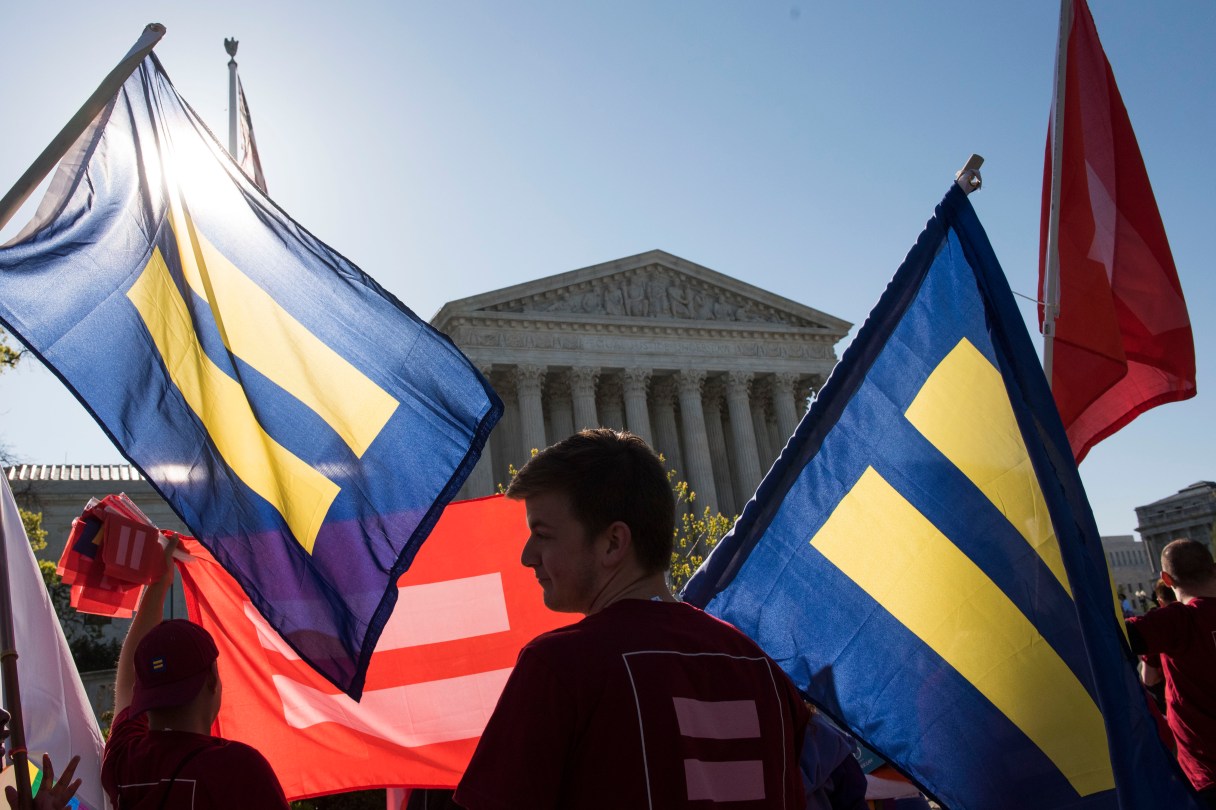
National journalists on Tuesday reported that the Supreme Court “seemed deeply divided about one of the great civil rights issues of the age: whether the Constitution guarantees same-sex couples the right to marry.”
At the root of the question are cases in Tennessee, Kentucky, Ohio and Michigan. And politics. And outdated perceptions.
Read more
* After historic arguments, court to rule on same-sex marriage* Gay marriage decision now up to court
Reporters covering the high court arguments said our nation’s justices clashed not only over what is the right answer but also over how to reach that answer, and their questions illuminated their “conflicting views on history, tradition, biology, constitutional interpretation, the democratic process and the role of the courts in prodding social change.”
Justice Anthony M. Kennedy worried about changing the conception of marriage that has persisted “for millennia,” though he also said he had qualms about excluding gay families from what he called a noble and sacred institution. Chief Justice John G. Roberts Jr. said he is concerned about shutting down a fast-moving societal debate.
Justice Antonin Scalia said a ruling for same-sex marriage might require some members of the clergy to perform the ceremonies that violate their religious teaching.
Justice Stephen G. Breyer described marriage as a fundamental liberty. And Justices Ruth Bader Ginsburg and Elena Kagan said that allowing same-sex marriage would do no harm to the marriages of opposite-sex couples.
Legal observers believe Justice Kennedy holds the controlling vote, which in Tuesday’s two-and-a-half hours of arguments seemed to be dividing the justices along the usual conservative and liberal political lines.
New York Times reporter Adam Liptak described Justice Kennedy’s tone as “more emotional and emphatic” when he made the case for same-sex marriage, and Liptak wrote: “That, coupled with his earlier judicial opinions, gave gay rights advocates reason for optimism by the end of the arguments.”
The Supreme Court’s decision is expected in about two months. The high court had been resisting cases on this issue, but the justices’ hands were forced by a decision in November when the Court of Appeals for the Sixth Circuit, in Cincinnati, became the only appeals court in the nation to uphold same-sex marriage bans in Kentucky, Michigan, Ohio and Tennessee. The Sixth Circuit said states and their voters and legislators, not federal judges, should decide the issue.
Until then, most lower courts (and therefore states) — like general public opinion — had been shifting swiftly toward right-to-marry arguments: Gay marriage is now legal in 36 states and the District of Columbia. Similarly, 60 percent of Americans support gay couples marrying, according to a Washington Post/ABC News poll out last week.
Now if the Supreme Court decides to allow such unions, then the 13 states where same-sex marriage is still prohibited — including Tennessee and Georgia — will be forced to reverse their bans. Gay marriage legality in Alabama is presently unclear because of conflicting state and federal court orders.
When you strip away politics and strip away habits and perceptions about this question, the basic issue becomes one of freedom and equality.
Who — among consenting adults — loves whom, sleeps with whom and marries whom should not be anyone’s business, let alone legal prohibition or requirement.
We once had millennia — centuries, anyway — of legal slavery. We once had laws forbidding interracial marriage, as well as laws requiring separate but equal schools, bathrooms, etc. Today we know those outdated contrivances for what they were: shameful and hypocritical customs we once thought necessary. Now we realize they not only were unnecessary, they also were simply and plainly wrong.
It is long past time for our Supreme Court justices to finally see us through this transition, just as they did through interracial marriage and segregation.