
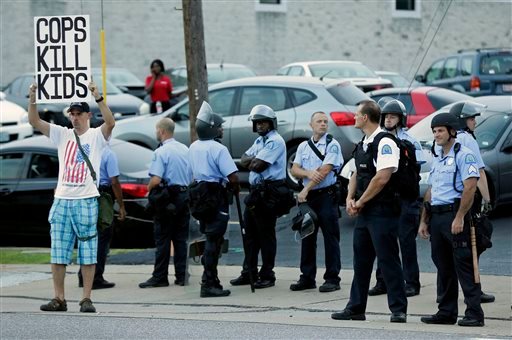
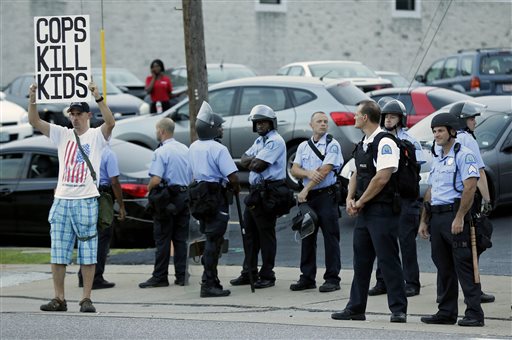
 A man holds a sign in front of a group of police officers to protest the shooting death of Michael Brown, an unarmed black teenager, by a white police officer a week earlier in Ferguson, Mo., in this Aug. 16, 2014 file photo.
FERGUSON, Mo. – Protesters who have for days lined a busy suburban St. Louis street not far from the place where a white police officer fatally shot an unarmed black teenager have walked from nearby apartments, driven from neighboring communities and flown in from states hundreds of miles away. Some are young parents carrying infants. Others, college students. Retirees. Professionals taking a break from their jobs.
They have chanted, marched, shouted, danced on vehicles and — though most have remained peaceful — also looted and vandalized stores during late-night clashes with armored police who have fired smoke canisters and tear gas into the crowds.
The demonstrators are demanding justice for 18-year-old Michael Brown, which they say can only be accomplished if Ferguson police officer Darren Wilson is charged and convicted for the shooting. Many also cite larger causes.
Some vent frustration about what they describe as a pattern of harassment and intimidation of black residents by police — not just in Ferguson, but in numerous other predominantly low-income minority communities. Others see an opportunity to participate in what they consider a modern civil rights movement.
“Being black in America is basically being born with a target,” said Keyon Watkins, a 26-year-old college graduate with a computer science degree who joined in protest on a late weekend night. “All of this is just built-up, pent-up aggression by being mistreated on a daily basis.”