
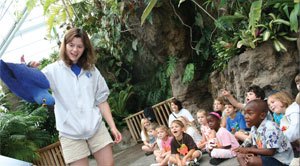
Turn a corner at the Tennessee Aquarium, and you might bump into a keeper holding a talking African gray parrot, a hissing Madagascar cockroach or a writhing Colombian red-tailed boa. Look closely, and you might even spot a newt.
The Aquarium’s more than 10,000 creatures-“animal ambassadors”-aren’t pampered pop stars. Their current role is to win the hearts and minds of humankind. “We take animals that are strange and scary,” explains Senior Educator Susie Grant, “and help people understand they are very, very cool.”
Since opening in 1992, the Aquarium has tapped animal appeal to spark appreciation for environmental stewardship, notes Tim Baker, the Aquarium’s education director. “We take education very seriously,” he says. “Once we capture people’s attention and connect them to nature, the light comes on.” Today, the Aquarium’s learning and conservat ion programs spill from its Boneless Beauties exhibit to a new mobile tidal pool. A shark tank and a lake sturgeon fry container are among learning tools.
To help flip the switch, the Aquarium in 2009 donated $1.2 million in free services to the community. Among its gifts were accredited classroom lessons, videoconferences involving exchanges from as far away as Medford, Ore., guided tours, camp scholarships, and free annual passes for needy youngsters.
Ensuring that inspired children have a thriving natural world to study, the Aquarium has also raised and released 90,000 lake sturgeon, spawned more than 8,000 Barrens topminnows and introduced more than 166,000 freshwater mussels into wild area streams. “People think we do research just to take care of our own animals,” says Dr. Anna George, the Aquarium’s conservation institute director. “But we believe it’s important to take care of wild animals, too. We ask academic institutions to tell us what’s going wrong. Then we scurry around and try to solve the problems.”