
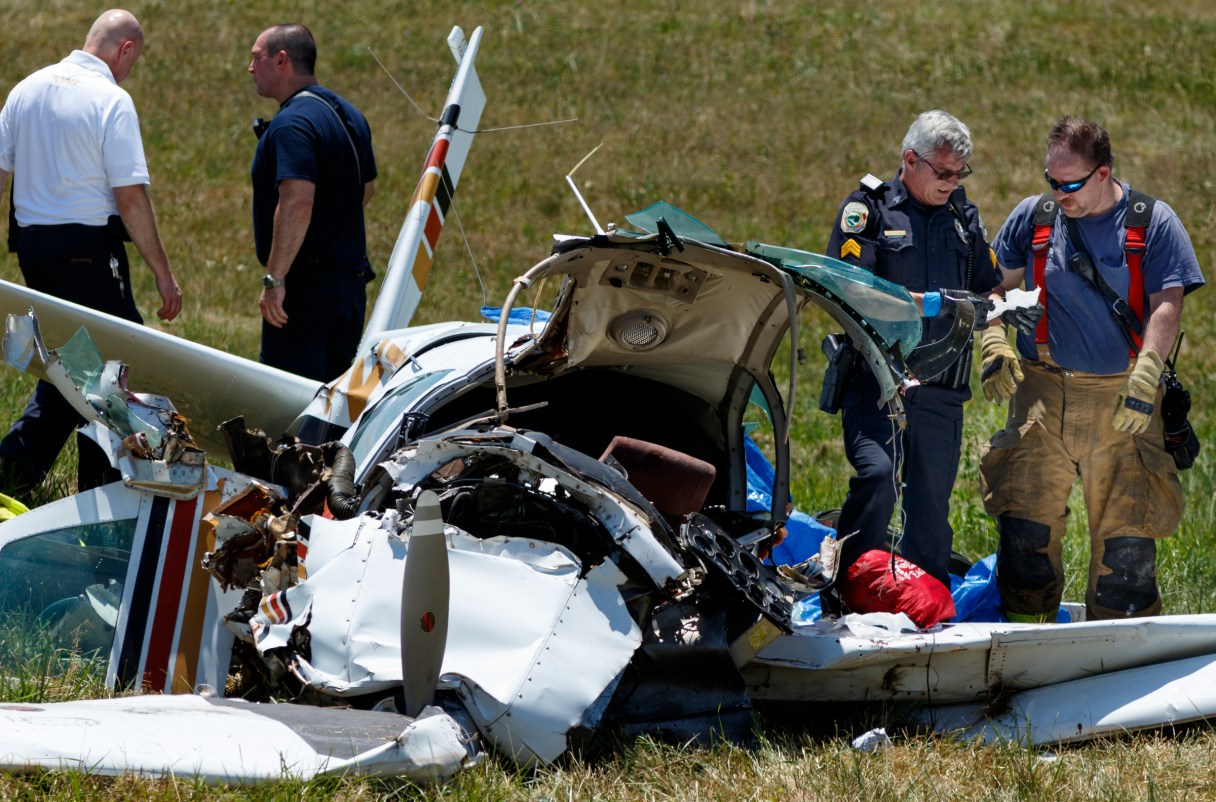
The plane that crashed at the Collegedale Municipal Airport on June 11 made a series of maneuvers typically used to recover from a botched landing just before it hit the ground, according to a preliminary report by the National Transportation Safety Board.
Three people were killed in the crash – the pilot, his mother and his son. The pilot’s daughter survived and was seriously injured.
A flight instructor who was flying with a student nearby witnessed the crash, according to the report. He told NTSB investigators that he saw the plane coming in on a short final approach.
The plane made a climbing turn to the left near the departure end of the runway, about 100 feet off the ground, and then made a steep bank to the right with the nose pulled high. During that turn, the plane’s nose dropped and the whole aircraft rotated as it rapidly descended into the ground.
The plane then slammed into the ground, leaving a 70-foot-long ground scar, according to the NTSB.
Multiple pilots told the Times Free Press that it sounds like the pilot, Todd Silver, from Ft. Lauderdale, Florida, tried to pull out of the landing and go around to try the approach again, but instead stalled the plane, which led to the crash.
John Bertrand, a flight instructor with Windsong Aviation in LaFayette, Ga., said that high temperatures negatively impact a plane’s performance, and he speculated that the day’s 91-degree heat, coupled with the plane’s heavy load, may have contributed to the crash.
“You have a very hot day – poor performance – combined with a very high load,” Bertrand said. “And you have a runway that for one reason or another the man decided he didn’t want to land on. So he goes full power, brings the nose up and retracts the gear. That’s the classic what you would do if you decide to do a go-around. And apparently he stalled the aircraft.”
The NTSB report notes that the plane’s landing gear was retracted, and that there were no apparent pre-impact mechanical malfunctions in the engine.
Air expands and becomes thin when it’s hot, Bertrand said, which impacts three major systems on planes – the wings, engine and propeller.
“It’s a triple whammy,” Bertrand said. “There’s less air to make lift, less air for the prop to throw to the rear to make thrust, and less oxygen for the engine to burn to make power.”
On the day of the crash, Todd Silver took off from Hollywood, Florida, and landed in Pine Mountain, Georgia, before continuing on to Collegedale, according to the report. His mother, Suzanne Silver, and his son, Gerhard Silver, were killed on impact. Todd Silver and his daughter, Gabriella Silver, were taken to a hospital, where Todd Silver later died.
Gabriella Silver is the crash’s sole survivor.
The NTSB report also notes that Todd Silver had 550 hours of flight experience and had purchased the Mooney M20E plane in February 2015. A GPS device was recovered from the plane and sent to a lab for analysis.