
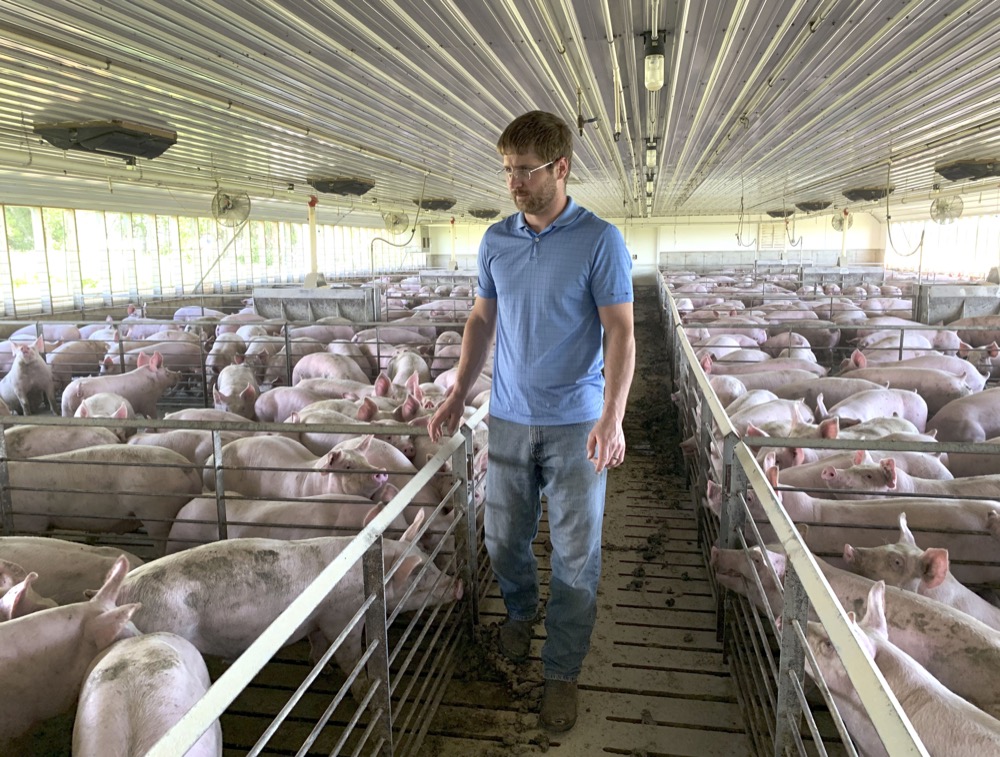
 In this Tuesday, June 25, 2019, photo, farmer Matthew Keller walks through one of his pig barns near Kenyon, Minn. When the Trump administration announced a $12 billion aid package for farmers struggling under the financial strain of his trade dispute with China, the payments were capped. But records obtained by The Associated Press under the Freedom of Information Act show that many large farming operations easily found legal ways around the limits to collect big checks. Recipients who spoke to AP defended the payouts, saying they didn’t even cover their losses under the trade war and that they were legally entitled to them. Keller, who also grows crops to feed his livestock, said he “definitely appreciated” the $143,820 he collected from the program. It didn’t cover all his losses but it helped with his cash flow, he said. He reached the $125,000 cap on his hogs, and the remaining money was for his soybeans and corn. (AP Photo/Jeff Baenen)
MINNEAPOLIS (AP) – When President Donald Trump’s administration announced a $12 billion aid package for farmers struggling under the financial strain of his trade dispute with China, the payments were capped. But many large farming operations had no trouble finding legal ways around them, records provided to The Associated Press under the Freedom of Information Act show.
The government paid nearly $2.8 million to a Missouri soybean operation registered as three entities at the same address. More than $900,000 went to five other farm businesses, in Indiana, Illinois, Tennessee and two in Texas. Three other farming operations collected more than $800,000, and 16 others collected more than $700,000.
Recipients defended the payouts, saying they didn’t cover their losses from the trade war and they were legally entitled to them. Department of Agriculture rules let farms file claims for multiple family members or other partners who meet the department’s definition of being “actively engaged in farming.”
But U.S. Sen. Charles Grassley, an Iowa Republican who has long fought for subsidy limits, and other critics say it’s the latest example of how loopholes let large farms collect far more than the supposed caps.
Grassley said in a statement to AP that some of the nation’s largest farms are receiving huge subsidies “through underhanded legal tricks. They’re getting richer off the backs of taxpayers while young and beginning farmers are priced out of the profession. This needs to end. The Department of Agriculture needs to re-evaluate its rules for awarding federal funds and conduct more thorough oversight of where it’s funneling taxpayer dollars.”