

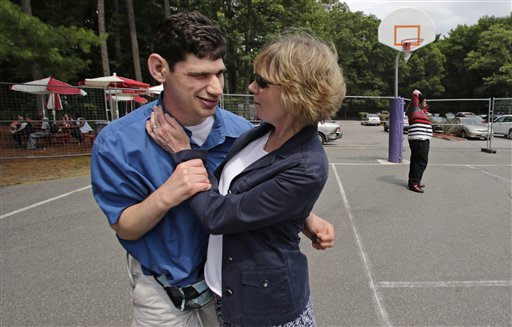
 Louisa Goldberg hugs her son Andrew, during a visit at the Judge Rotenberg Educational Center in Canton, Mass. Andrew, who was born with a developmental disorder, wears a electrical shocking device to control violent episodes. The Food and Drug Administration is considering whether to ban the devices used at the center, the only place in the country known to use electrical shocks as aversive conditioning for aggressive students.
CANTON, Mass. – Some cut themselves. Others slam their heads against walls or desks – so hard that one girl detached both retinas and a young man triggered a stroke. Another pulled out all his teeth.
Self-injury is one of the most difficult behaviors associated with autism and other developmental or intellectual disabilities, and a private facility outside Boston that takes on some of the hardest-to-treat cases is embroiled in a major debate: Should it use electrical skin shocks to try to keep patients from harming themselves or others?
The Food and Drug Administration is considering whether to ban devices used by the Judge Rotenberg Educational Center in Canton, Massachusetts, the only place in the country known to use skin shocks as aversive conditioning for aggressive patients.
It’s a rare move by the FDA, following years of complaints from disability rights’ groups and even a U.N. report that the shocks are tantamount to torture.
FDA Commissioner Margaret Hamburg says the shock therapy has raised a lot of questions.