
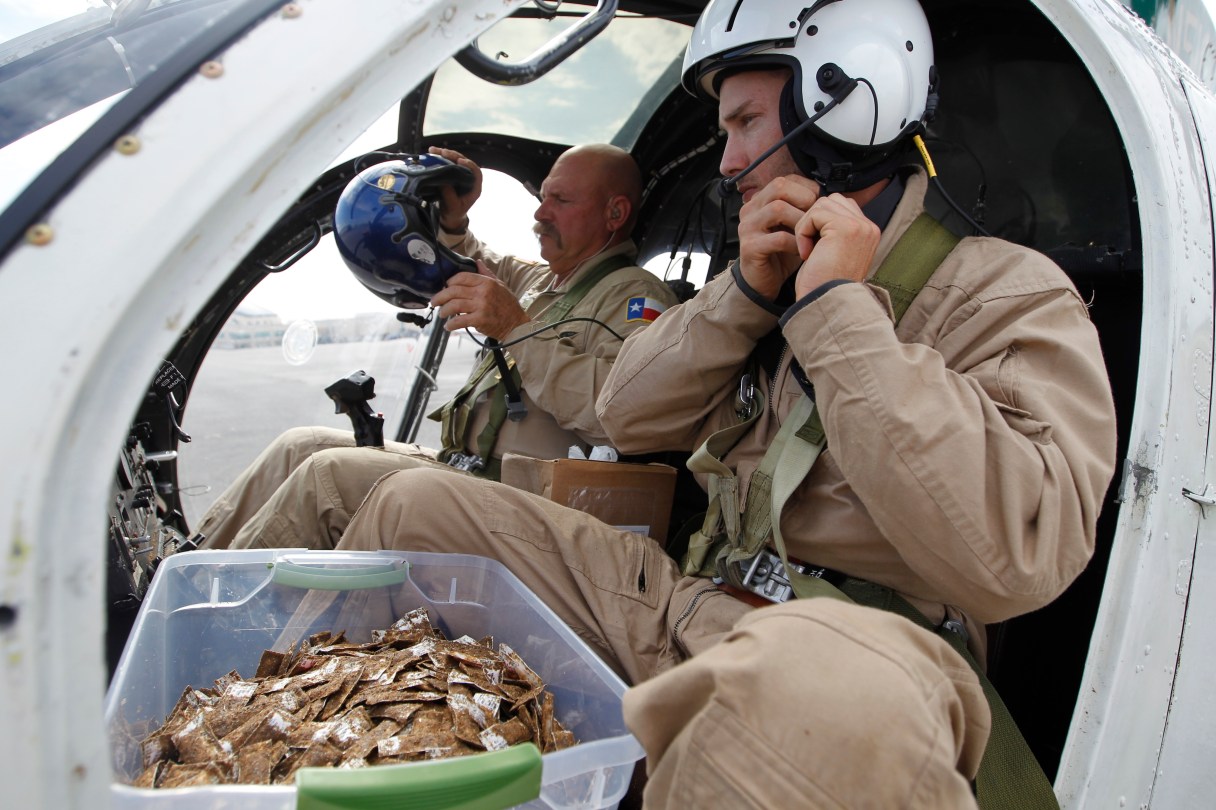

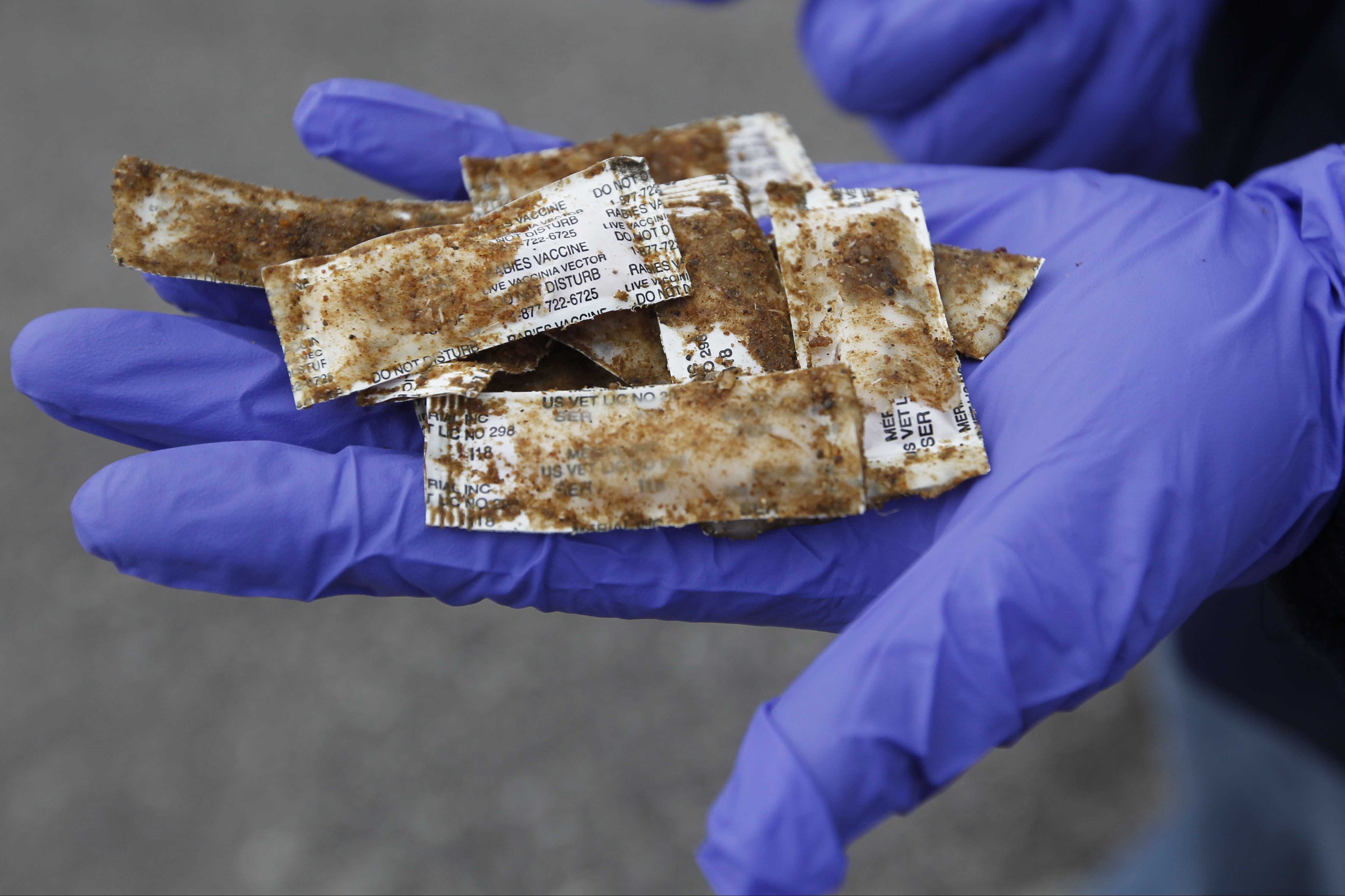
 USDA wildlife biologist Erin Patrick holds fish-flavored packets of rabies vaccine before their distribution by helicopter Tuesday, Oct. 22, 2013, at Chattanooga Metropolitan Airport’s Lovell Field in Chattanooga, Tenn. The vaccine is administered when animals bite into the baited packets. The USDA is spending several days dropping bait-coated packets of rabies vaccine from a helicopter across Hamilton and Bradley Counties to combat rabies in raccoons.
Rabies facts
Any mammal can get rabies. The most common wild reservoirs of rabies are raccoon, skunks, bats, foxes and coyotes. Domestic mammals like cats, cattle and dogs are the most frequently reported household animals to get rabies. The rabies virus is transmitted through saliva or brain or nervous system tissue. Rabies can only be contracted by coming in contact with these specific bodily excretions and tissues. If exposed, decisions should not be delayed.› Wash any wounds immediately. One of the most effective ways to decrease the chance for infection is to wash the wound thoroughly with soap and water.› See a doctor for any trauma due to an animal attack before considering the need for rabies vaccination. The doctor, possibly in consultation with the state or local health department, will decide if a rabies vaccination is needed.› Decisions to start vaccination, known as postexposure prophylaxis, will be based on the type of exposure and the animal the person was exposed to, as well as laboratory and surveillance information for the geographic area where the exposure occurred.› In the U.S., post-exposure prophylaxis consists of a regimen of one dose of immune globulin and four doses of rabies vaccine over a 14-day period. Current vaccines are relatively painless and are given in the arm, like a flu or tetanus vaccine.Source: U.S. Centers for Disease Control and Prevention
Just like last year, raccoons in North Alabama are the targets of rabies vaccine air drops that started Monday and will continue over the next 10 days.
Airplanes, helicopters and people in trucks and on foot will be tossing and dropping vaccine-laden baits in “sparsely populated areas” through the week, and officials are notifying people to leave the packets alone so raccoon can get them.
The baits are aimed at stemming the westward spread of the deadly virus.
“It is important to not only let people know the beneficial aspects of the vaccine efforts, but to let them know ahead of time there is going to be [oral rabies vaccine] in the area,” Alabama Department of Public Health veterinarian Dr. Dee. W. Jones said in a statement. “We don’t want people to be shocked to find a vaccine packet and let anxiety undermine the overall cause.”
DeKalb and Jackson counties, nearest Chattanooga, and Blount, Cherokee, Cullman, Etowah, Limestone, Madison, Marshall and Morgan counties will be the focus of baiting from Oct. 5 to Oct. 15.
Where it’s practical, baits will air-dropped, but areas like Collinsville, Fort Payne, Gadsden, Henager, Leesburg, Sylvania and a small portion of Huntsville also will have packets distributed by hand.
A small outbreak last fall in Northeast Alabama, just south of Chattanooga, prompted similar operations. In that outbreak, 10 animals – mostly raccoons – tested positive for the raccoon variant of rabies. Most cases were in Jackson County.
On Monday, Cassie Brailer, public health associate with the Alabama Department of Public Health, said no cases have been reported this year in Jackson County. There have been two cases of rabies – in a bat and a dog – reported in DeKalb County, Brailer said.
John Roman, an environmental specialist with the Tennessee Department of Health, said there have been no reported cases in Southeast Tennessee this year. Roman said the nearest case to Chattanooga was a bat that tested positive in Knox County this year.
Most baits are packaged in a plastic container or a shiny foil packet that have foul-smelling fishmeal crumbs smeared on them to tempt raccoon. Officials said exposure to the bait packets or vaccine does not pose an infection risk for humans or pets. Pets that eat the bait sometimes experience mild digestive upset.
The most common adverse reaction to touching a vaccine packet is an allergic reaction to the fishmeal.
Women who are pregnant or anyone with a compromised immune system should consult their physician if they have direct contact with a punctured packet.
Contact staff writer Ben Benton at bbenton@timesfreepress.com or twitter.com/Ben Benton or www.facebook.com/ben.benton1 or 423-757-6569.
Find a packet?
The following recommendations should be followed if a person or a pet finds a vaccine packet.› Avoid direct skin contact by always wearing gloves or using a plastic bag to remove or relocate the vaccine packet.› A found, still intact vaccine packet can be moved to the woods where a raccoon may find it or it may be disposed of in the trash if pets are likely to contact it again. If the plastic cover is opened or punctured, the packet should be thrown in the trash using gloves.› If the packet is in a pet’s mouth, it is not recommended to remove it because of the risk of injury from a bite and to avoid potential bare-skin contact with the vaccine.› The vaccine is generally not harmful to pets and only very rarely requires any veterinary medical attention. There is no risk of pets contracting rabies from the vaccine, but mild gastrointestinal upset is the most common occurrence after eating the vaccine packets. Oral lesions are possible, but are much less common. Consultation with a veterinarian is recommended for any persistent clinical signs after exposure to the vaccine packets.For questions about human or animal reactions from accidental exposure to vaccine carriers, please contact the Alabama Department of Public Health at 1-800-338-8374. For more information about the National Rabies Management program, contact USDA WS at 1-866-4-USDA-WS (1-866-487-3297).Source: Alabama Department of Public Health