
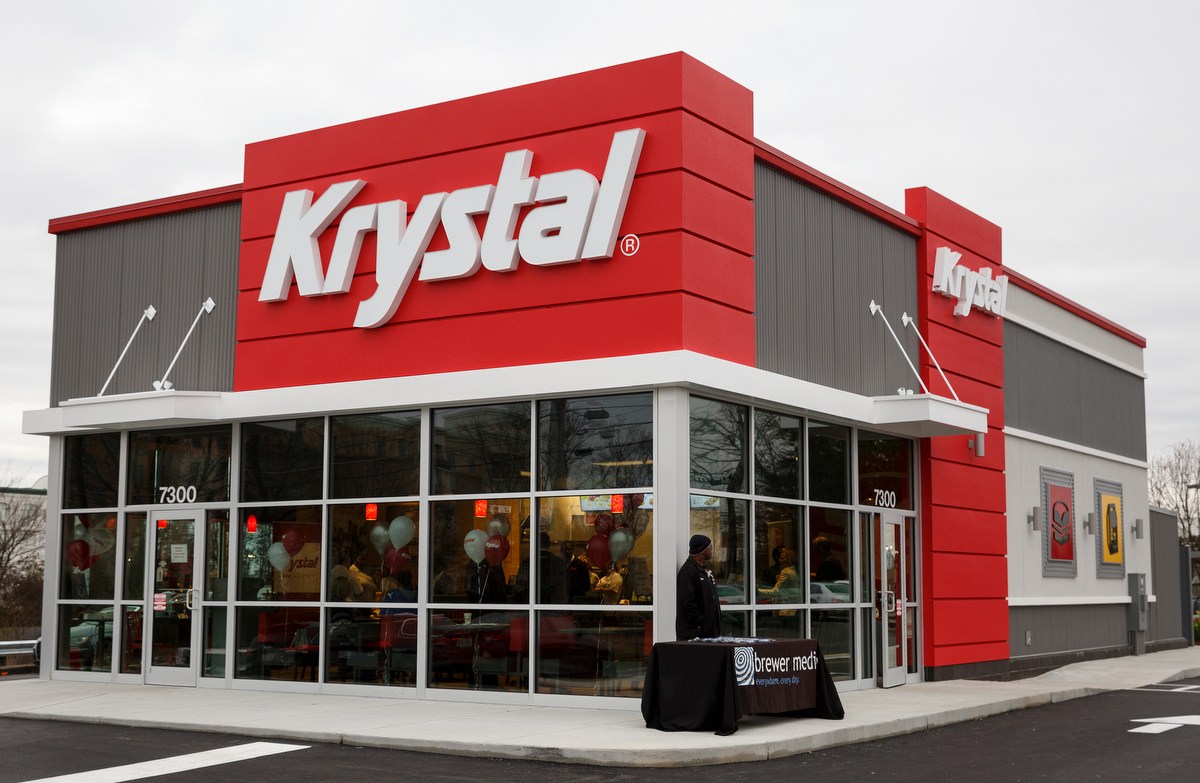
The Krystal Company says its razed and redesigned stores, such as the new Krystal built on Shallowford Road in Chattanooga last year, are generating sustained sales volume lifts of 70-80 percent. The redesigns are part of a company-wide initiative to improve the dining experience and adapt to changes in consumer behavior and the new units typically have 66 percent more staff than the units they replaced.
“The impact of the redesigned stores has exceeded our expectations,” Krystal President Paul Macaluso said. “Customers love the streamlined, efficient drive-through and the fresh look and feel of the new restaurants, which are also a magnet for recruiting and energizing employees.”
Krystal opened its first “Iconic Series” prototype restaurant, named after Krystal’s iconic burger and new abstract burger emblem used in both the exterior and interior design, in Jackson, Mississippi in August 2018. Since then, the Atlanta-based restaurant chain has added similar units in Tifton, Georgia, Tuscaloosa, Alabama, Memphis and Chattanooga.
Truck tonnage rises by most in 20 years
America’s trucking industry reported the biggest annual gain in for-hire truck tonnage in two decades last year as an improving economy and growing e-commerce boosted shipments to an all-time high, according to the American Trucking Associations’ (ATA) annual index released Tuesday.
Truck tonnage for all of 2018 rose 6.6 percent – nearly double the 3.8 percent gain in 2017 and the highest increase since 1998 when truck shipments surged by 10.1 percent. The annual gain last year was realized despite a year-end decline in shipments. Tonnage fell in December by 4.3 percent from the seasonally adjusted rate in November, which was also below the peak reached in October on the ATA index.
“The good news is that 2018 was a banner year for truck tonnage, witnessing the largest annual increase we’ve seen in two decades,” ATA Chief Economist Bob Costello said. “With that said, there is evidence that the industry and economy is moderating as tonnage fell a combined total of 5.6 percent in October and November after hitting an all-time high in October.”
ATA calculates the tonnage index based on surveys from its membership and has been doing so since the 1970s.
Starbucks expands coffee delivery service
Starbucks is expanding its delivery service and aims to offer it at nearly one-fourth of its U.S. company-operated coffee shops.
The company said it is launching the service Tuesday in San Francisco and will expand to some stores in New York, Boston, Washington, Chicago and Los Angeles in coming weeks. It tested the idea in 200 Miami stores last fall.
Starbucks says 95 percent of its core menu will be available for order using the Uber Eats mobile app. There will be a $2.49 booking fee.
In December, company executives laid out plans to expand deliveries in the U.S. and China this year.
Executives say delivery works best in dense urban areas where Uber Eats’ delivery fees are lower because of high demand, and customers spend more than they do in stores.
Volvo recalls 200,000 cars
Swedish automaker Volvo Cars, owned by China’s Geely holding company, says it is recalling 200,000 diesel cars worldwide because the fuel line may crack, saying it is “a preventive safety measure.”
Group spokeswoman Annika Bjerstaf says, “What may happen is that the fuel may leak out into the engine compartment over a long period of time.”
She says Volvo Cars “however, has not received any reports of incidents surrounding this.”
Bjerstaf said Tuesday the recall covers the Volvo V40, S60 and V60 and their Cross Country versions. Also covered are the V70 and XC70, S80, XC60 and XC90 built in 2015 and 2016.
Volvo says it is offering to replace the fuel line at no costs and owners have been notified.
Home sales drop 6.4 percent in December
U.S. home sales cratered in December, causing price growth to slip to the lowest level in more than six years as the housing sector ended 2018 on a decidedly weak note.
The National Association of Realtors said Tuesday that sales of existing homes plunged 6.4 percent to a seasonally adjusted annual rate of 4.99 million last month, the worst pace in almost three years. For all of 2018, sales of existing homes fell 3.1 percent from a year ago to 5.34 million units, the weakest total since 2015.
“Looking ahead to 2019, expect weaker existing-homes sales as the new year ushered in a government shutdown and worsening economic uncertainty,” said Cheryl Young, a senior economist at Trulia.
The median sales price in December was $253,600, up just 2.9 percent from last year. In a rarity, the modest price growth was eclipsed by the December increase in average hourly wages. If income gains begin to outstrip home price growth, some of the recent affordability pressures could disappear.