
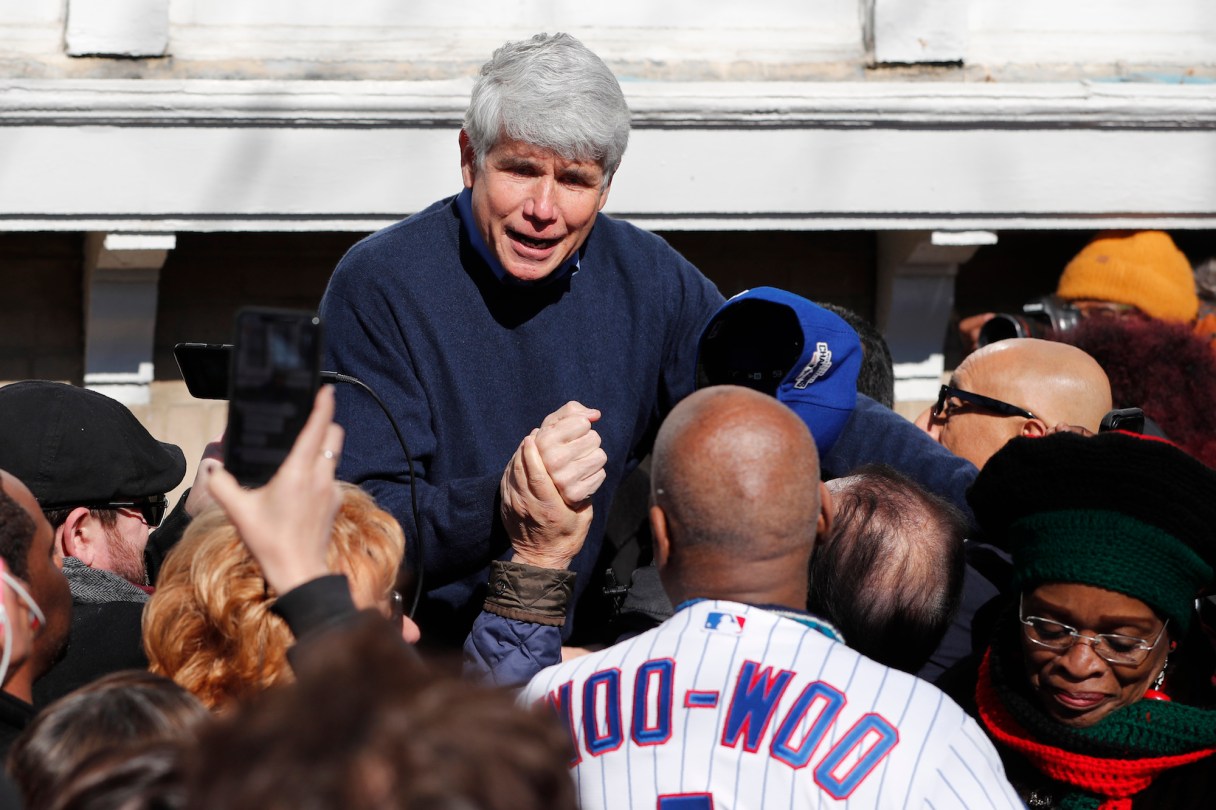
Not for the first time, President Trump has perverted the presidential pardon power to benefit undeserving recipients with whom he shares a personal or political affinity. On Tuesday, the White House announced that Trump had commuted the prison sentence of former Illinois Gov. Rod Blagojevich, an epically corrupt politician who once appeared on Trump’s reality TV series “Celebrity Apprentice,” and granted a pardon to former New York City Police Commissioner Bernard B. Kerik, who was appointed to that post by then-Mayor Rudolph W. Giuliani, currently Trump’s personal lawyer.
Objectionable as these grants of clemency may be, they also raise concerns about what would be an even more outrageous abuse of the pardon power: clemency for convicted Trump associates such as Paul Manafort, Trump’s 2016 campaign chairman, and Roger Stone. On Tuesday, Trump again expressed sympathy for Stone, who faces sentencing Thursday in federal court for lying to Congress, witness tampering and obstructing a congressional investigation into Russian meddling in the 2016 election. (Trump asserted, however, that he hadn’t given any thought to a pardon for Stone.)
The Constitution gives the president essentially unbounded power “to grant reprieves and pardons for offenses against the United States, except in cases of impeachment.” But a principled president will exercise that power in the interests of mercy, not because the recipients of clemency are prominent or political bedfellows or well-connected or cronies of the president himself.
Trump, however, seems to see the pardon power as a way to reward supporters and score political points. The beneficiaries of his clemency have included former Arizona Sheriff Joe Arpaio, a hero of the anti-immigrant right who was absolved of a contempt-of-court conviction; conservative provocateur Dinesh D’Souza, who was pardoned after pleading guilty to violating campaign finance laws; and, more recently, several members of the U.S. military, including three service members accused or convicted of war crimes.
Blagojevich was convicted in 2011 of several counts of corruption, including trying to sell the U.S. Senate seat vacated by Barack Obama after he won the presidency. Blagojevich has served eight years of a 14-year sentence. In addition to the “Celebrity Apprentice” connection, he was prosecuted by Patrick Fitzgerald, a friend of James B. Comey, who was fired as FBI director by Trump and who has become an obsession for the president. On Tuesday, Trump said that the case against Blagojevich was “a prosecution by the same people – Comey, Fitzpatrick – the same group.” (Comey wasn’t even in the Justice Department when Blagojevich was prosecuted.)