
If you go
› What: Sandhill Crane Cruises aboard the Tennessee Aquarium’s River Gorge Explorer.› When: 10 a.m.-2 p.m. Friday-Sunday, Dec. 30-Jan. 1; Friday-Sunday, Jan. 6-8; and Friday-Monday, Jan. 13-16.› Where: Departing from Sale Creek Marina, 3900 Lee Pike, Soddy-Daisy.› Admission: $35 Aquarium members and $45 nonmembers (must be purchased in advance).› Website: www.tnaqua.org/sandhill-crane-cruises.Special programming› Lizzie Condon, the Keeping Whooping Cranes Safe coordinator for the Wisconsin-based International Crane Foundation, will speak on crane conservation efforts from 2 to 3 p.m. Monday, Jan. 16, at the Tennessee Aquarium, 1 Broad St. Her talk will include a brief overview of the history of whooping crane populations and human efforts to bring the species back from the brink of extinction. Condon will be accompanied by Hope the Whooping Crane, a mascot that figures into new marketing efforts. Admission is free with aquarium admission.
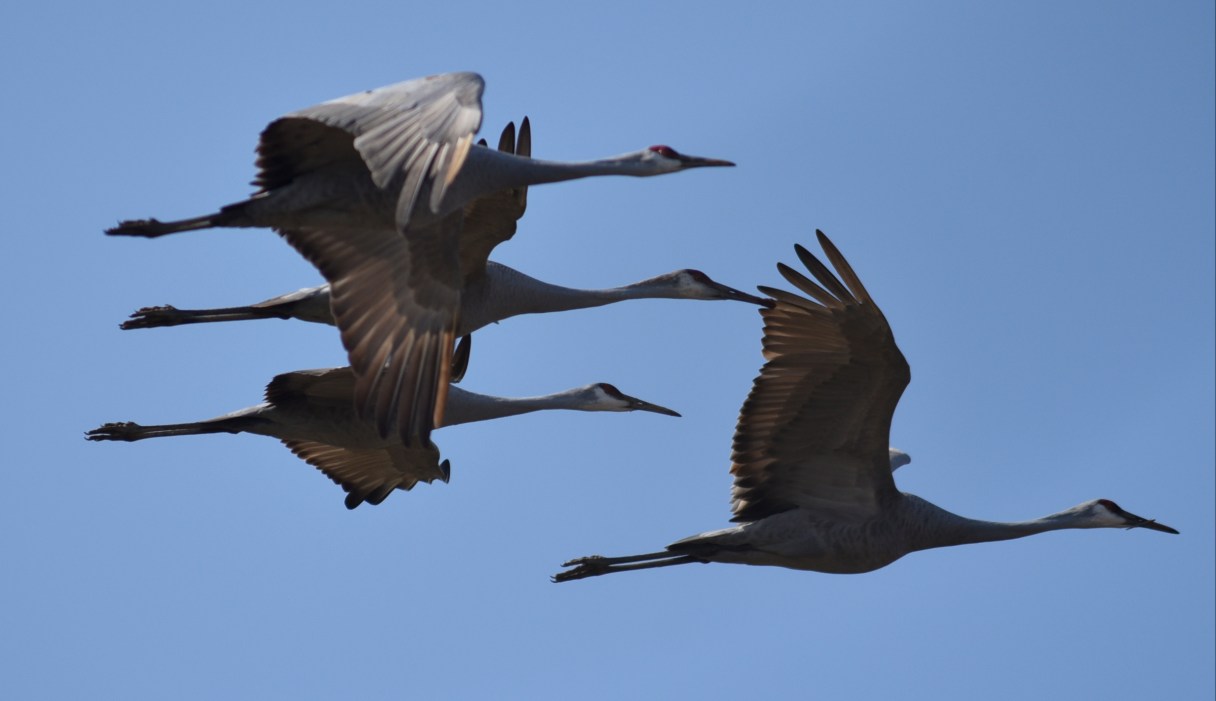
The annual migration of hundreds of thousands of sandhill cranes from the Upper Midwest to Florida each winter is a sight the National Audubon Society has described as “among the greatest wildlife spectacles on the continent.”
In advance of the annual Tennessee Sandhill Crane Festival, set for the weekend of Jan. 14-15, the Tennessee Aquarium has scheduled early visits to the Hiwassee Wildlife Refuge to see these magnificent birds from the climate-controlled comfort of the River Gorge Explorer.
The refuge is a stopping-off point for the largest winter flock of sandhill cranes in the Southeast outside of Florida. The two-hour eco-cruises circle the river channel next to Hiwassee Island.
“It’s a great way to get close to these birds,” says Kevin Calhoon, the aquarium’s assistant curator of forests. “You get much better looks from the boat than you do from the observation area [at the refuge]. It’s just a whole different way to view them.”
That so many sandhill cranes can be seen at once is a sign of their tremendous conservation success story. In the 1930s, the wild population of these elegant birds had dwindled to less than 1,000. These days, Hiwassee Island may host an estimated 5,000 to 8,000 sandhill cranes, whose rattling, cacophonous call can be heard from miles away.
“This is really the only place where you can see them in Tennessee in any numbers and the only place that you can get that nice of a view,” Calhoon says. “That’s what makes it special.”
First cruises embark this Friday through Sunday, Dec. 30-Jan. 1, and continue weekends through Martin Luther King Day, Jan. 16, from Sale Creek Marina.
The trip up to and around Hiwassee Island also includes sightings of the occasional peregrine falcon or black vulture, large numbers of bald eagles and thousands of ducks and geese of various species.
In recent years, hundreds of white pelicans, the largest bird in North America, also have begun making regular appearances during the journey. On rare occasions, birders may even spot a wayward whooping crane, the sandhill crane’s larger and endangered near relative.
For the ornithological set, a Sandhill Crane Cruise can be an observational smorgasbord, says John Dever, one of two on-board naturalists.
“You see things you don’t normally see and in big concentrations, big numbers,” Dever says. “You look over, and in this little inlet, you might see a few thousand ducks of different species. You might see 100 herons. Then, there will be six or seven kingfishers.
“You’re looking through a window into this slough area, and you see this incredible density of bird life.”
Guests on the River Gorge Explorer also will be able to learn more about the island’s naturalistic and historical heritage by perusing maps and historical texts.