
Friday, November 13, 2026Nov 13

Ocean world near Saturn top contender for life beyond Earth

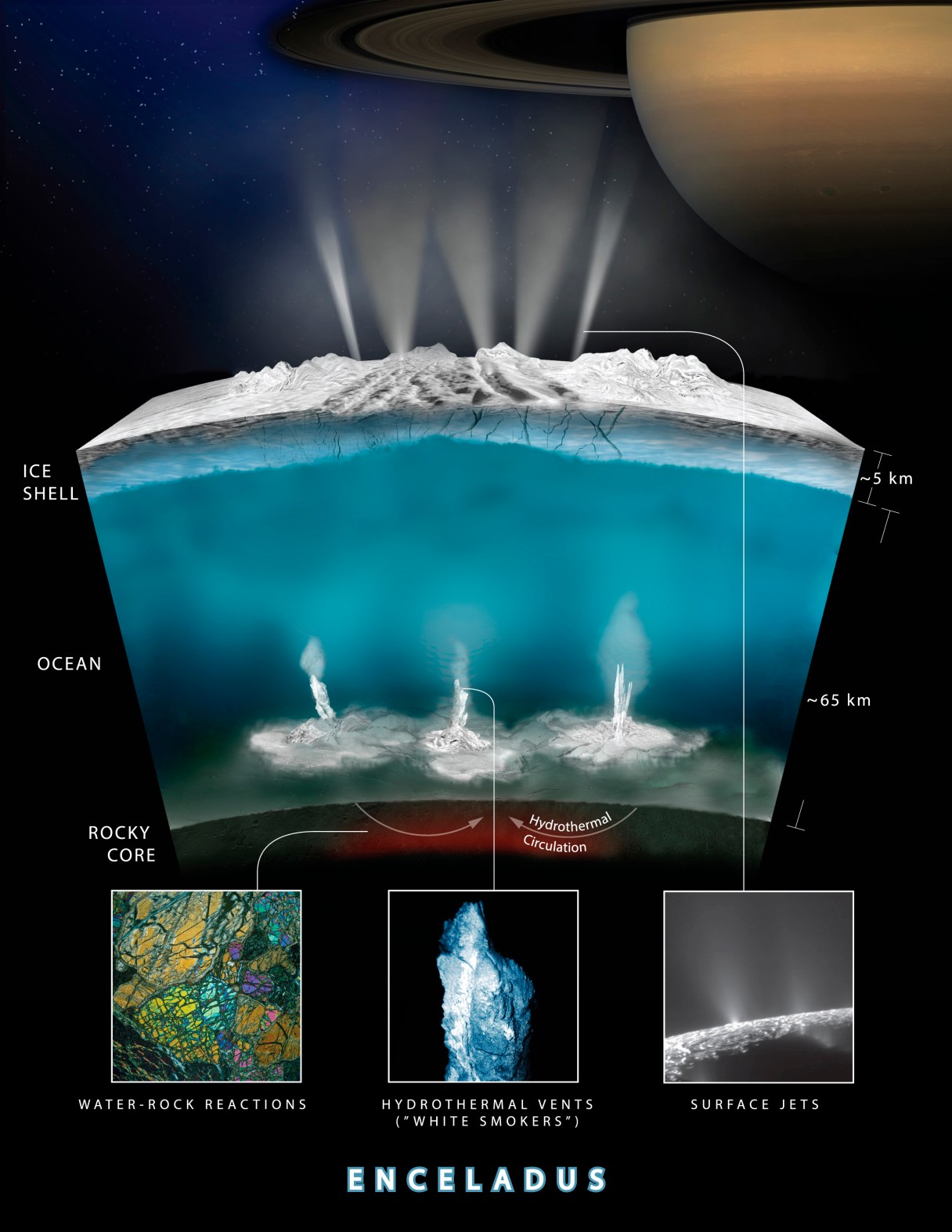
This illustration provided by NASA on Thursday, April 13, 2017 shows what scientists on the space agency's Cassini mission theorize how water interacts with rock at the bottom of the ocean of Saturn's icy moon Enceladus, producing hydrogen gas (H2). The graphic shows water from the ocean circulating through the seafloor, where it is heated and interacts chemically with the rock. This warm water, laden with minerals and dissolved gases (including hydrogen and possibly methane) then pours into the ocean creating chimney-like vents. (NASA/JPL-Caltech/Southwest Research Institute via AP)
This illustration provided by NASA on Thursday, April 13, 2017 shows what scientists on the space agency's Cassini mission theorize how water interacts with rock at the bottom of the ocean of Saturn's icy moon Enceladus, producing hydrogen gas (H2). The graphic shows water from the ocean circulating through the seafloor, where it is heated and interacts chemically with the rock. This warm water, laden with minerals and dissolved gases (including hydrogen and possibly methane) then pours into the ocean creating chimney-like vents. (NASA/JPL-Caltech/Southwest Research Institute via AP) This illustration provided by NASA on Thursday, April 13, 2017 shows what scientists on the space agency's Cassini mission theorize how water interacts with rock at the bottom of the ocean of Saturn's icy moon Enceladus, producing hydrogen gas (H2). The graphic shows water from the ocean circulating through the seafloor, where it is heated and interacts chemically with the rock. This warm water, laden with minerals and dissolved gases (including hydrogen and possibly methane) then pours into the ocean creating chimney-like vents. (NASA/JPL-Caltech/Southwest Research Institute via AP)

CAPE CANAVERAL, Fla. (AP) – A tiny, ice-encrusted ocean world orbiting Saturn is now a hotter-than-ever candidate for potential life.

NASA’s Cassini spacecraft has detected hydrogen molecules in the geysers shooting off the moon Enceladus, possibly the result of deep-sea chemical reactions between water and rock that could spark microbial life, scientists announced Thursday.

NASA and others are quick to point out this latest discovery does not mean there’s life on Enceladus, but that there may be conditions favorable for life.

A liquid ocean exists beneath the icy surface of Enceladus, which is barely 300 miles (500 kilometers) across. Scientists have long known about the plumes of water vapor spewing from cracks at the moon’s south pole, thanks to Cassini . The heavy presence of hydrogen suggests chemical reactions between the warm water and ocean-floor rock that could support life.

Cassini uncovered the hydrogen during its final close flyby of Enceladus in 2015, when it dove deeper than ever through its plumes of vapor and particles. The researchers reported that the hydrogen, along with carbon dioxide that was also found, could mean that undersea microbes are producing methane as they do in the bowels of our own oceans and waterways.