
Monday, November 9, 2026Nov 9

Japan, US burying World War II ghosts after 70 years

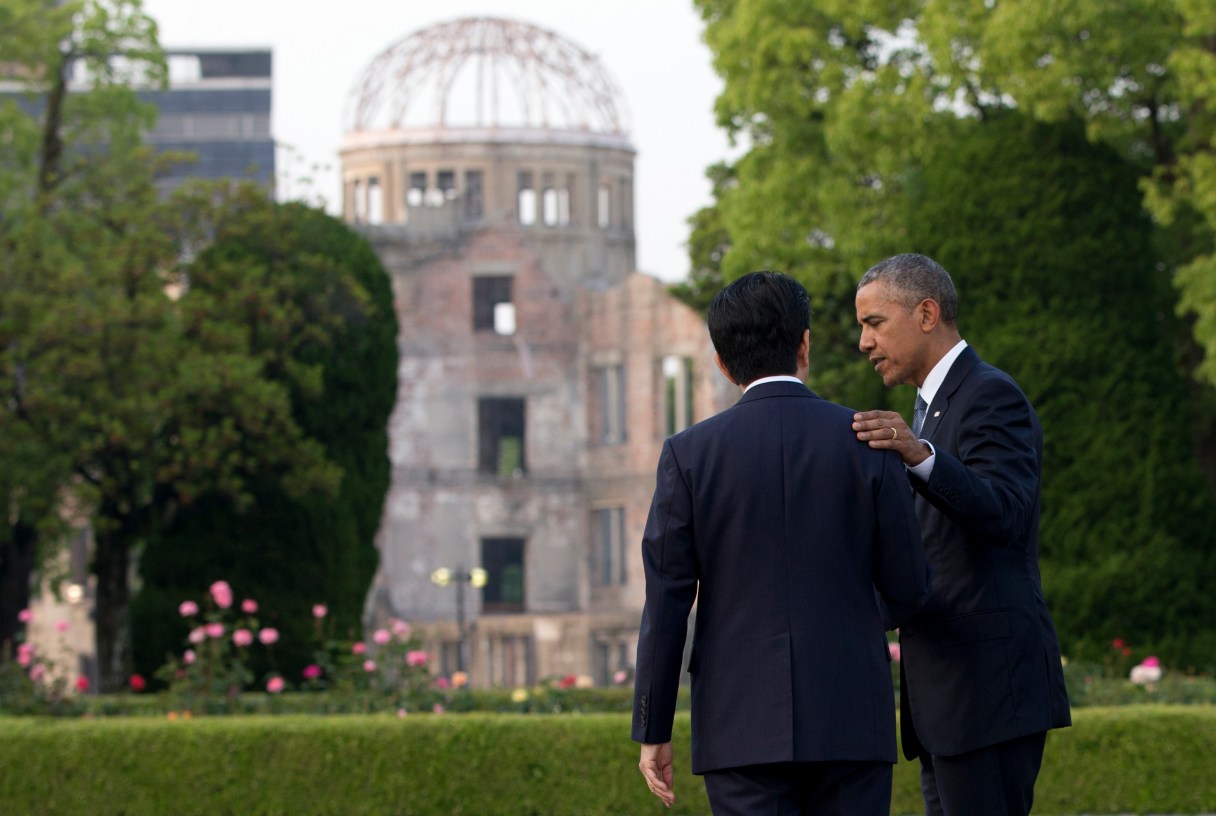
FILE - In this Friday, May 27, 2016, file photo, U.S. President Barack Obama and Japanese Prime Minister Shinzo Abe speak with the Atomic Bomb Dome seen at rear at the Hiroshima Peace Memorial Park in Hiroshima, western Japan. U.S. President Barack Obama risked criticism at home when he decided to visit the memorial to the 140,000 killed in the atomic bombing of the Japanese city during World War II. Japanese generally welcomed his visit and praised his speech which called on humankind to prevent war and pursue a world without nuclear weapons. (AP Photo/Carolyn Kaster, File)
FILE - In this Friday, May 27, 2016, file photo, U.S. President Barack Obama and Japanese Prime Minister Shinzo Abe speak with the Atomic Bomb Dome seen at rear at the Hiroshima Peace Memorial Park in Hiroshima, western Japan. U.S. President Barack Obama risked criticism at home when he decided to visit the memorial to the 140,000 killed in the atomic bombing of the Japanese city during World War II. Japanese generally welcomed his visit and praised his speech which called on humankind to prevent war and pursue a world without nuclear weapons. (AP Photo/Carolyn Kaster, File) FILE - In this Friday, May 27, 2016, file photo, U.S. President Barack Obama and Japanese Prime Minister Shinzo Abe speak with the Atomic Bomb Dome seen at rear at the Hiroshima Peace Memorial Park in Hiroshima, western Japan. U.S. President Barack Obama risked criticism at home when he decided to visit the memorial to the 140,000 killed in the atomic bombing of the Japanese city during World War II. Japanese generally welcomed his visit and praised his speech which called on humankind to prevent war and pursue a world without nuclear weapons. (AP Photo/Carolyn Kaster, File)

TOKYO (AP) – An American president in Hiroshima. A Japanese prime minister at Pearl Harbor. One longtime taboo has already fallen this year, and the other soon will.

On Dec. 27, Prime Minister Shinzo Abe will visit the Hawaiian U.S. naval base attacked by Japan in 1941. He will be joined by President Barack Obama, who seven months earlier traveled to Hiroshima to pay tribute to the 140,000 people killed there by a U.S. atomic bomb in 1945. The two attacks bookend World War II in the Pacific.

The importance of the visits may be mostly symbolic for two countries that, in a remarkable transformation, have grown into close allies in the decades since they faced off in brutal conflict. At the same time, it’s significant that it took more than 70 years for U.S.-Japanese relations to get to this point. The two gestures of reconciliation are in some ways an attempt to sweep out the final ghosts of the war.

“Despite the amicable relationship that the two countries have enjoyed since the end of the Pacific War, deep-rooted negative sentiment has remained in both countries,” said Narushige Michishita, a security expert at the National Graduate Institute for Policy Studies in Tokyo. “The Obama-Abe joint visit to Pearl Harbor will change this.”

Several factors have helped both Obama and Abe step in hallowed places their predecessors did not: