
Friday, October 30, 2026Oct 30

This story is free to read.

Radicalization’s path: In case studies, finding similarities

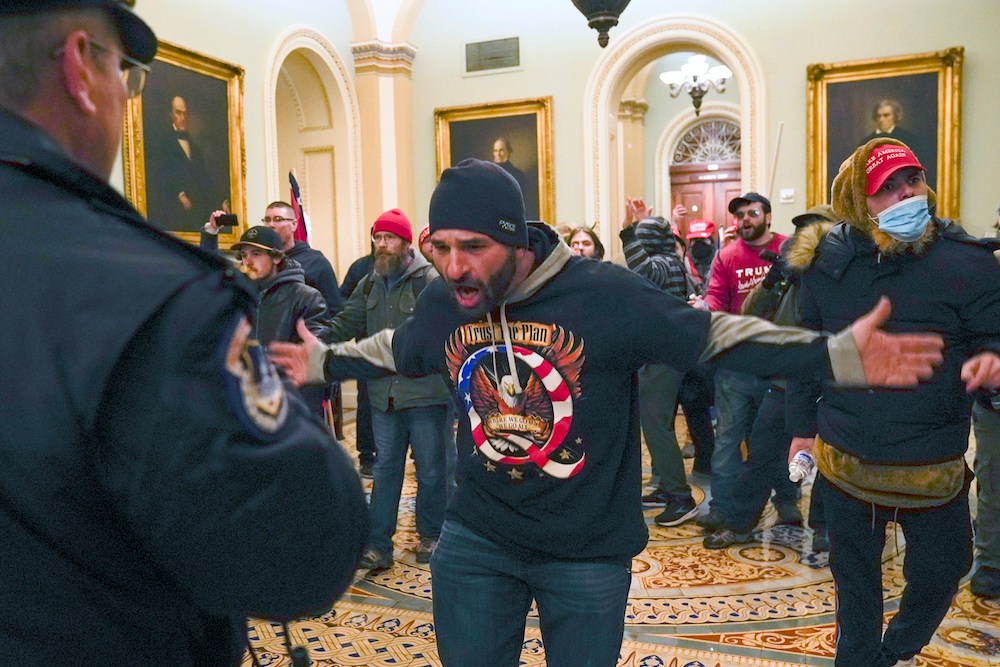
In this Jan. 6, 2021, file photo, Trump supporters, including Doug Jensen, center, confront U.S. Capitol Police in the hallway outside of the Senate chamber at the Capitol in Washington. America met Jensen via a video that ricocheted across the Internet that turned an officer into a hero and laid bare the mob mentality inside the Capitol on Jan. 6. (AP Photo/Manuel Balce Ceneta, File)
In this Jan. 6, 2021, file photo, Trump supporters, including Doug Jensen, center, confront U.S. Capitol Police in the hallway outside of the Senate chamber at the Capitol in Washington. America met Jensen via a video that ricocheted across the Internet that turned an officer into a hero and laid bare the mob mentality inside the Capitol on Jan. 6. (AP Photo/Manuel Balce Ceneta, File) In this Jan. 6, 2021, file photo, Trump supporters, including Doug Jensen, center, confront U.S. Capitol Police in the hallway outside of the Senate chamber at the Capitol in Washington. America met Jensen via a video that ricocheted across the Internet that turned an officer into a hero and laid bare the mob mentality inside the Capitol on Jan. 6. (AP Photo/Manuel Balce Ceneta, File)

In the months before he was charged with storming the Capitol, Doug Jensen was sharing conspiracy theories he’d consumed online. But it hadn’t always been that way, says his brother, who recalls how he once posted the sort of family and vacation photos familiar to nearly all social media users.

A world away, Wahab hadn’t always spent his days immersed in jihadist teaching. The product of a wealthy Pakistani family and the youngest son of four, he was into cars and video games, had his own motorcycle, even studied in Japan.

No two ideologues are identical. No two groups are comprised of monolithic clones. No single light switch marks the shift to radicalism. The gulf between different kinds of extremists – in religious and political convictions, in desired world orders, in how deeply they embrace violence in the name of their cause – is as wide as it is obvious.

But to dwell only on the differences obscures the similarities, not only in how people absorb extremist ideology but also in how they feed off grievances and mobilize to action.

For any American who casts violent extremism as a foreign problem, the Jan. 6 Capitol siege held up an uncomfortable mirror that showed the same conditions for fantastical thinking and politically motivated violence as any society.