
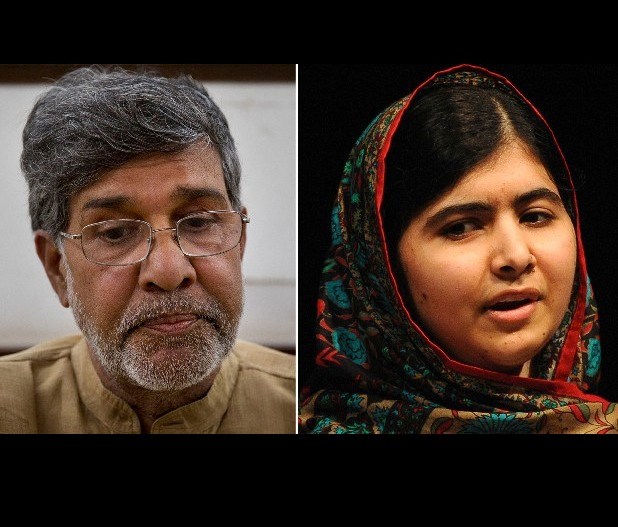
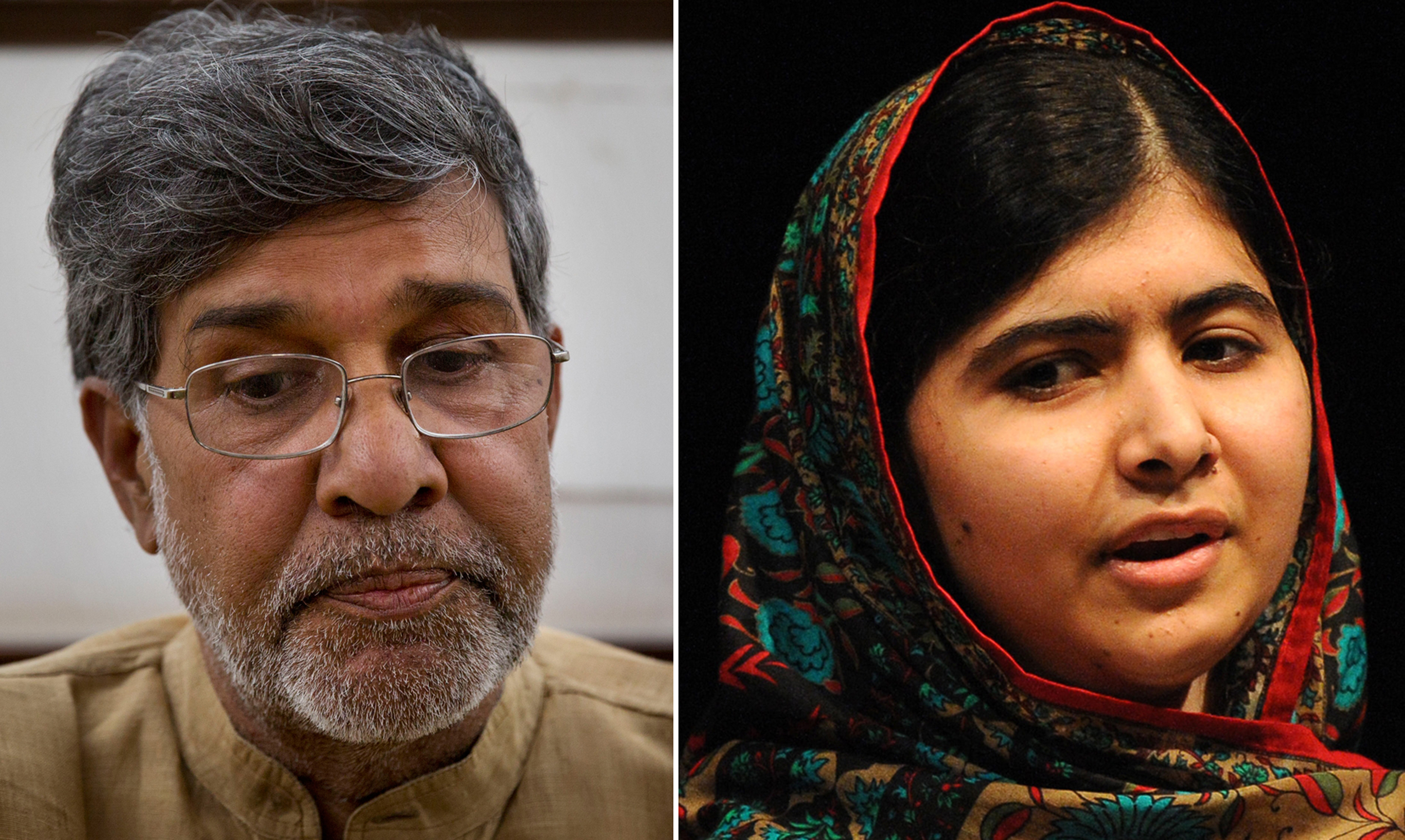
 Indian children’s rights activist Kailash Satyarthi, left, and Malala Yousafzai, right, were awarded the Nobel Peace Prize on Friday. Satyarthi of India and Yousafzai of Pakistan jointly won for risking their lives to fight for children’s rights.
NEW DELHI- One is Muslim, the other Hindu. One a Pakistani, the other Indian. One a school girl just starting out in life, the other a man with decades of experience.
Despite their many differences, 17-year-old Malala Yousafzai and 60-year-old Kailash Satyarthi will be forever linked — co-winners of the 2014 Nobel Peace Prize, honored for risking their lives for the rights of children to education and to lives free of abuse. Their selection was widely acclaimed, their heroism undeniable.
But something more was at work here: In awarding the prize Friday, the Nobel Committee also sent a blunt message to the rival nations of India and Pakistan that if two of their citizens can work for a common goal, their governments too could do better in finding common ground.
The two nations have almost defined themselves by their staunch opposition to one another. They became enemies almost instantly upon gaining independence in 1947 from imperial Britain, and have since fought three full-scale wars over various issues, including competing claims to the Himalayan region of Kashmir that sits between them. Just this week, their troops have hurled mortar shells and firing guns at one another across the Kashmir border, with civilian casualties in double digits.
The Nobel Committee’s chairman, Thorbjoern Jagland, acknowledged his panel gave the prize to Yousafzai and Satyarthi partly to nudge the two countries together, though he cautioned that the impact of the award should not be overestimated.