
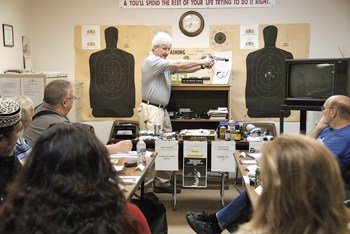

For a decade Gary Harmon has run a handgun safety course in Altamont, Tenn. Once a year an inspector recertified the school after a short visit.
But in October a Tennessee Highway Patrol trooper cited him for six violations, shut his school down and gave him 30 days to fix the problems, one of which was that his classroom sat behind the berm where his students shot targets.
The suspension letter stated that was “an extreme danger to students waiting to enter the live fire area or waiting to use the restrooms.”
Mr. Harmon used a backhoe to face the range in another direction. But the original layout was never mentioned by previous inspectors, he said.
“Does that mean all these other state troopers didn’t know what they were doing?” he said.
Not necessarily, said Lt. Robert Eckerman, head of the handgun unit for the Tennessee Department of Safety.
The department took responsibility for inspecting and certifying safety courses for handgun carry permits in 1996. Before then each county was in charge of permitting, he said.
Within a few years the number of courses across the state grew at such a rate that there were not enough uniformed troopers to handle the demand, Lt. Eckerman said.
So driver services employees in some counties and some retired troopers took over the task, resulting in an uneven certifying process, he said.
In 2008 the department put 16 uniformed troopers, two for each district in Tennessee, in charge of inspecting any certified Tennessee handgun safety course.
“I’d say we’ve done a complete turnaround, 100 percent improvement,” the lieutenant said.
Safely learning safety
At Sportsman’s Indoor Shooting on Hixson Pike, Chattanooga police Sgt. Mark Haskins held an empty handgun pointed toward a wall as he talked to a class of about a dozen students.
“We’re going to keep our finger off the trigger until we’re ready to shoot,” he said, showing different ways to hold the gun.
Sgt. Haskins is a SWAT-trained sniper for the police department and instructs the class while off duty. Some of the students have shot weapons all of their lives, while others never had shot before that night.
Lang Johnson, a former Marine who worked as a marksmanship instructor, said the course “definitely covers all aspects as far as safety.”
Students must spend at least eight hours in the course, half of that on the firing range, according to state law.
During the classroom portion of the safety course, participants reviewed gun laws, watched a department-provided video and covered weapons terminology, safety and shooting scenarios.
On the range students shot at a torso-sized paper target, six shots at a time for 48 shots. As long as 33 of the bullets pierced the black, they passed.
PDF: Suspension and warning letters for trainers
Mixed standards
Tennessee honors all out-of-state handgun carry permits for people visiting the state.
But to obtain a Tennessee permit, holders from 31 states must go through the Tennessee handgun safety course. This is because the home state either doesn’t require any training or requires less training than mandated by Tennessee.
Neither Alabama nor Georgia require any safety training before applicants receive a handgun carry permit.
“I wish that Georgia did have a training program,” said Catoosa County Sheriff Phil Summers.
The sheriff said annual applications for handgun carry permits have tripled in the last three years.
There are a number of people who “have no experience handling a firearm,” he said.
If Georgia adopts a training program, the sheriff said he would like to see something similar to Tennessee’s, with the Department of Public Safety in charge of inspecting and certifying both the classes and instructors.
CHANGES MADE
When uniformed troopers and the department gained more control over regulating handgun courses, a number of things changed, said Lt. Eckerman and Department of Safety spokesman Mike Browning.
The handgun unit brings to bear the inspection experience of uniformed officers and has the capability to do its own background checks, they said.
A 2008 report in the Commercial Appeal newspaper in Memphis showed instances where individuals convicted of felonies continued to possess valid handgun carry permits even though the law required revoking the permit.
At the time the FBI did not allow the department to do the background checks, because authority for the program rested with drivers’ services. After the highway patrol took over duties in 2008, its personnel were able to do background checks themselves, Mr. Browning said.
State law also now charges courts with checking if someone charged with a crime has a permit and then notifying the department.
Shifting responsibilities may have resulted in more problems for gun safety instructors and course providers such as Mr. Harmon, but officials say they’re pleased the process is more professional than in previous years.
“I think we’ve made leaps and bounds as far as improvements,” Lt. Eckerman said. “But I’m not near as satisfied that we have done everything we can do.”
By the numbers
* 18 – States that meet Tennessee’s safety training requirement for handgun carry permits
* 31 – States that do not meet the requirement
* 243 – Approved handgun schools in Tennessee
* 21 – Approved schools in Southeast Tennessee
* 5 – Approved schools in Hamilton County
* 882 – Approved handgun instructors in Tennessee
* 16 – Handgun schools suspended in the last two years
* 2 – Handgun schools’ certification revoked in the last two years
* $50 – cost for handgun safety school certification
Source: Tennessee Department of Safety
Click here to vote in our daily poll: Should training be required to obtain a handgun permit?
Continue reading by following these links to related stories:
Times editorial: No guns in parks here, please