
Friday, November 13, 2026Nov 13

Italy’s largest bank to shed jobs in aggressive overhaul

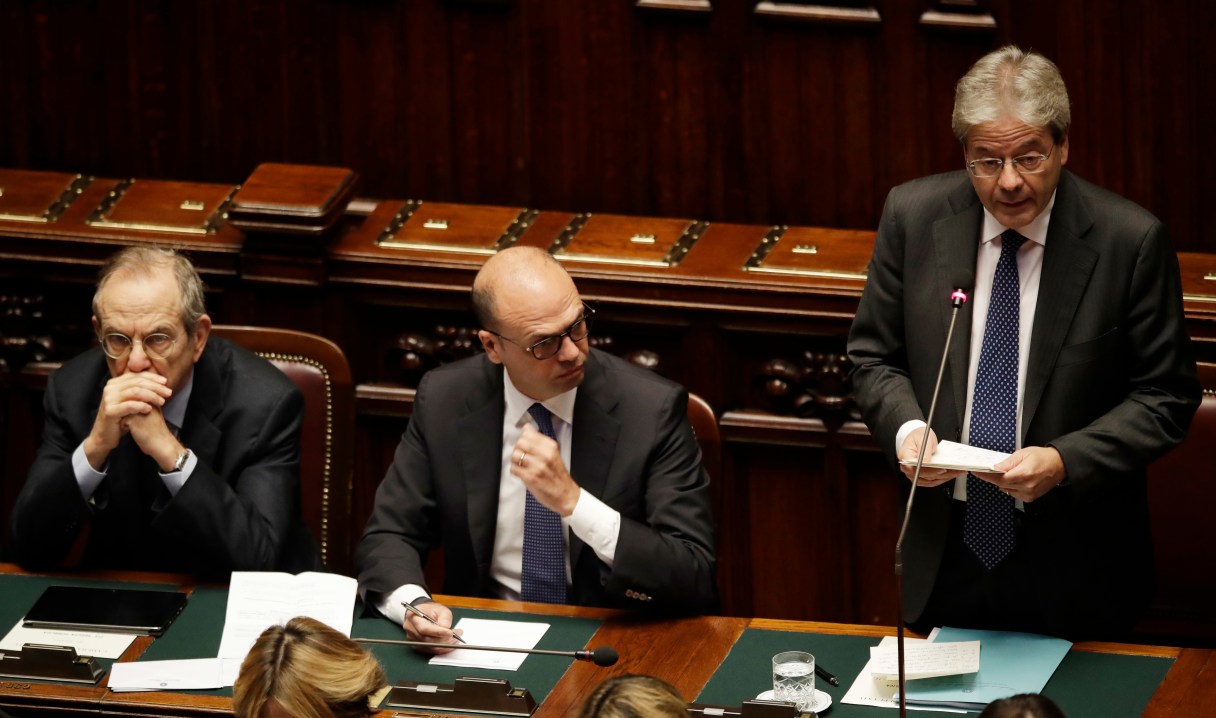
Italian Prime Minister Paolo Gentiloni, right, gives his first speech as premier at the lower house where he will later face a confidence vote, in Rome Tuesday, Dec. 13, 2016. Paolo Gentiloni, a Democrat formerly serving as foreign minister, formed Italy’s new government Monday, keeping several key ministers from the coalition of Matteo Renzi, who resigned last week. At left is Finance minister Pier Carlo Padoan, at center is Foreign minister Angelino Alfano. (AP Photo/Alessandra Tarantino)
Italian Prime Minister Paolo Gentiloni, right, gives his first speech as premier at the lower house where he will later face a confidence vote, in Rome Tuesday, Dec. 13, 2016. Paolo Gentiloni, a Democrat formerly serving as foreign minister, formed Italy’s new government Monday, keeping several key ministers from the coalition of Matteo Renzi, who resigned last week. At left is Finance minister Pier Carlo Padoan, at center is Foreign minister Angelino Alfano. (AP Photo/Alessandra Tarantino) Italian Prime Minister Paolo Gentiloni, right, gives his first speech as premier at the lower house where he will later face a confidence vote, in Rome Tuesday, Dec. 13, 2016. Paolo Gentiloni, a Democrat formerly serving as foreign minister, formed Italy’s new government Monday, keeping several key ministers from the coalition of Matteo Renzi, who resigned last week. At left is Finance minister Pier Carlo Padoan, at center is Foreign minister Angelino Alfano. (AP Photo/Alessandra Tarantino)

MILAN (AP) – Italy’s largest bank, UniCredit, said Tuesday it will unload 17.7 billion euros ($18.8 billion) in soured loans, raise billions in new money and shed thousands of jobs as it seeks to re-launch the company under new management.

The move to reduce the bank’s risk profile and cut costs emerged in a new strategic plan that includes increasing by 6,500 – to 14,000 – the number of jobs it will cut by 2019.

“We have developed a plan which is pragmatic, with tangible and achievable targets, which depends mostly on cost and risk management levers which are firmly under our control,” CEO Jean Pierre Mustier told a presentation to the financial community in London .

The CEO referred repeatedly to the plan as “self-help,” saying it would create “a stronger, even better, more attractive bank.”

Investors seemed to welcome UniCredit’s plan, with shares in the bank jumping 7.7 percent to 2.61 euros in Milan.