
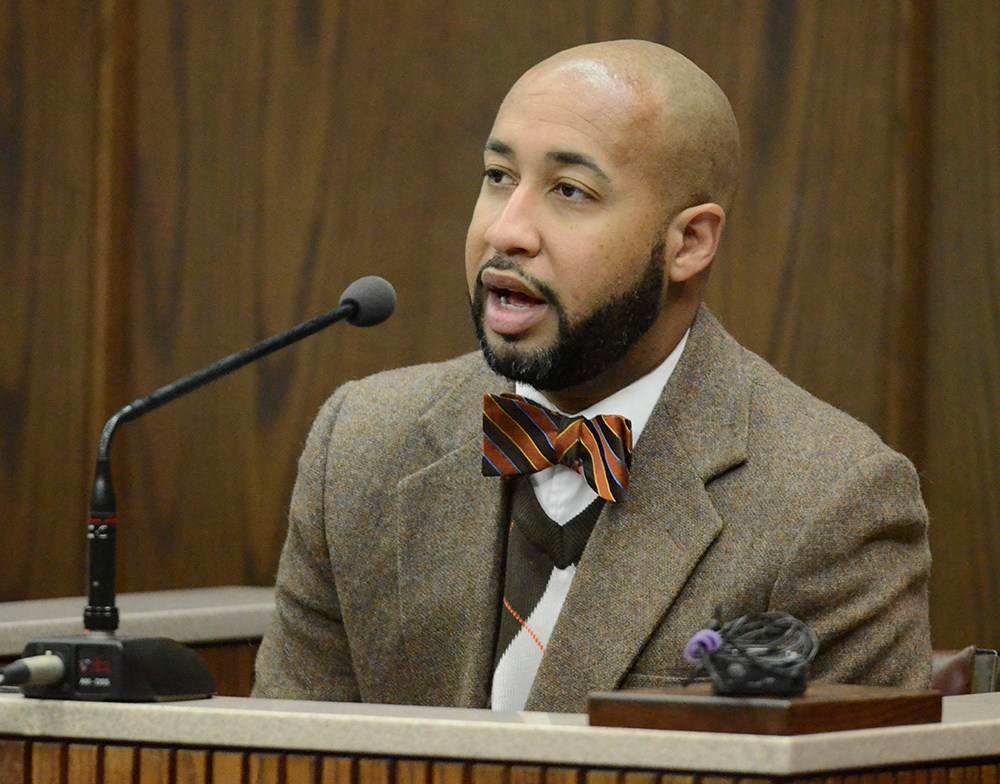
Before jurors could begin deliberating, a judge Friday dismissed charges against a former Chattanooga police detective on trial for concealing evidence in a 2014 rape and kidnapping case.
Hamilton County Criminal Court Judge Barry Steelman said special prosecutors failed to prove beyond a reasonable doubt that Karl Fields, 44, concealed six cellphone videos when he submitted a master case file to the district attorney’s office on Aug. 20, 2014, in the James Leon Works Jr. case. Fields started investigating June 1, 2014, when an alleged victim said Works beat, burned and raped her in a hotel room.
Steelman said one glaring issue was Fields was out of town the week the master case file was submitted.

“He didn’t submit the file,” Steelman said on the fourth day of the trial. “It was submitted by Yolanda Massey [of the Chattanooga Police Department]. To prove tampering of evidence, the state must prove the defendant in an investigation concealed a thing. What evidence is there he concealed it?”
Steelman announced the unusual, mid-trial dismissal after Fields’ defense attorneys finished presenting proof on Friday afternoon. Earlier in the week, Steelman rejected another defense motion to dismiss the charges of tampering with evidence and official misconduct against Fields, who was fired in 2015. He said Fields had a responsibility as a major crimes detective to log evidence into the master case file, and that he sent a text message to the alleged rape victim saying the evidence didn’t help her.
“He also said in the text he was not going to use [the video evidence] in the trial,” Steelman said. “All of these things were said in the context of his desire to continue to foster this relationship with her It’s a good argument that may convince the jury.”
That was before defense attorneys presented their proof starting Thursday afternoon. They said public records referenced the video evidence in question several times and that Fields reported his concerns about the video to his supervisors.
A different officer, Brian Cottell, collected Works’ cellphone from the scene and testified it may contain evidence of an aggravated rape during a June 18, 2014, preliminary hearing in Hamilton County General Sessions Court, attorney Jerry Tidwell said. Fields filed a public search warrant affidavit to search the phone data, which a magistrate judge granted July 8, 2014. Fields viewed the video, which showed Works and the woman having consensual sex, then told his supervisor, Sgt. Bill Phillips, and District Attorney General Neal Pinkston that he was concerned the state couldn’t prove a rape charge.
“How could anyone in Karl Fields’ shoes think they could conceal this videotape with this paper trail and nobody would know about it?” Tidwell asked jurors, who started hearing the case Tuesday.
Tidwell called Pinkston and Phillips to the stand Thursday. Neither could recall the specific date Fields told them about the evidence, which special prosecutors used to try to discredit Pinkston’s testimony.
Since authorities have a constitutional duty to turn potential exonerating evidence over to a defendant’s attorney, special prosecutors called Pinkston back to the stand Friday and attempted to nail him down on when he learned about the video footage. Was it before a grand jury indicted Works on July 30, 2014? Pinkston said he wasn’t aware of it then.
“You have to understand – some days I could get 40 or 50 phone calls, and I don’t keep a log of everyone,” Pinkston said Friday. “But I remember a number of phone calls between Fields and Phillips about this case.”
Records suggested another timeline.
Pinkston was officially elected district attorney on Sept. 1, 2014, in Hamilton County. Fields was suspended three days later, after the alleged victim filed a complaint with the police department’s internal affairs and released thousands of messages she exchanged with the 44-year-old detective. Pinkston sent a letter to the Chattanooga Police Department on Sept. 4, 2014, saying one text message alluded to a video: “We have not received a video – but our search warrant mentions it.” Four days later, he asked the Tennessee Bureau of Investigation to take a look into Fields’ behavior, since there was “potential criminal action” over the alleged video. He filed the video into Works’ case file on Sept. 9, 2014. In October, TBI agents found a disc of the evidence sitting in plain view on a desk in Fields’ office.
Alyson Kennedy, an appointed prosecutor sent from the 9th Judicial District, said Pinkston requested the Tennessee Bureau of Investigation look into the case, knowing that Fields mentioned the video and his concerns about it.
“If it’s your testimony that either Sgt. Phillips or detective Fields had advised you in some form prior to Sept. 1 about this video, then you knew those allegations aren’t true,” she said of the letter he sent to the TBI on Sept. 8, 2014.
“Are you accusing me of not being honest?” Pinkston asked. “Is that what you’re doing?”
Pinkston said he followed the law, including the facts as he knew them at the time. “I’ve heard there’s a video from two other lawyers. But I try not to assume anything. Sometimes allegations are made and it’s not true. So until I have a copy of the video – it may or may not exist.”
Steelman had a handful of meetings in his chambers with the attorneys and announced he wasn’t convinced the letters impeached Pinkston. Several times he grappled with his decision to dismiss the counts, calling Fields’ behavior “highly unethical” and “messed-up.”
“The easiest thing to do is to let the case go to the jury and in my opinion get it right,” Steelman said. “I’m saying that if the jury returned a verdict of guilt, I would [become the] 13th juror and overturn the verdict. And when I think that, I don’t need to let it go to the jury.”
Contact staff writer Zack Peterson @zpeterson@timesfreepress.com or 423-757-6347. Follow him on Twitter @zackpeterson918.