
Here at the newspaper, we get packages practically weekly from self-published authors.
As a former features editor, I’ve had to disappoint a lot of nice folks who were hoping for full-blown reviews in the Sunday books page.
Millions of Americans, it seems, yearn to make words line up and march. There’s something about writing a book that makes you feel immortal – knowing your literary legacy will no longer be just a few words sandblasted onto a headstone. Advances in printing technology have made inexpensive micro-publishing possible.
 Staff File Photo
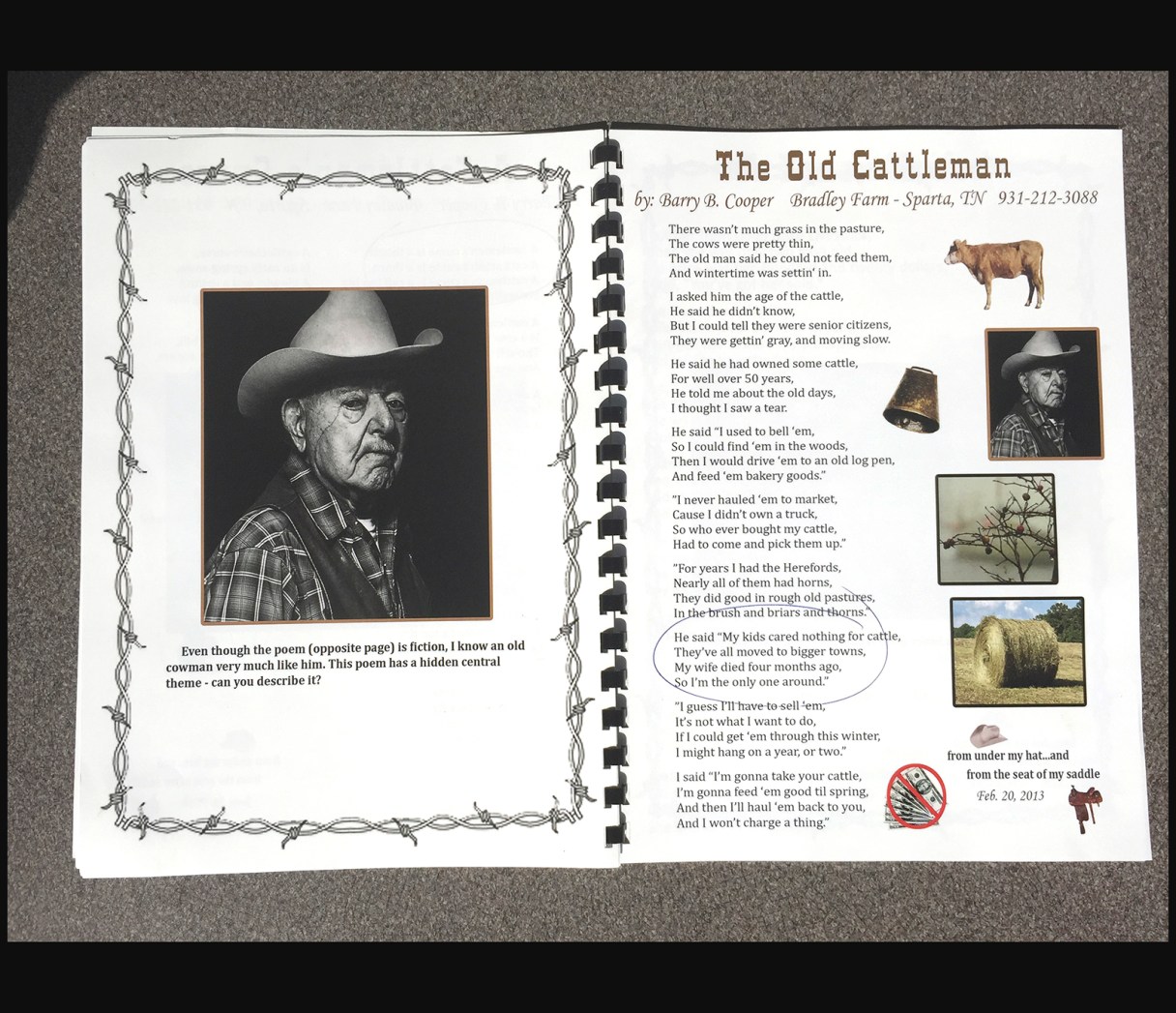
Barry Cooper, a retired University of Tennessee Agricultural Extension Service agent from Sparta, Tenn., recently sent us a self-published book, a collection of his poems about life as a Tennessee cattleman.
“If you don’t like my poems, it won’t hurt my feelings any,” he told me – which might have been the most endearingly plain-spoken book pitch I’ve ever gotten.
Still, after we talked, I set the book on one of the unruly piles on my desk. Then one day, Cooper left a follow-up voice mail, and I decided to read his poems and call him back.
Cooper’s poems, in the familiar ABCB rhyme scheme of novices, are about small-town life and family farms. They’re about watching calves being born, the aggravation of a pasture full of thistles, and the under-appreciated spirit of small-town bank tellers.
Cooper says he pays about $25 a copy to have his books printed, and he gives them away to family and friends. I came away thinking that everybody should write a book.
Interestingly, Cooper told me that while he lives in Middle Tennessee, he subscribes to the Times Free Press because he likes the farm price reports, Billy Graham’s columns and the Bible verses on the Free Press opinion page. It doesn’t bother him that the news gets to him few days late by U.S. mail.
When we talked, Cooper explained that he got off to a rocky start as a poet. As a seventh-grader in Sparta, Cooper says he panicked when his teacher had the kids write a poem as homework.
“I didn’t know how to do it,” says Cooper, 64. “So, I asked my mother, who was a teacher, to help me do it. She actually wrote it, but I wrote my name on it and turned it in.”
As the story goes, “Cooper’s” poem was voted the best in the class.
“I knew it was dishonest, but I was glad I won,” he chuckles.
From that stumbling beginning, Cooper has turned simple poetry about farm culture and small-town life into an adult hobby.
One of his poems, “The Old Cattleman,” hits an often overlooked note: Most of today’s small farms are owned and maintained by aging land owners. I saw a U.S. Census report the other day showing that the largest age group for farmers in Tennessee is “over 65.”
In “The Old Cattleman” Cooper writes about one of these old-timers:
“My kids care nothing for cattle,
They’ve moved to bigger towns,
My wife died four months ago,
So, I’m the only one around.”
As much as anything, this is why Cooper writes, to preserve his impressions about a way of life, a culture, that may be on the down slope.
“For most people today, with children and a family, farming would be a challenge because of the upfront costs,” he said. “And it’s hard for a young person to live on $10,000, $20,000 or $30,000 a year.”
I appreciated Cooper’s poem about tellers at small-town banks. My mother, who died in 2006, spent her career as a bank teller, and was known as one of the cheeriest people in my hometown, Columbia, Tenn.
Cooper writes:
“The president of the bank,
should give these girls some praise,
And while he’s bragging on ’em,
Don’t forget they need a raise.”
His poems won’t win a Pulitzer, but his musings are from the heart.
If writing is about sharing, then Cooper plays the part.
Contact Mark Kennedy at mkennedy@timesfreepress.com or 423-757-6645. Follow him on Twitter @TFPCOLUMNIST.
Subscribe to his Facebook updates at www.facebook.com/mkennedycolumnist.