
Sunday, November 15, 2026Nov 15

Russian drone footage show wide damage at Syria’s Palmyra

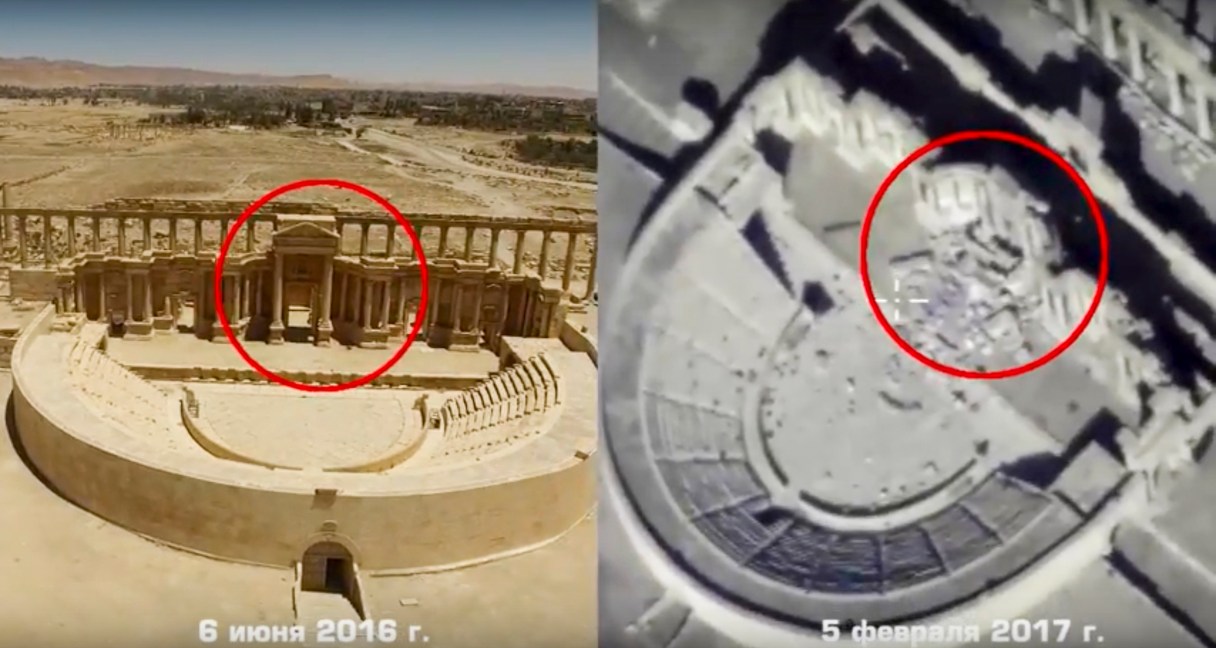
This photo combo, made from footage taken from the Russian Defense Ministry official website, purports to show the Roman-era amphitheater on June 6, 2016, left, and on Feb. 5, 2017, right, in Palmyra, Syria. Russia's defense ministry has released drone footage showing new destruction in Syria's historic town of Palmyra, which was recently recaptured by the Islamic State group, and warned that the militants could be planning the further demolition of antiquities. The video shows that the militants have badly damaged the facade of the amphitheater. (Russian Defense Ministry Press Service, via AP)

MOSCOW (AP) – Russia released drone footage Monday showing new destruction in Syria’s historic town of Palmyra, which was recently recaptured by the Islamic State group, and warned that the militants could be planning the further demolition of antiquities.

The Russian Defense Ministry says Syrian government forces are advancing toward the town as another battle for the ancient site looms.

The video showed that the militants have badly damaged the facade of the Roman-era amphitheater and the Tetrapylon – a set of four monuments with four columns each at the center of the colonnaded road leading to the theater.

The video appears to show that only two of the 16 columns remain standing.

IS militants have destroyed ancient sites across their self-styled Islamic caliphate in Syria and Iraq, perceiving them as monuments to idolatry.