
Monday, November 16, 2026Nov 16

Analysis: Like Iran, pacts with USSR ignored foe’s behavior

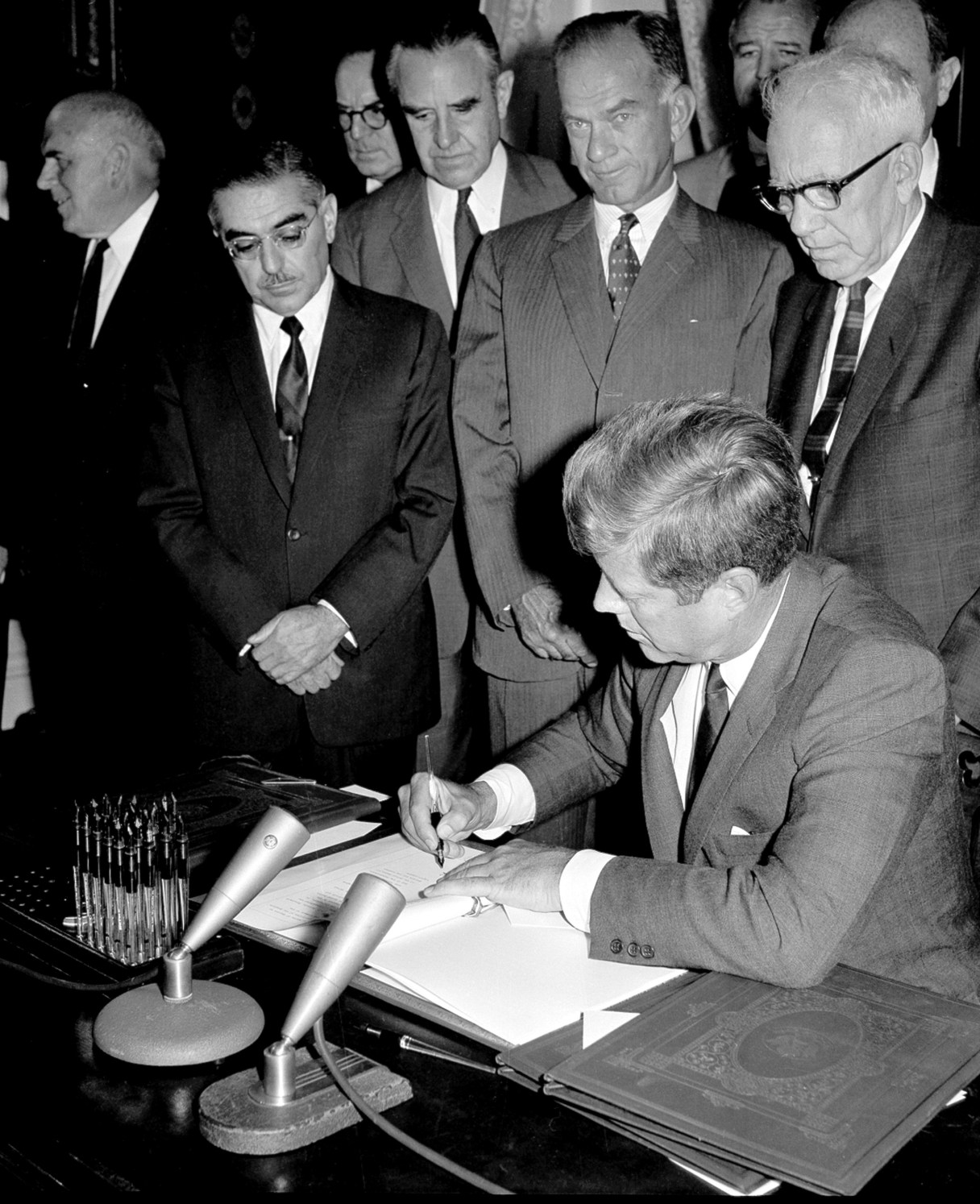
FILE -  In this Oct. 7, 1963, file photo, President John F. Kennedy signs the Limited Test Ban Treaty during a ratification ceremony in the White House Treaty Room in Washington.  Critics of the Iran nuclear deal claim it is flawed, among many reasons, because it does not demand that Tehran also change its behavior at home and abroad. That complaint ignores the United States’ long history of striking arms control agreements with the Soviet Union, a far more dangerous enemy. Dating as far back as the Limited Test Ban Treaty in 1963, U.S. administrations engaged the Soviet Union in agreements to limit nuclear threats while not linking deals to Soviet human rights abuses and the active arming and funding of leftist, anti-American revolutionary movements around the world. Watching from left are, Sen. John A. Pastore, D-R.I.; Undersecretary of State W. Averell Harriman; Sen. William Fulbright, D-Ark.; Sen. George Smathers, D-Fla.; Sen. George D. Aiken, R-Vt.  (AP Photo/File)
FILE - In this Oct. 7, 1963, file photo, President John F. Kennedy signs the Limited Test Ban Treaty during a ratification ceremony in the White House Treaty Room in Washington. Critics of the Iran nuclear deal claim it is flawed, among many reasons, because it does not demand that Tehran also change its behavior at home and abroad. That complaint ignores the United States’ long history of striking arms control agreements with the Soviet Union, a far more dangerous enemy. Dating as far back as the Limited Test Ban Treaty in 1963, U.S. administrations engaged the Soviet Union in agreements to limit nuclear threats while not linking deals to Soviet human rights abuses and the active arming and funding of leftist, anti-American revolutionary movements around the world. Watching from left are, Sen. John A. Pastore, D-R.I.; Undersecretary of State W. Averell Harriman; Sen. William Fulbright, D-Ark.; Sen. George Smathers, D-Fla.; Sen. George D. Aiken, R-Vt. (AP Photo/File)

WASHINGTON (AP) – Critics of the Iran nuclear deal claim it is flawed, among many reasons, because it does not demand that Tehran also change its behavior at home and abroad. That complaint ignores the United States’ long history of striking arms control agreements with the Soviet Union, a far more dangerous enemy.

Those deals probably made the world a safer place through some of the darkest days of the Cold War and they proved talks could be productive even with a sworn adversary.

Dating as far back as the Limited Test Ban Treaty in 1963 – less than a year after the Cuban missile crisis – U.S. administrations engaged the Soviet Union in agreements to limit nuclear threats while not linking deals to abhorrent Soviet human rights abuses and the active arming and funding of leftist, anti-American revolutionary movements around the world.

As Cold War brinksmanship moved apace, the U.S., the Soviet Union, Britain, France and China signed on to the 1963 Nonproliferation Treaty. That agreement was designed to prevent other countries from developing nuclear weapons, while guaranteeing their rights to civilian nuclear technology – the very guarantee that, 47 years later, allows Iran to continue building nuclear facilities for power generation and medical research.

The U.S. and the Soviets moved in the 1970s to a period of “detente” which spawned the Strategic Arms Limitation Treaty, known as SALT, and the Anti-Ballistic Missile Treaty in the early 1970s. The treaties held despite the 1973 Arab-Israeli Yom Kippur War, where conflicting alliances took the superpowers close to military conflict.