
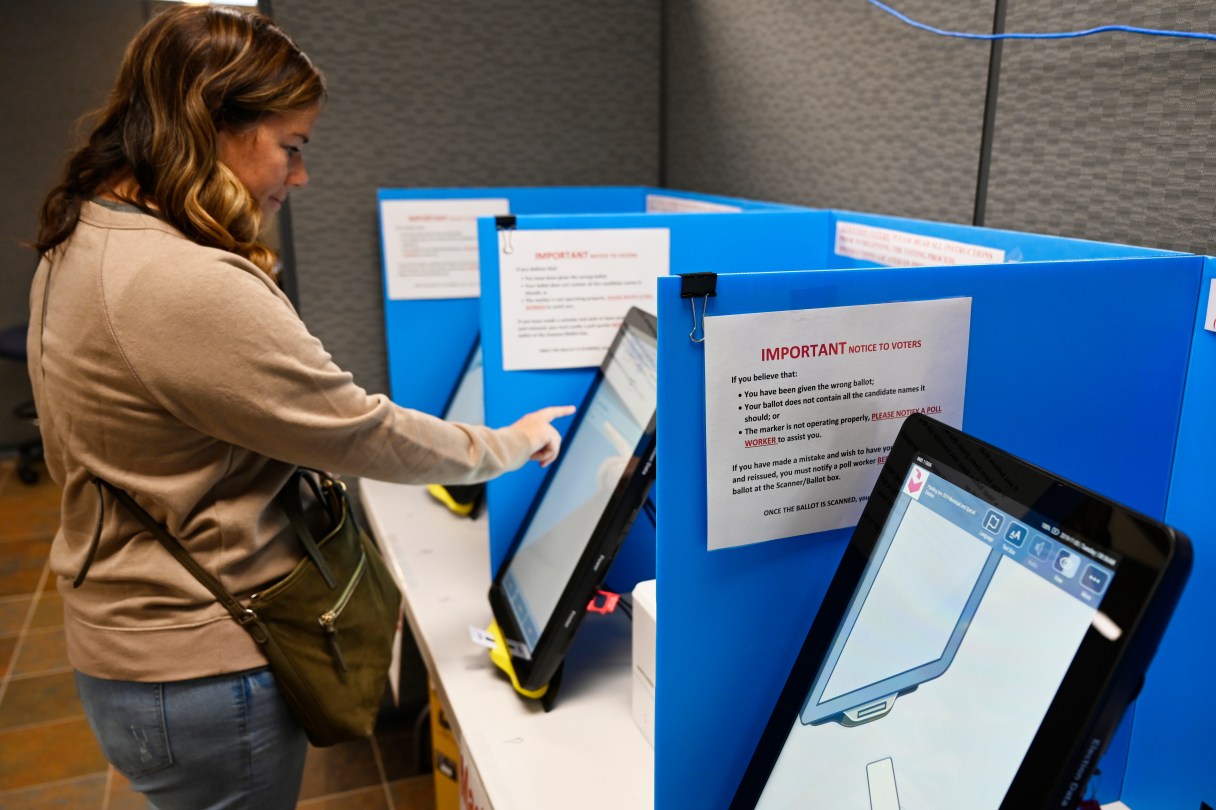
ATLANTA (AP) — Tuesday’s special state House election was another chance to work out kinks with Georgia’s new voting machines.
Secretary of State Brad Raffensperger traveled to the southwest Georgia district, which includes parts of Colquitt, Decatur and Mitchell counties to observe the election. The Republican told news outlets that the state’s new ballot markers and counters performed well, saying voters experienced “just two minor issues.”
But state Democrats and poll watchers said they observed more problems, including failures of ballot markers, ballot printers, scanners and a lack of voter privacy.
The big test looming for the new equipment is the March 24 presidential primary.
The $104 million system includes an electronic poll book to check voters in, a touchscreen computer to make selections, a printer that creates a paper ballot with a text summary of choices and a scanner that reads a code on each printout to tabulate the votes. The printed ballots are then stored inside each machine.
Raffensperger said several voter access cards, used to activate the touchscreens, weren’t working because a poll worker inserted them the wrong way in the computer that encodes them.
In addition, 13 ballots were placed in an emergency ballot box when a ballot scanner lost power. A technician found the scanner wasn’t plugged in.
“The transition to any new system will inevitably trigger some human error, and we experienced some minor ones Tuesday” Raffensperger said in a statement. “Our challenge is to scale up this success to more than 2,000 polling places in March for the presidential preference primary.”
About 5,000 votes were tallied in Tuesday’s election. Joe Campbell, the chairman of the Mitchell County Republican Party, won the three-way race with 58% of the vote.
The problems didn’t prevent anyone from voting or delay precincts from opening on time, Raffensperger said.
But Georgia Democratic Party Voter Protection Director Saira Draper said poll watchers saw multiple problems. She expressed concern about what will happen with hundreds of thousands of voters arrive at polls statewide.
“A 30-minute or one-hour delay in these conditions is one thing, but when you look at what can happen (in bigger elections) the effects of machine failure are going to be felt more,” Draper said.
Ronnie Martin, who watched voting in eight precincts in Colquitt County on Tuesday, said she witnessed several occasions when voters had to repeatedly turn around and flip their ballots over before they could be scanned.
Martin also said that the touchscreens are so large that poll workers and others could see how people were voting.
During a test run of the new voting equipment in six counties in November, election officials reported 45 problems. State election officials said the problems were mostly caused by human mistakes that can be corrected by training.