
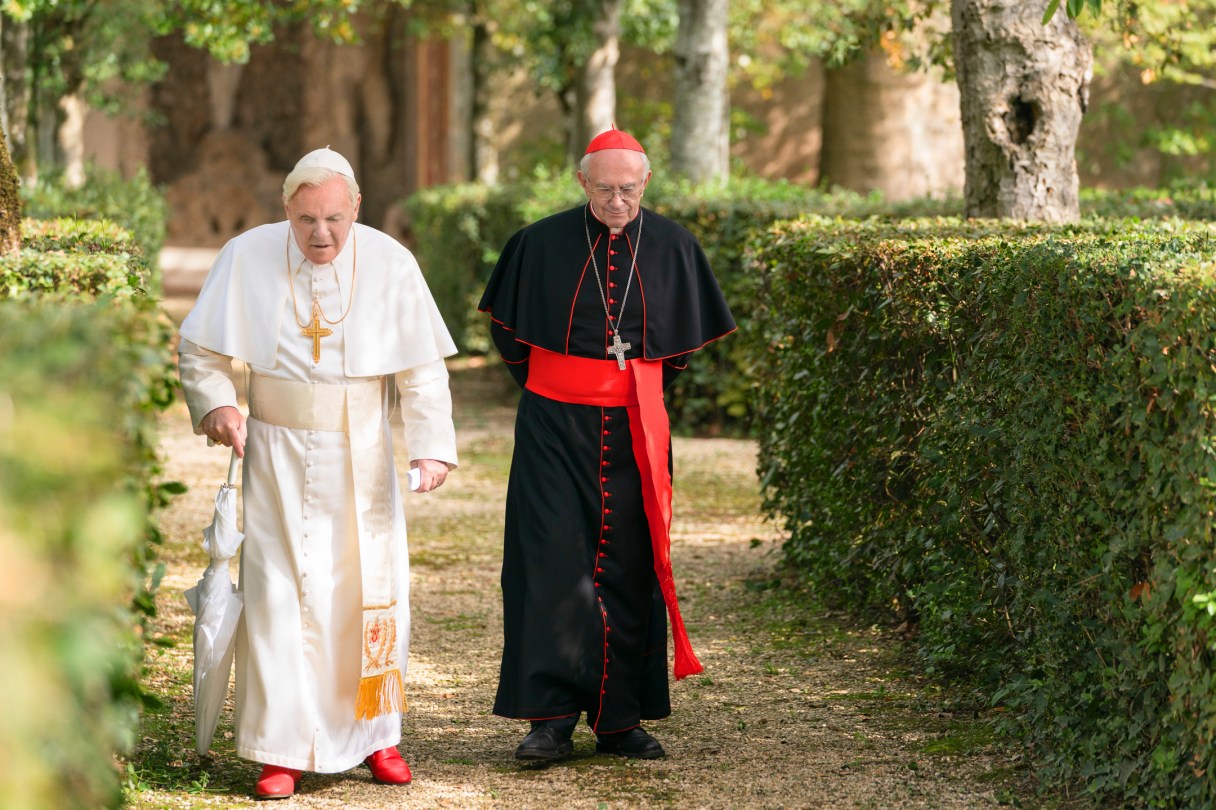
Believers of all religions can agree on one thing: the Vatican is an unlikely place for a bromance.
The novelty of Fernando Meirelles’ “The Two Popes” is right there in its title. There has only been one leader of the Roman Catholic Church going back centuries except in trying times of, you know, schism. But Meirelles’ film, from a script by Anthony McCarten (“Darkest Hour,” “The Theory of Everything”) concerns a real moment in recent history during an unusual Vatican transition.
In 2013, Pope Benedict XVI, formerly Cardinal Joseph Ratzinger (played by Anthony Hopkins in the film), resigned from the papacy, the first to do so since the 15th century. “The Two Popes” takes place just before this momentous decision, as Pope Benedict is mulling it over. In the film, he summons the Argentinian Cardinal Jorge Bergoglio (Jonathan Pryce), his eventual successor as Pope Francis, from Buenos Aires to Rome for a tête-à-tête, or, if you will, a pope-à-pope.
The whole scenario is a work of imagination. There are few institutions with more private innerworkings than the Vatican. Usually, we get little more than a puff of white smoke. “The Two Popes” aims to go not just inside the Church but imagine a deep dialogue between the two pontiffs. “The Two Popes” is a fantasy of impossible intimacy.
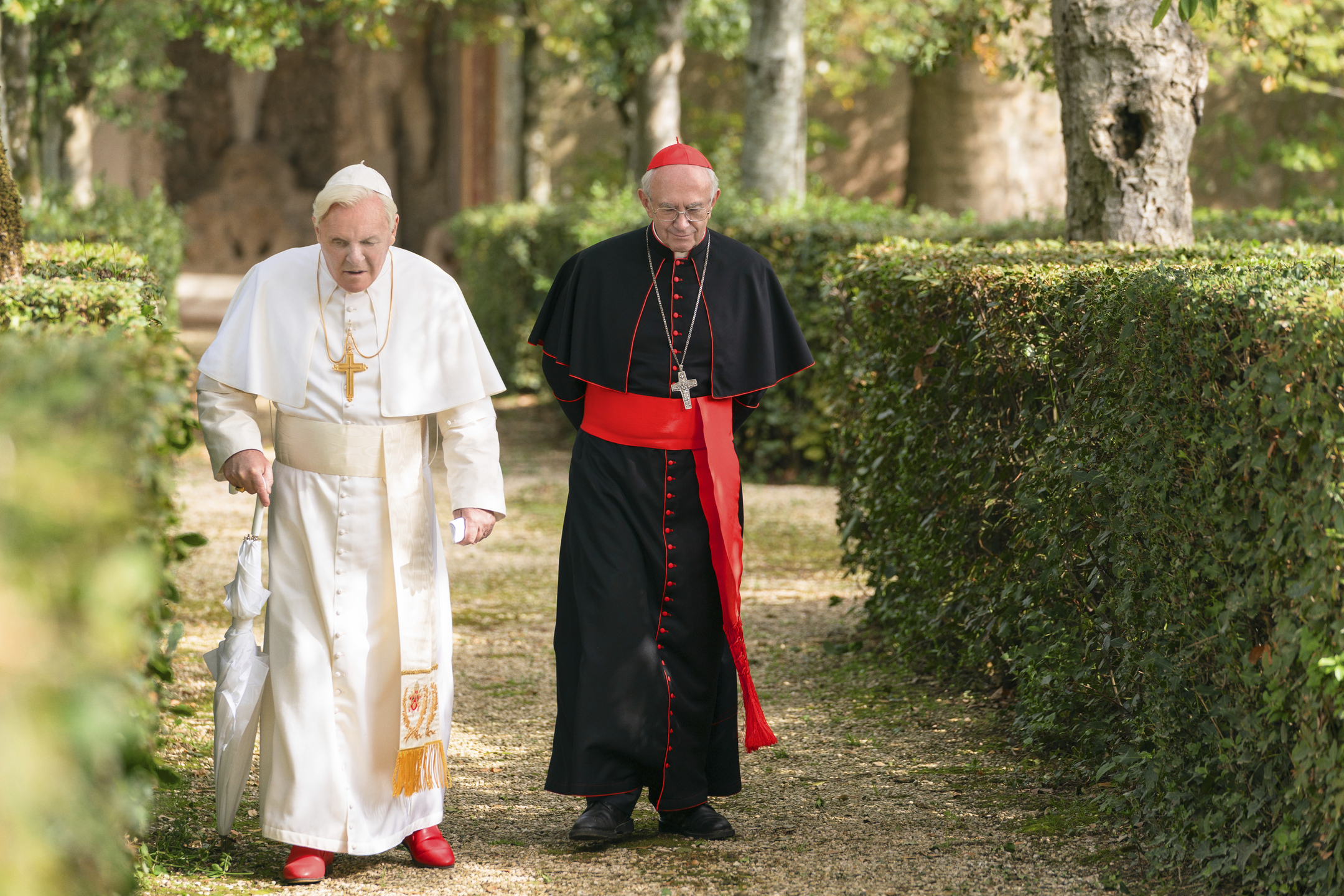 This image released by Netflix shows Jonathan Pryce as Cardinal Bergoglio, right, and Anthony Hopkins as Pope Benedict in a scene from “The Two Popes.” (Peter Mountain/Netflix via AP)
It’s also a riveting two-hander paced by two fabulous actors in ping-ponging conversation. They are opposites: Pope Benedict is a conservative, a German and a loner who eats dinner in solitude. Bergoglio is a reformer, an Argentine, an avid soccer watcher and, gasp, an ABBA listener. When they meet at the papal summer retreat, their conversation quickly turns into a theological volley on matters of sacrament, homosexuality and footwear.