
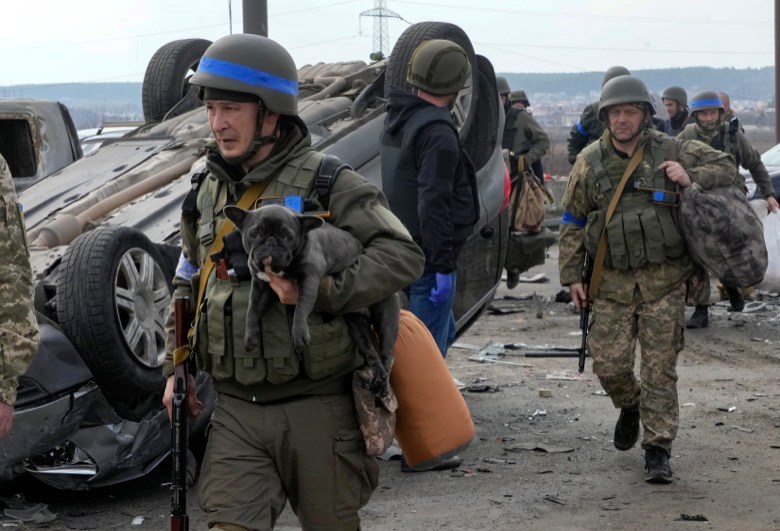
Almost six weeks into the war between Russia and Ukraine, I’m beginning to wonder if this conflict isn’t our first true world war – much more than World War I or World War II ever were. In this war, which I think of as “World War Wired,” virtually everyone on the planet can either observe the fighting at a granular level, participate in some way or be affected economically – no matter where they live.
While the battle on the ground that triggered World War Wired is ostensibly over who should control Ukraine, do not be fooled. This has quickly turned into “the big battle” between the two most dominant political systems in the world today: free-market, “rule-of-law democracy versus authoritarian kleptocracy,” the Swedish expert on the Russian economy, Anders Aslund, remarked to me.
Though this war is far from over, and Vladimir Putin may still find a way to prevail and come out stronger, if he doesn’t, it could be a watershed in the conflict between democratic and undemocratic systems. It is worth recalling that World War II put an end to fascism, and the Cold War put an end to orthodox communism, eventually even in China. So, what happens on the streets of Kyiv, Mariupol and the Donbas region could influence political systems far beyond Ukraine and far into the future.
Indeed, other autocratic leaders, like China’s, are watching Russia carefully. They see its economy being weakened by Western sanctions; thousands of its young technologists fleeing to escape a government denying them access to the internet and credible news; and its inept army seemingly unable to gather, share and funnel accurate information to the top. Those leaders have to be asking themselves: “Holy cow – am I that vulnerable? Am I presiding over a similar house of cards?”
In World War I and World War II, no one had a smartphone or access to social networks through which to observe and participate in the war in nonkinetic ways. Indeed, a large chunk of the world’s population was still colonized and did not have the full freedom to express independent views, even if they had the technology. And many residing outside the war zones were extremely poor subsistence farmers, not the giant connected globalized and urbanized lower and middle classes of today’s wired world.
Now, between 3 billion and 4 billion people on the planet – almost half – have a smartphone. That’s not all.
Anyone with a smartphone and a credit card can aid strangers in Ukraine, through Airbnb, by just reserving a night at their home and not using it. Teenagers anywhere can create apps on Twitter to track Russian oligarchs and their yachts. And encrypted instant messaging app Telegram – which was invented by two Russian-born techie brothers as a tool to communicate outside the Kremlin’s earshot – “has emerged as the go-to place for unfiltered live war updates for both Ukrainian refugees and increasingly isolated Russians alike,” NPR reported. It’s run out of Dubai, United Arab Emirates!
Meanwhile, Ukraine’s government has been able to tap a whole new source of funding – raising more than $70 million worth of cryptocurrency donations from individuals around the world. And Tesla billionaire Elon Musk activated his SpaceX company’s satellite broadband service in Ukraine to provide high-speed internet after Russian tried to disconnect Ukraine from the world.
Such nongovernmental, super-empowered global players and platforms were not present in WWI or II.
But just as so many more people can affect this war, so, too, can more be affected by it. Russia and Ukraine are key suppliers of wheat and fertilizer. Thus a war between just two countries in Europe has spiked the price of food for Egyptians, Brazilians, Indians and Africans.
Russia is one of the world’s biggest exporters of natural gas, crude oil and the diesel fuel used by farm tractors, and rising pump prices from Minneapolis to Mexico to Mumbai are forcing farmers as far away as Argentina to ration tractor and fossil-fuel-rich fertilizer, adding to soaring world food prices.
There’s another unexpected financial globalization angle: Putin saved up over $600 billion in gold, foreign government bonds and foreign currency so he would have a cushion if he were sanctioned by the West. But, as is standard practice in today’s wired world, his government had deposited most of it in the banks of Western countries and China. All but China have frozen the Russian reserves, leaving Putin with about half his savings.
For all these reasons, leaders around the world who have drifted toward authoritarian capitalism or kleptocracy have to be worried.
To be sure, Ukraine’s democracy is frail, and the country has had its own serious issues with oligarchs and corruption. Kyiv’s burning aspiration, though, was not to join NATO but to join the European Union, and it was in the process of cleaning itself up to do just that.
That’s what really triggered this war. Putin was never going to let a Slavic Ukraine become a successful free-market democracy in the EU next door to his stagnating Slavic Russian kleptocracy. That is why he is trying to erase Ukraine.
But Putin, it turns out, had no clue what world he was living in, no clue about the frailties of his own system, no clue how much the whole free, democratic world could and would join the fight against him in Ukraine, and no clue, most of all, about how many people would be watching.
New York Times