
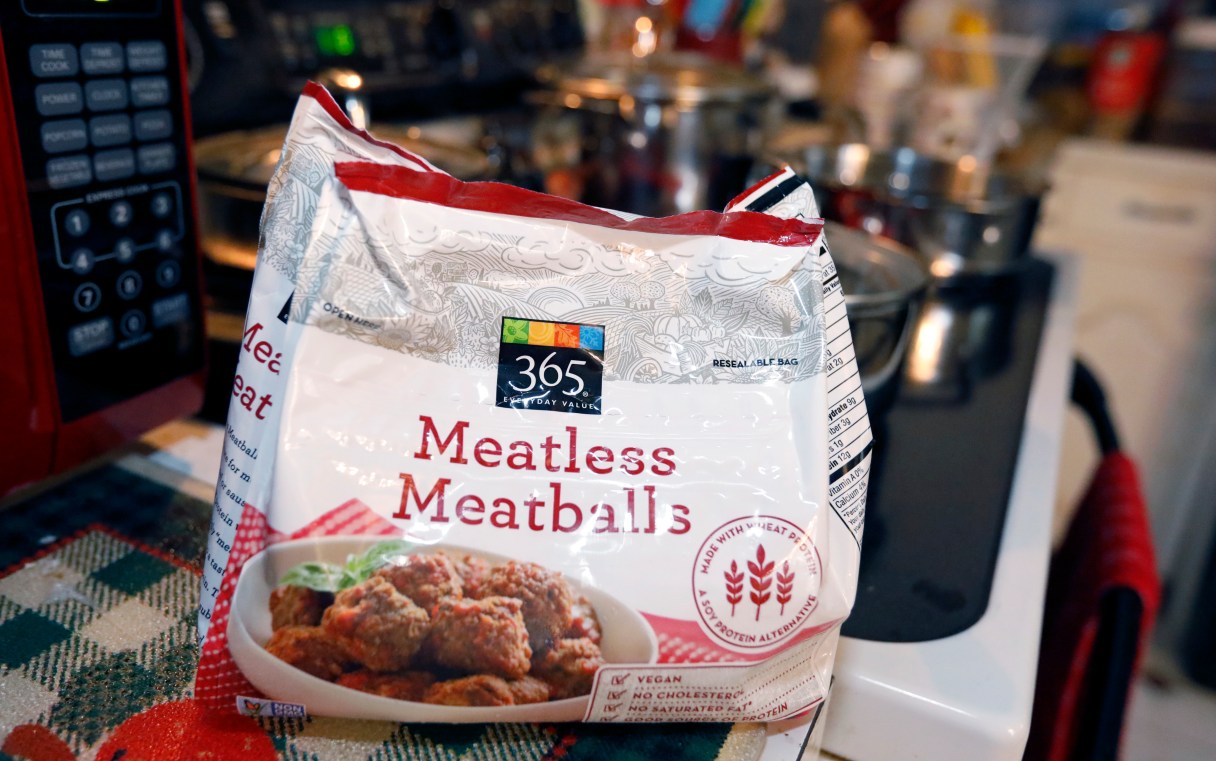
JACKSON, Miss. (AP) – A federal lawsuit says Mississippi is violating free-speech rights by banning makers of plant-based foods from using terms such as “meatless meatballs” and “vegan bacon.”
The lawsuit against Mississippi Republican Gov. Phil Bryant and the state’s Republican agriculture commissioner, Andy Gipson, was filed Monday by the Plant Based Foods Association and the Illinois-based Upton’s Naturals Co., which makes vegan products and sells them in many states, including Mississippi. It was filed the same day Mississippi enacted a new law that declares “a plant-based or insect-based food product shall not be labeled as meat or a meat food product.”
“The ban serves only to create consumer confusion where none previously existed,” says the lawsuit, which is backed by Institute for Justice, a free-market advocacy group based in Virginia.
A similar food labeling lawsuit was filed in Missouri last year by the Oregon-based Tofurky Co., which makes vegetarian food products, and the Good Food Institute, a Washington, D.C.-based nonprofit that advocates for alternatives to meat. A Missouri law made it a misdemeanor to label plant-based products as meat.
Producers of beef, poultry, pork and lamb have been pushing to protect meat terminology as companies develop more plant-based products that look and taste similar to meat.
The Good Food Institute says 12 states have enacted what it calls “meat label censorship” laws. In addition to Mississippi and Missouri, the states are Alabama, Arkansas, Kentucky, Louisiana, Montana, North Dakota, Oklahoma, South Carolina, South Dakota and Wyoming.
The Louisiana measure signed by Democratic Gov. John Bel Edwards prohibits veggie products from being called meat, non-rice products from being described as rice and sugar alternatives from being marketed as sugar. It becomes law in October 2020.
The chairman of the Mississippi Senate Agriculture Committee, Republican Billy Hudson of Hattiesburg, was chief sponsor of the meat labeling legislation. He said the state agriculture department and the Mississippi Cattlemen’s Association pushed for it because of concerns that consumers could be misled. The Mississippi law also says food produced using animal tissue cultured in a laboratory may not be labeled as meat.
“They tell me that fake steak looks just like our real meat,” Hudson told The Associated Press on Monday. He said if a consumer sees two similar products side by side, they could think they’re getting meat when they’re not.
“I don’t want to eat meat grown by a test tube in a laboratory,” Hudson said. “If my constituents do, they ought to know what they’re getting.”
Mississippi’s agriculture commissioner said Tuesday that he looks forward to defending the law.
“A food product made of insect-protein should not be deceptively labeled as beef,” Gipson said. “Someone looking to purchase tofu should not be tricked into buying lab-grown animal protein.”
The lawsuit in Mississippi says that Upton’s Naturals does not make meat products but does use terms such as “vegan burgers,” ”vegan bacon” and “vegan chorizo.”
“These terms, as used by Upton’s Naturals, increase consumer understanding of the foods’ characteristics and communicate how the foods should be prepared and eaten,” the lawsuit says.
The Plant Based Foods Association says in the lawsuit that “no reasonable consumer would be misled” by terms such as “meatless steaks” and “vegan jerky.”
Jessica Almy, policy director for the Good Food Institute, said the food labeling restrictions in Mississippi should be overturned: “This law is a tremendous overstep of state powers and is really just a sad attempt to censor veggie burgers.”
Airlines union in court fight
A leader of the union representing American Airlines mechanics said a lawsuit accusing its members of slowing down work “came as a shock” during testimony in federal court Monday.
Gary Peterson, a Transport Workers Union vice president based at DFW International Airport, said he and other union leaders tried to disprove accusations that they told members to slow down work and turn down overtime to increase pressure on American as the parties negotiate a new combined contract after four years of talks.
“No one from American Airlines reached out to us before this about a slowdown,” he said.
Lawyers and witnesses for American contend statistics since February show that a backlog of maintenance work can be pinned on illegal union collusion. They also keyed on signs and internet posts at various locations throughout the country earlier this year that American interpreted as a call to action for maintenance workers.
The world’s largest airline estimates as many as 88,000 customers have had flights delayed or canceled because of the alleged slowdowns.
U.S. mulls more tariffs on European products
The U.S. is considering tariffs on an additional $4 billion of goods from the European Union over what it considers to be illegal aircraft subsidies.
Whether it does so depends on the results of a World Trade Organization assessment of EU subsidies on large civil aircraft, specifically to Airbus.
The U.S. Trade Representative’s Office said it could target a further 89 sub-categories following an earlier list in April. The new items include cheeses, olives and coffee.
The USTR said it plans a public hearing in August on the proposed additional tariffs
Coal producer goes bankrupt
The CEO of one of the nation’s largest coal producers says he’s confident the company will bounce back despite the shutdown of several mines after it filed for federal bankruptcy protection.
Blackjewel LLC filed for Chapter 11 bankruptcy protection Monday in U.S. Bankruptcy Court for southern West Virginia. The company cited at least $500 million owed in liabilities.
Blackjewel follows other major U.S. coal producers that have filed for bankruptcy protection in recent years, including Englewood, Colorado-based Westmoreland Coal Co. in October and Gillette, Wyoming-based Cloud Peak Energy in May.
St. Louis-based Peabody Energy Corp. emerged from bankruptcy protection in 2017 and both St. Louis-based Arch Coal and Bristol, Virginia-based Alpha Natural Resources emerged in 2016.
“The entire industry either has gone through, or is currently going through, a period of financial distress and reorganization,” Blackjewel CEO Jeff Hoops said in a court filing. “We are confident that this restructuring will solidify Blackjewel’s position as a significant participant in the (U.S.) coal market,” Hoops said in a separate statement.
Blackjewel has about 1,100 employees in its eastern division at mines in Kentucky, Virginia and West Virginia. It also operates two mines with about 600 workers in northeast Wyoming.