
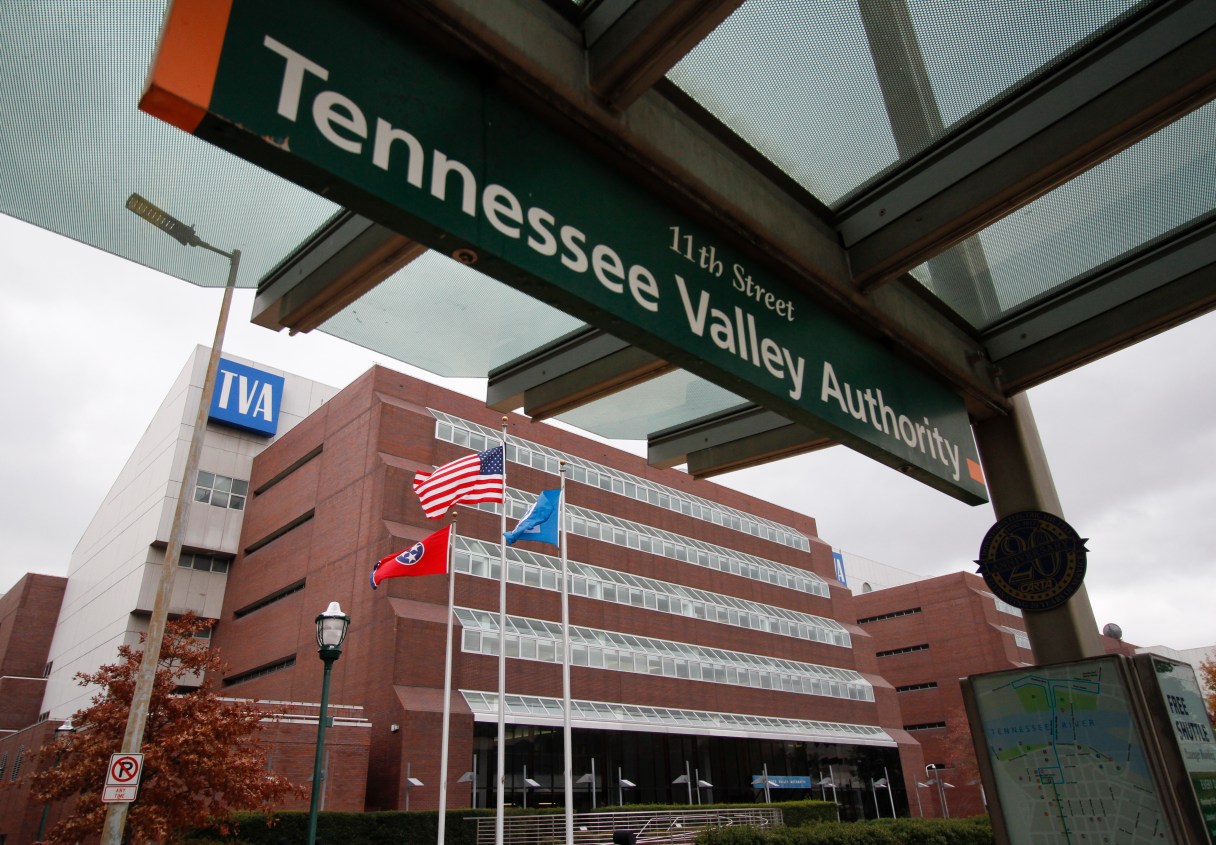
 Tennessee Valley Authority’s downtown facility is seen on Monday.
Draft Power Plan
The draft power plan is available here.
America’s biggest government-owned electric utility will use more natural gas, rather than coal or nuclear power to meet its future power demand.
In a draft strategic plan for the next 20 to 30 years, the Tennessee Valley Authority said today it envisions building or buying more natural gas-fired power generation, but does not plan new nuclear or coal power plants beyond those already being built.
The preliminary Integrated Resource Plan recommendation released today anticipates slower growth in power demand in the next two decades than what TVA has historically enjoyed in the first 82 years of its existence.
The 20-year power plan looks at a variety of economic and power demand scenarios, but all envision more use of natural gas generation, which has become much cheaper as fracking and other drilling technologies have boosted gas supplies and lowered the price of natural gas. None of the scenarios call for any more nuclear power generation in the next 20 years after TVA completes its second reactor at the Watts Bar Nuclear Plant, which is scheduled to come on line by the end of 2015.
TVA says the Integrated Resource Plan will be a map for its power future, but any specific decisions must still be made by management and the board. The new power plan updates the last TVA integrated resource plan completed in 2011.
“Scenario planning is useful for determining how various business decisions will perform in an uncertain future,” said Joe Hoagland, vice president of TVA stakeholder relations. “The goal is to develop scenarios that allow TVA to dynamically respond to market conditions and perform well regardless of how the future unfolds.”
The new power plan examines five main scenarios for the future, ranging from no power growth and more regulations on carbon emissions to more rapid economic growth and power demand growing somewhat faster than the current 1 percent annual pace.
Those scenarios were then used to assess strategies that variously focus on an emphasis on air pollution emission reductions, a reliance on market-supplied resources, a focus on maximizing energy efficiency and an emphasis on maximizing renewable energy.
The plan will still be reviewed and the public will have a chance to comment on the findings before TVA directors vote on the plan in August. But TVA said the draft does contain some preliminary observations:
* There is a need for new power generating capacity in every scenario. Even without more load growth, some generation will be needed to replace coal-fired plants that are being phase out by TVA.
* New natural gas capacity is needed in every scenario; as early as 2020 in some cases.
* There is no immediate need for new nuclear or coal-fired baseload generation beyond the completion of Watts Bar Unit 2 and power upgrades or “uprates” being evaluated for Browns Ferry Nuclear station.
Under development since the fall of 2013, TVA’s newest plan is a roadmap to 2033.