
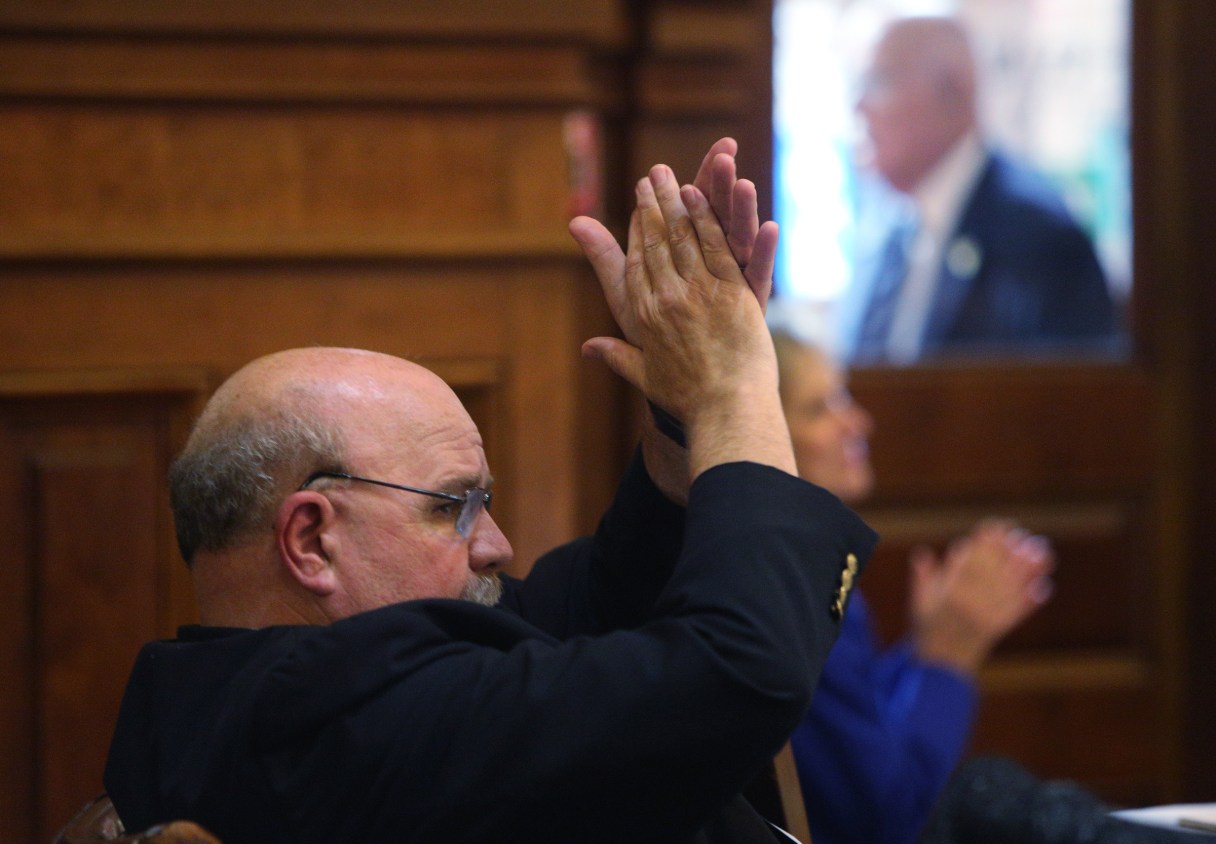
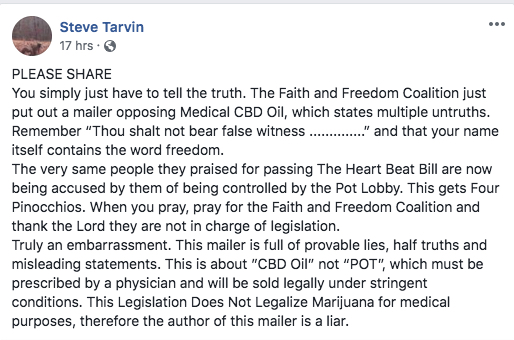

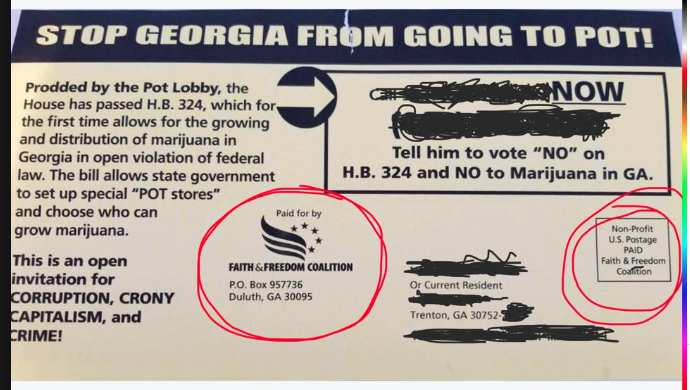
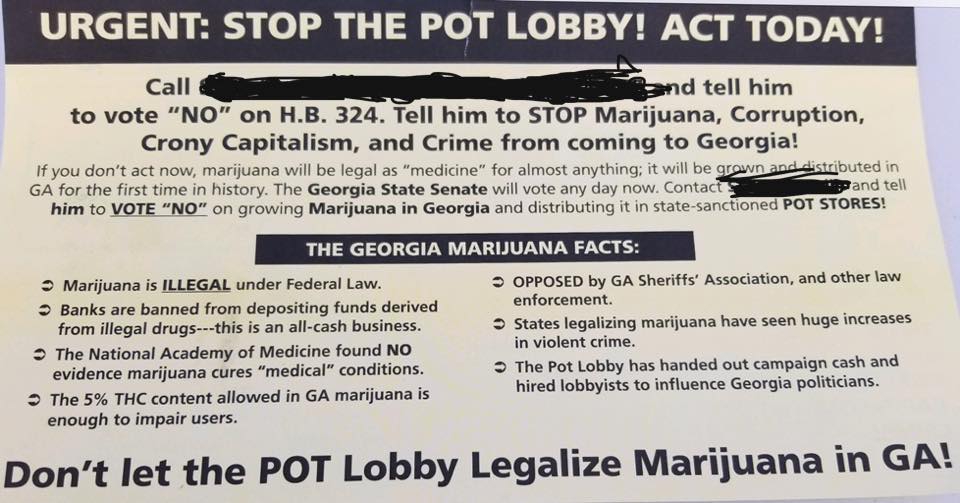
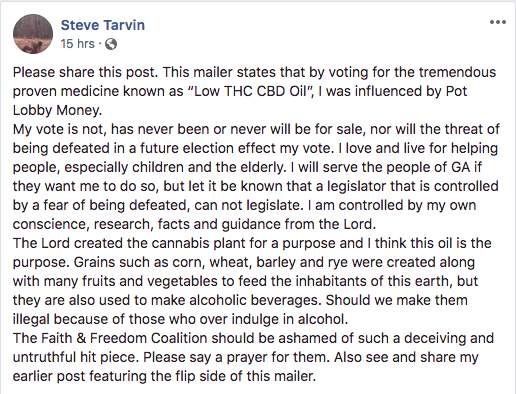
State Rep. Steve Tarvin said the Faith and Freedom Coalition is lying to residents about Georgia’s pending medical marijuana legislation.
The coalition accused the “Pot Lobby” of influencing lawmakers with campaign donations. In a postcard distributed to about 150,000 residents, the coalition said the law change is an “open invitation for CORRUPTION, CRONY CAPITALISM and CRIME!”
How North Georgia voted on HB 324
State Rep. Colton Moore, R-Trenton: YesState Rep. Dewayne Hill, R-Ringgold: YesState Rep. Steve Tarvin, R-Chickamauga: YesState Rep. Kasey Carpenter, R-Dalton: YesState Rep. Matt Barton, R-Calhoun: NoState Rep. Jason Ridley, R-Chatsworth: Yes
In a Facebook post Saturday, Tarvin call the mailer a “hit piece.”
“The Lord created the cannabis plant for a reason, and I think this oil is the purpose,” wrote Tarvin, R-Chickamauga. “Grains such as corn, wheat, barley and rye were created along with many fruits and vegetables to feed the inhabitants of the earth, but they are also used to make alcoholic beverages. Should we make them illegal because of those who over indulge in alcohol[?]”
He added: “When you pray, pray for the Faith and Freedom Coalition and thank the Lord they are not in charge of legislation. Truly an embarrassment.”
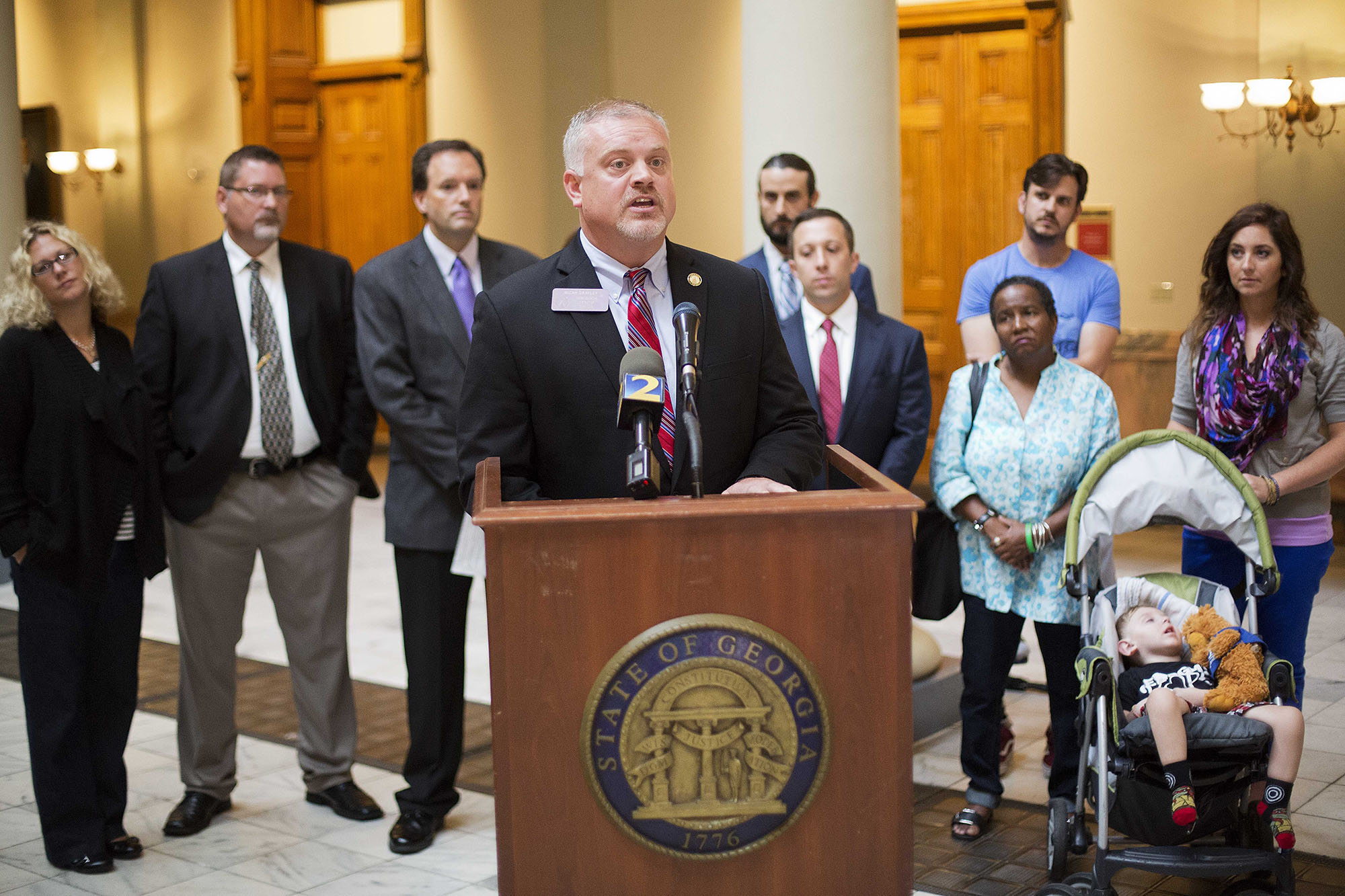
The bill’s sponsor, state Rep. Micah Gravley, has argued the legislation is necessary to provide relief to patients with serious medical issues. THC, the psychoactive component of marijuana, can treat severe nausea. As it stands, patients who qualify for medical marijuana in Georgia have no legal method for obtaining the drug.
“This is deception in full view,” Gravley, R-Douglasville, wrote of the postcard on Tarvin’s Facebook page. “They can be against it, but this mail piece is full of lies. Thank you Steve for helping to expose their untruths.”
Tarvin, who voted for Gravley’s bill March 5, did not return a call seeking comment this week. Virginia Galloway, the regional field director for the Faith and Freedom Coalition in Georgia, defended the mailer. It calls for residents to contact their lawmakers and advocate against the bill.
“Our postcard is factual,” she said. “They may not like it. But it’s factual.”
The General Assembly legalized medical marijuana in Georgia in 2015 for people suffering from eight different conditions. Subsequent laws have expanded the number of qualifying conditions to 16. The drug is available to treat seizures, cancer, peripheral neuropathy, multiple sclerosis, autism spectrum disorder and Crohn’s disease.
To watch:
In addition to Micah Gravley’s bill on marijuana distribution, the state Senate passed a bill legalizing hemp farming in Georgia on Tuesday, 45-6. The bill already passed the House in February. Hemp is a form of the cannabis plant that can be used to form cannabidiol (CBD). The bill is in the Senate Agriculture and Consumer Affairs Committee.
For patients to become eligible, doctors must diagnose them with a qualifying condition. Patients then need to apply for a registration card with the Georgia Department of Public Health. As of Tuesday, 9,303 Georgia residents have received the cards, though the state is approving people at a rate of about 300 per month.
The 2015 law was fundamentally flawed, Gravley said. The bill allowed patients to possess up to 20 fluid ounces of oil, as long as the oil contains less than 5 percent THC. However, the law did not provide any means to legally get the drug.
Gravley’s bill opens the door for marijuana growth and distribution. The legislation allows for 50 retail shops and allows for large-scale distribution.
The biggest players would be companies that receive Class 1 Production licenses from a 12-member oversight board, appointed by the heads of several state agencies. To apply, a company has to show it has at least $10 million in cash reserves. It also has to pay $150,000 up front – including $50,000 the company would not get back if the board rejected the application.
If it received the license, the company would have to pay $50,000 every year to renew. The holder of a Class 1 Production License can grow unlimited cannabis and hemp, manufacture it into oil and operate up to five of its own shops. The oversight board will reward up to five of these licenses.
The House passed Gravley’s bill on March 5, 123-40. The Senate Regulated Industries and Utilities Committee held a hearing on the bill Tuesday but did not take action. The committee was scheduled to meet and vote on the legislation at 2 p.m. Wednesday.
In addition to the Faith and Freedom Coalition, other opponents include National Families in Action, the Georgia Baptist Mission Board and the Georgia Sheriff’s Association. During a March 4 news conference, a collection of North Georgia sheriffs told local media outlets that Gravley’s bill did not provide for enough oversight of distributors. Gravley told the Times Free Press the news conference was “ridiculous,” pointing out that law requires distributors to maintain thorough logs and work with the Georgia Bureau of Investigation.
Galloway argued the bill will eventually lead to legalized, recreational marijuana use. She said the major investment for a Class 1 Production License doesn’t make sense when only about 8,400 patients are eligible for the drug.
“For them to say we’re not on a slippery slope – well, their actions belie their words,” Galloway told the Times Free Press.
She defended the mailer that Tarvin objected to, arguing that even low-THC oil will have an impact.
“They’re acting like it won’t get you high,” she said. “That is false. Unless you have built up a tolerance to THC, you will get high. And in children, it will be worse.”
Dr. Peter Grinspoon, a primary care physician who teaches at Harvard Medical School and has written a memoir about his own struggles with addiction, said Galloway is telling the truth – but missing the point. Conversations about THC percentage are “arbitrary and silly,” he said. He compared the regulations to limiting the alcohol content of a beer. You can still get drunk, if you consume enough Bud Lights.
In the 1970s, people often smoked marijuana with THC contents between 3 and 5 percent. Today, consumers buy strains with THC levels of 15-20 percent. The thing is, people usually smoked an entire joint in one sitting back then. As marijuana became stronger, Grinspoon said, consumers more frequently settled with only a couple of puffs. It got them to the same place.
Without medical marijuana, Grinspoon argued, parents may turn to other drugs, perhaps less effective or more dangerous, to treat their children’s pain. He pointed out that doctors are less likely to prescribe opioids than they used to be, further limiting pain treatment.
“Superficially, 5 percent THC could get you high,” he said. “But in the bigger picture, that’s completely irrelevant to any discussion of medical marijuana. THC helps a child with cancer who is dying. Whether they get high is the least of your concerns.”
Contact staff writer Tyler Jett at 423-757-6476 or tjett@timesfreepress.com. Follow him on Twitter @LetsJett.