

It’s a rite of fall: the annual recruitment week for college sororities and fraternities, known as rush to old-school alumni.
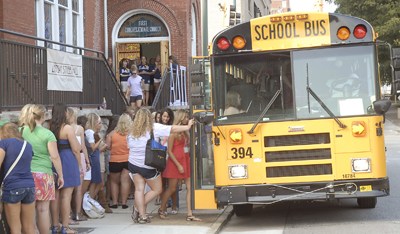
For the first time, big yellow school buses rolled through the University of Tennessee at Chattanooga campus last week shuttling a record 370 young women through nightly rounds of sorority recruitment parties. The buses are one sign of a trend affecting UTC’s student life: Increasing numbers of collegians signing up to join fraternities and sororities.
Officials speculate that the rise coincides with a general surge in college enrollment.
“This is the fourth consecutive year that our recruitment registration has reached more than 300,” said UTC Panhellenic Council president Patti Phillips.
Greek advisers around the region say their campuses are experiencing similar growth. Nicki Meneley, executive director of the National Panhellenic Conference headquartered in Indianapolis, Ind., said it’s a trend being reported nationwide.
“I attribute this to a lot more young women going to college and that they still find the sorority experience to be viable and worthwhile,” Meneley said.
UTC Greek Councils
UTC Greek organizations are governed by three councils on campus: Interfraternity Council, National Panhellenic Conference and the National Pan-Hellenic Council Inc.
All have thriving memberships. NPHC fraternities and sororities traditionally hold new-member intake later in the fall.
Sara Jahansouz, assistant dean of students at UTC, said registration for IFC recruitment increased by 80 students last week over 2009, with 200 men registered.
As recruitment week progresses, chapters and prospective new members narrow their choices for membership. Midway through the week, the number of remaining students in recruitment is divided by the number of sorority or fraternity chapters on campus to set quota, which is the number to whom one chapter may extend bids.
“The ideal new member group is around 35 women,” said Phillips, “and when organizations are extending bids to 60 women several years consecutively, it’s obvious that another group would benefit our campus.”
Last spring, UTC added a fifth NPC sorority to its campus, Delta Zeta. DZ participated in the first round of last week’s recruitment with an information party in the Mayor’s Mansion bed and breakfast inn.
Jahansouz said Delta Zeta will conduct its own formal recruitment process following Labor Day.
A new fraternity, UTC’s ninth, was also added in the spring: Delta Upsilon, which started with 24 members, according to its president Leighton Fuqua.
Fraternities and sororities are outpacing available accommodations.
Jahansouz said fraternities and sororities that do not have housing use the University Center, local churches and community centers for recruitment parties.
Kappa Delta Sorority, with its house near completion on the 10th Street Greek Row, pitched a huge white tent on the lot next door for its parties.
Alpha Delta Pi Sorority, which sold its former house to the university but hasn’t broken ground on its new house, rented Lindsay Street Hall for the week.
Chi Omega and Sigma Kappa sororities both have chapter houses in the Fort Wood neighborhood. Sigma Kappa is already in its second house since colonizing at UTC in 1991.
CAUSES OF GROWTH
Greek advisers at regional universities attribute Greek growth to two factors: annually increasing numbers in freshmen classes and more students using Hope scholarships to help pay tuition which allows them more disposable cash.
“The UTC fraternity and sorority community continues to grow as our undergraduate student body grows,” said Jahansouz.
“Students come to college now with experience in community service and leadership and they want to continue that,” said Carrie Youell, Panhellenic Affairs adviser at UTK.
“Greek life gives them the opportunity to do that plus it focuses on meaningful relationships through sisterhood,” Youell said. “We have more than 2,000 women in UT’s sorority community alone.”
“If women are choosing to stay in-state to go to college, they may have more access to extracurriculars. Women who have a Hope scholarship have some of their tuition paid, so they have money for sorority life,” said Megan Janasiewicz, Panhellenic adviser at the University of Georgia.
LIFELONG FRIENDSHIPS
Delta Upsilon president Fuqua said he never went through recruitment before the end of his sophomore year “because I never really felt like I fit in a fraternity until I was recruited by Delta Upsilon.
“I liked that diversity is big in DU. We have a lot of guys who probably wouldn’t hang out together until they came together in DU. Then we all just clicked,” he said.
Fuqua attributes UTC’s Greek growth to the number of commuting students.
“A lot of people commute and Greeks are just trying to make sure people get as involved on campus as much as they can. Greek life opens a lot of doors,” said Fuqua.
“The friendships made in Greek life are unlike any other,” added IFC president Adam Higgs.
“Our alumni always say ‘The men you pledge with are the ones who will be with you when you’re married and when you’re buried.'”