
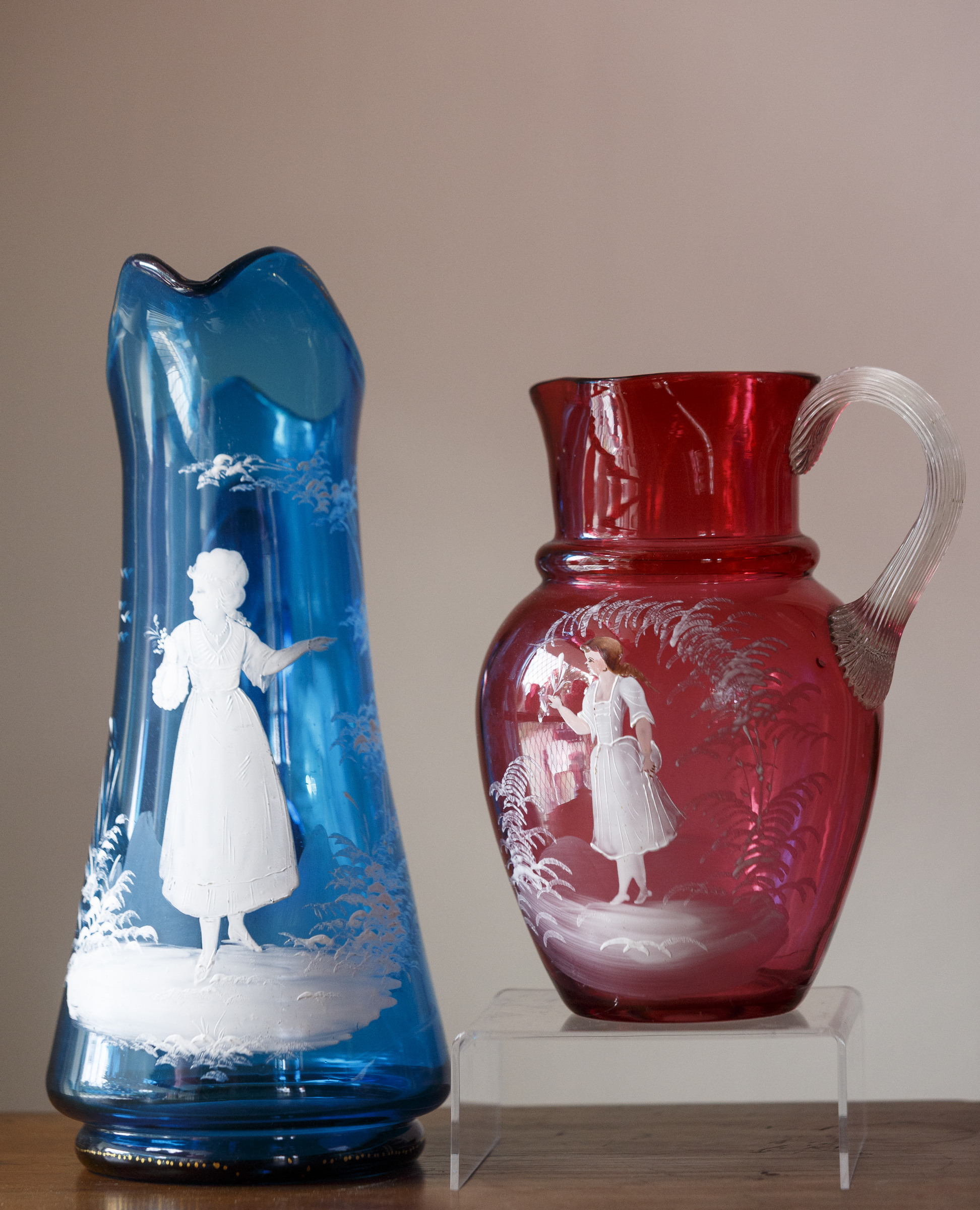
 Mary Gregory glass is easily recognizable for its scenes of Victorian children and landscapes painted in white on jewel-toned glass.
More Info
If you go› What: Here’s Looking at You exhibit, through July 30› Where: Houston Museum of Decorative Arts, 201 High St.› Museum hours: Noon-4 p.m. Wednesdays-Saturday & first Sunday of the month› Information: 267-7176 or thehoustonmuseum.org› Admission: $9 adults, $5 college students with ID, $3.50 ages 4-17› For more information: 423-267-7176
Amy Autenreith was searching for pieces in the storage rooms of the Houston Museum of Decorative Arts when she had the sensation that she was being watched.
“I felt like there was a set of eyes on me. I looked and there really was,” says Autenreith, executive director of the museum. “It was the bust of a young girl looking over her shoulder toward me.
“I got to noticing that, every time I went into storage, there were a lot of faces – much more than I could even bring up for one exhibit.”
So she has handpicked some of the most interesting pieces for the Houston’s latest exhibit, “Here’s Looking at You.” It’s an interesting collection of faces incorporated into the designs of pitchers, ink wells, shaving mugs, marmalade jars, glassware, ceramic busts, dolls, humidors, even a German music box that dates to the late 1800s.
“These are all pieces typically kept in storage,” Autenreith says. “I think it’s important to get them out and let people see them, and talk about things that don’t get to be on permanent display.”
In the exhibit, a corner hutch holds a display of two dozen pitchers with faces representing celebrities of their day – Napoleon Bonaparte, George Washington, William McKinley – as well as a midwife and highwayman.
In addition to giving these pieces some facetime, the exhibit includes a display of Mary Gregory glass, which is easily recognizable for its scenes of Victorian children and landscapes painted in white on jewel-toned glass.
Gregory worked for the Boston & Sandwich Glass Co. as a glass decorator from 1880 to 1884. Legend has it that she created a line of glass featuring handpainted scenes of Victorian children at play. Using a white enamel paint containing ground glass as a mixture, the art was applied to the glasses then fired, with an additional firing after each layer of the white-on-white buildup.
However, extensive research after her death in 1908 revealed that the decoration known as Mary Gregory was not produced in this country before 1957, according to antiquelegacies.com. It is believed to have started in the mid-19th century in Europe. Even so, the Mary Gregory name stuck and the beautiful style of handpainted glass remains popular today.
The value of Mary Gregory glass is affected by the color of the glass. Colors ranked by antiquelegacies.com from least expensive to most expensive are: clear, clear with amethyst, dark green, light green, amber, light blue, turquoise, cobalt blue, ruby or cranberry. Extremely rare pieces are champagne- or amethyst-colored glass.
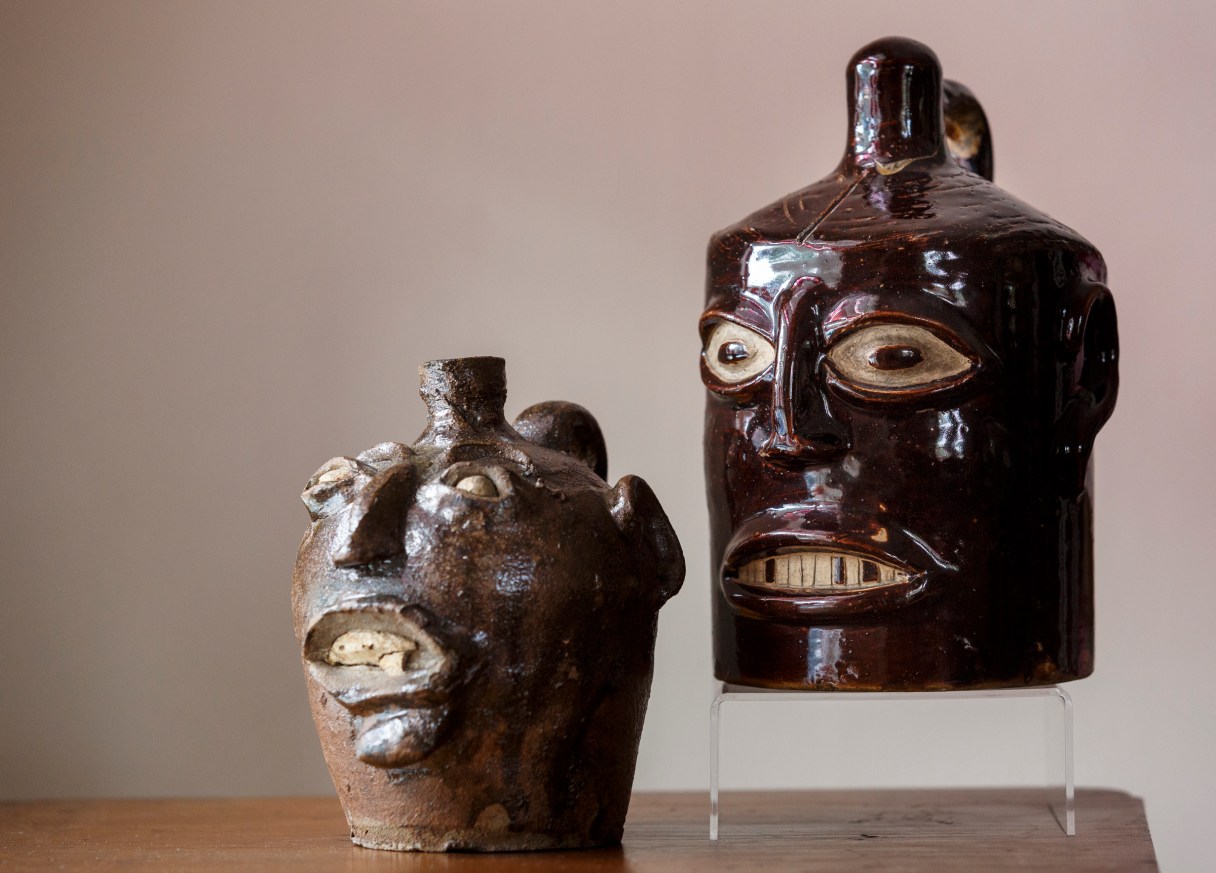
Two of the most interesting pieces of the “Here’s Looking at You” exhibit are representations of face jugs made in the early 1900s. One is a 1916 bank with a face signed by its maker, Abe Thomas; the other is a small clay face jug made in Edgefield, S.C. Primitive pottery pieces, face jugs were made by slaves who were transported to the United States from Africa and the Caribbean.
“Slaves were not allowed to read or write. They were also not allowed headstones at their burials,” says Autenreith. “So clay faces were made to place as headstones. They were designed with grotesque, scary expressions to scare away evil spirits from the grave site.”
Some of the jugs were designed with openings in which personal items of the deceased, mystic symbols and other forms of protection could be placed, she says.
Contact Susan Pierce at spierce@timesfreepress.com or 423-757-6284.