
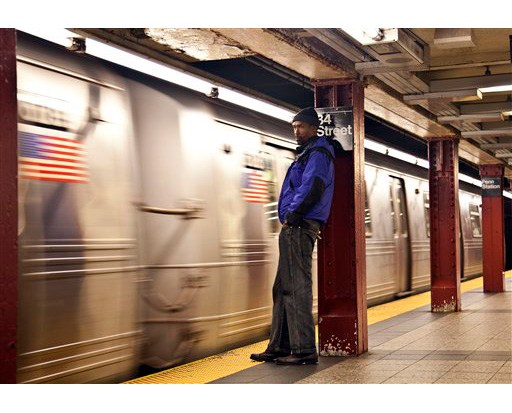
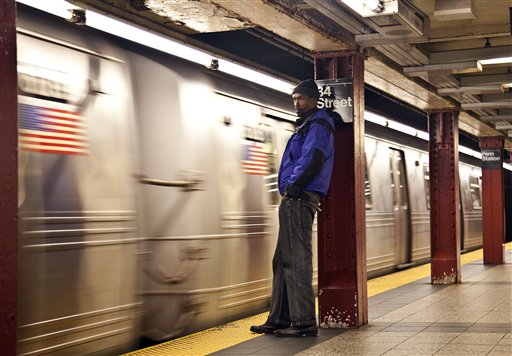
 A commuter waits as the first A train approaches the platform at Penn Station as MTA resumed limited service Thursday, Nov. 1, 2012, in New York. The decision to reopen undamaged parts of the nation’s largest transit system came as the region struggles to restore other basic services to recover from a storm that ravaged the East Coast, killing more than 70 people and leaving millions powerless.
NEW YORK – Subways started running again in much of New York City on Thursday for the first time since Superstorm Sandy, but traffic at bridges backed up for miles, long lines formed at gas stations, and big crowds waited impatiently for buses.
The trains couldn’t take some New Yorkers where they needed to go. There was no service in downtown Manhattan and other hard-hit parts of the city, and people had to switch to buses. But some of those who did use the subway were grateful.
“It’s the lifeline of the city. It can’t get much better than this,” said Ronnie Abraham, who was waiting at Penn Station for a subway train to Harlem, a trip that takes 20 minutes underground but 2 1/2 hours on the city’s badly overcrowded buses.
Three days after Sandy slammed the mid-Atlantic and the Northeast, New York and New Jersey struggled to get back on their feet, the U.S. death toll climbed to more than 80, and more than 4.6 million homes and businesses were still without power.
The total damage from Superstorm Sandy could run as high as $50 billion, according to the forecasting firm Eqecat. That would make it the second-costliest storm in U.S. history after Hurricane Katrina. The estimate include property damage and lost business