
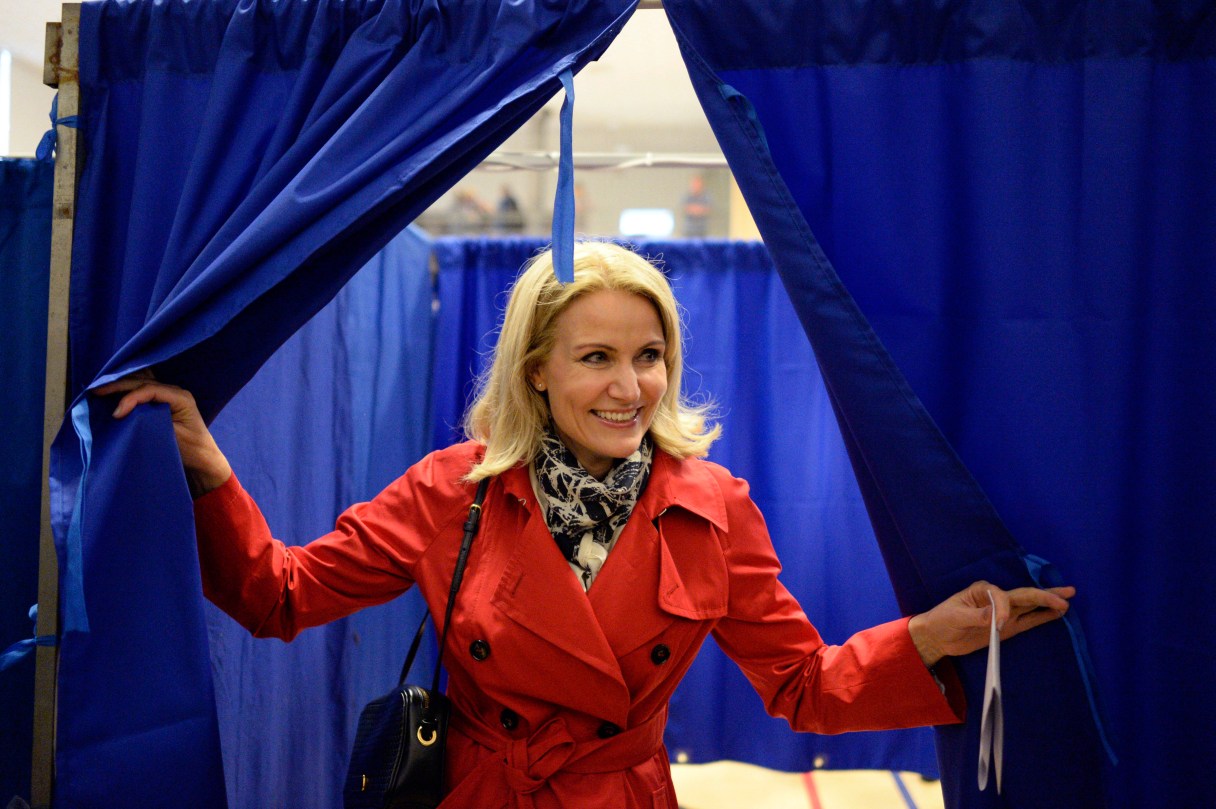
COPENHAGEN, Denmark (AP) – Danes voted Thursday in a parliamentary election that will determine whether Prime Minister Helle Thorning-Schmidt’s center-left government can continue or whether the center-right opposition will be back at the helm.
Both Thorning-Schmidt’s Social Democrats and opposition leader Lars Loekke Rasmussen’s Liberals will depend on other parties to build a majority in the 179-seat Folketing, or parliament.
Ahead of the vote, polls showed the two blocs neck and neck, with campaigns focusing on immigration and welfare spending, among other issues.
In a voting day poll in the Politiken newspaper and on the TV2 channel, the government side was expected to get 49.1 percent and the opposition 50.1 percent. Pollster Megafon said some 1,800 interviews were carried out Wednesday and the margin of error was 3 percentage points.
Some 4.1 million Danes were eligible to choose among 10 parties and 799 candidates. In addition to the 175 seats decided by voters in Denmark, the semi-autonomous territories of the Faeroe Islands and Greenland get two seats each.
If the vote is close, those four seats could swing a result in favor of either Thorning-Schmidt or Loekke Rasmussen. Currently the government bloc has three of the four seats.
Both Thorning-Schmidt and Loekke Rasmussen have promised to further tighten Denmark’s controls on immigration.
Loekke Rasmussen, a former prime minister, needs support from the populist Danish People’s Party, which wants to reintroduce border controls to prevent criminals from entering Denmark.
“I want an open Denmark but I also want a Denmark that is efficiently shut for people who don’t want our country,” he told reporters as he voted Thursday.
Thorning-Schmidt, a prime minister since 2011, emphasized Denmark’s economic growth in recent years. She was accompanied by her husband, Stephen Kinnock, who was elected to the British Parliament for the Labour Party in Aberavon last month.
“That road we have steered Denmark onto, where we have a grip on the economy, where there is money for the welfare, if that is the way you want to take, then you must vote for the Social Democrats,” she said.
Thorning-Schmidt has pledged to raise welfare spending by 39 billion kroner ($5.7 billion), while the opposition says improvements can be achieved without expanding the public sector.
Candidates were campaigning until the very end, handing out leaflets, flowers, balloons and sweets to voters in this Scandinavian country of 5.6 million. According to pollsters, up to 20 percent of Danish voters had not made up their minds before the election.