
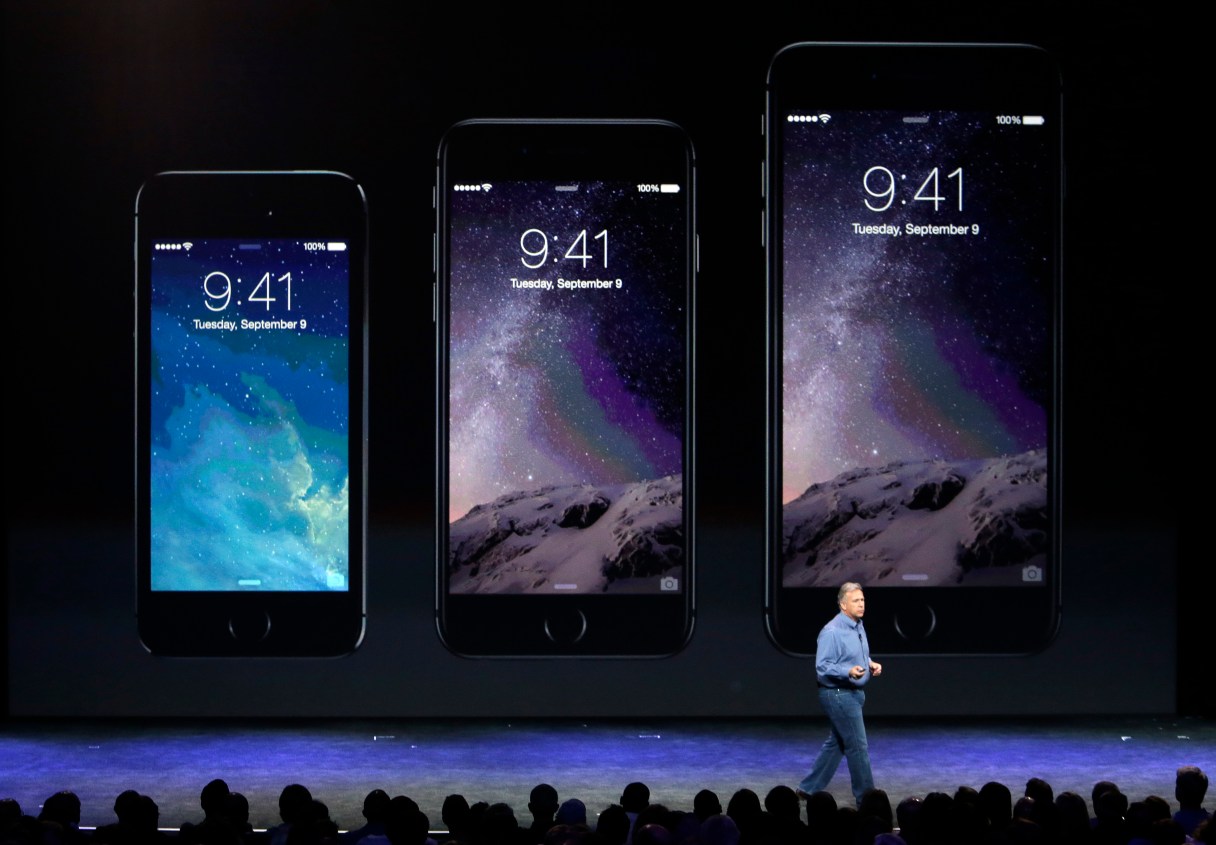
 Phil Schiller, Apple’s senior vice president of worldwide product marketing, discusses the new iPhone 6, center, and iPhone 6 plus, right, on Tuesday, Sept. 9, 2014, in Cupertino, Calif.
Last Tuesday, Apple pulled back the curtain on its latest-generation mobile phone, the iPhone 6, and its much-anticipated – if confusingly named – Apple (symbol) Watch.
Like a lot of people, I spent months leading up to the unveiling tracking rumors about these devices and wondering what Apple would deliver. Would the phone have a nigh-unscratchable sapphire screen? Would it be bigger? Could Apple turn the smartwatch into a mainstream device? (In case you’re curious, the answers are no, yes and remains to be seen.)
After its launch Friday, the iPhone 6 is expected to sell a record 10 million units during its first weekend, but its announcement wasn’t universally met by consumers jovially bouncing on their toes and scrambling for their wallets. Apple also inspired a lot of grumbling from owners of “older” – and I’m using that term exceptionally loosely – devices.
Because of the rapidity with which new models are released, consumers have been trained to treat annual and biannual technology upgrades as necessities, even if the actual advancements often are measured in terms that, if you stop to think about it, are ridiculously minuscule.
Take thickness for example. The iPhone 6 is 6.9 millimeters thin. That’s astonishingly svelte, but the iPhone 5S was not exactly husky at 7.6 millimeters, and it was released less than a year ago. Yet a difference equivalent to half the height of a penny apparently was important enough to bring up during a high-profile announcement? Please.