
From the time John Evans was a little boy he has loved all things related to plants.
“One of my earliest memories was being on my hands and knees in my grandmother’s garden trying to figure out how plants work,” he said. “I was already thinking about hybridization at that age, wondering what would happen if I could mix this plant with that plant.”
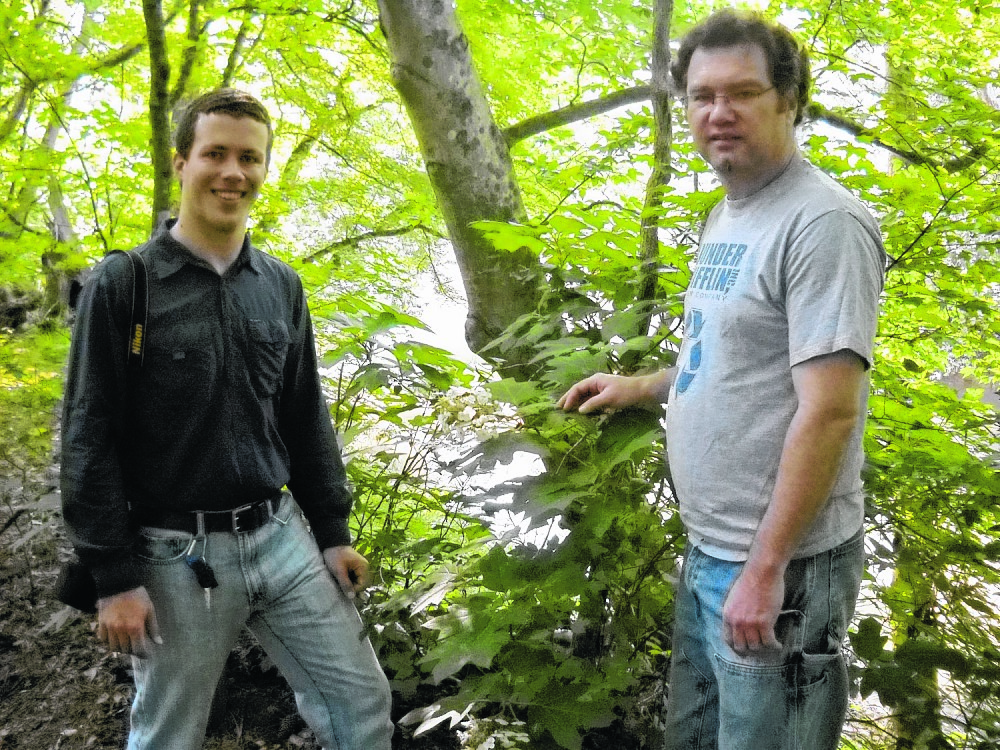 Audubon Acres land manager Kyle Simpson, left, and volunteer John Evans showcase a White Oak Hydrangea growing on the East Brainerd property. Evans, who is an expert in botany, plans to send in a sample of the plant to the University of Tennessee at Knoxville because it has never been documented in Hamilton County.
Now with an undergraduate degree in evolutionary biology and ecology and a graduate degree in environmental science, the Brainerd resident and Audubon Acres volunteer combines his passion for plants and his vast knowledge into programs and services for the land sanctuary.
He will be leading plant walks through Audubon Acres, located at 900 N. Sanctuary Road in East Brainerd, the second Saturday of each month at 2 p.m.
“During the walks I plan to point out native plants that are of significance for wildlife and show the kinds of plants that would make good garden plants,” he said.
One of the things Evans said he is most passionate about is maintaining biodiversity at Audubon Acres and other local areas by controlling invasive exotic plants. For instance, in the Chattanooga area there is a lot of Chinese privet, a plant that is not native and is so dominant that it often chokes out other native plants that provide important food sources to local wildlife and give the region its unique character.
According to Evans and Audubon Acres land manager Kyle Simpson, losing plant biodiversity is bad for the region’s ecosystems, but especially bad for Audubon Acres since it was designed as a land and wildlife preserve.
“We need different species of plants to provide our wildlife species food sources,” said Simpson. “If native plants are all gone and not providing food for the wildlife throughout all the seasons of the year, we can have a real problem.”
To help encourage more biodiversity Evans is working with Simpson to plant native plants that provide a food source for the animals and also help achieve other purposes. For instance, the wild roses Evans has been growing have large thorns which will deter people from walking through them.
“Today we’re going to plant them in a spot where we’ve had some neighbors hopping over the fence and visiting,” said Simpson. “We are strategically planting these roses to create a thicket.”
Through their partnership Evans and Simpson have also identified a species of plant otherwise undocumented in Hamilton County. They recently found White Oak Hydrangea on both Maclellan Island, which was gifted to the local Audubon Society as a wildlife preserve, and the Audubon Acres property in East Brainerd.
“It doesn’t officially exist according to the records,” said Evans of the plant. “Now we’ve got a sample to show that it does.”
He said he would love to help grow more native plants for Audubon Acres and is considering the idea of surveying all the plants on the two properties to see exactly what is growing in the area. He said he is also interested in educating people about how to maintain their yards with native plants.
“I’m a big supporter of suburban residents making their yards more wildlife-friendly,” Evans said. “With highways and interstates there is a hostile matrix between the different wildlife preserves, so using native plants to make yards wildlife-friendly can be a big help.”
For more information about Audubon Acres visit www.chattanoogaaudubon.org.