
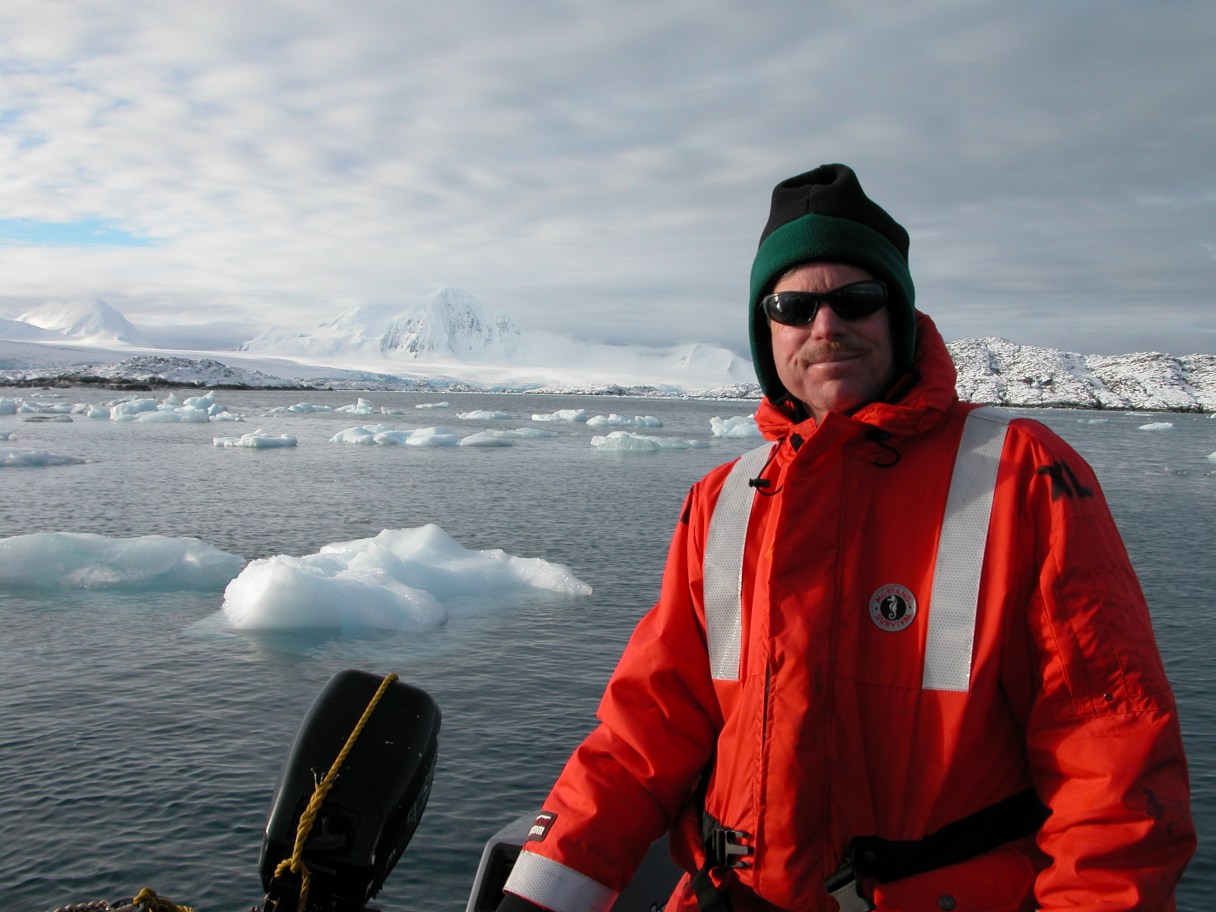
 Dr. James McClintock near Palmer Station Antarctica
 Thom Benson with the Tennessee Aquarium has a close encounter with “Pepper,” one of the aquarium’s macaroni penguins
My mind has been wandering a bit lately. While many people are thinking about the North Pole during December, I’ve been counting down the days until an Tennessee Aquarium member’s trip leaves for Antarctica. This will be a voyage of science and exploration. We’ll be travelling with Dr. James McClintock Professor of Polar and Marine Biology at the University of Alabama at Birmingham. Dr. McClintock’s research is based out of Palmer Long Term Ecological Research Station on the Antarctic Peninsula.
I have always been fascinated with polar exploration for a variety of reasons. The meteorologist in me loves extremes. Antarctica is the coldest place on Earth. The animal lover in me wants to see, and know more about, albatross, seals, whales and penguins. As a SCUBA diver, I’m intrigued by underwater images from beneath the ice. (Although I’ll leave that kind of diving to others like Dr. McClintock.) And, there’s a part of me that is in awe of the remote and pristine conditions of the polar regions.
I have been to the Arctic Circle before, which was an amazing experience, but I never thought I would have the opportunity to actually visit Antarctica. So, I’d like to share this experience with others via this blog.
This adventure begins in Chattanooga tomorrow with a short flight to Atlanta before a much more lengthy flight to Buenos Aires. We’ll have a day to explore the capital city of Argentina before heading to Ushuaia, Tierra del Fuego, Argentina which is billed as the “Southernmost City in the World.” After a few hours on land, we’ll board Le Boreal, an impressive cruise ship, for the trip across the famous Drake Passage.
In total, we’ll end up roughly 7,000 miles south of the Tennessee Valley by the time we reach the Antarctic Peninsula.