
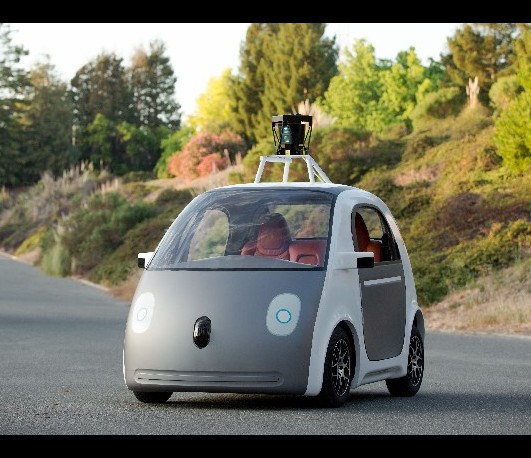
 A very early version of Google’s prototype self-driving car drives on a street. The two-seater won’t be sold publicly, but Google on Tuesday said it hopes by this time next year, 100 prototypes will be on public roads.
LOS ANGELES – Google plans to build and launch onto city streets a small fleet of subcompact cars that could operate without a person at the wheel.
Actually, the cars wouldn’t even have a wheel. Or gas and brake pedals. The company says the vehicles will use sensors and computing power, with no human needed.
Google Inc. hopes that by this time next year, 100 of the two-seaters will be on public roads, following extensive testing. The cars would not be for sale and instead would be provided to select operators for further tweaking and have limitations such as a 25 mph top speed.
The announcement presents a challenge to automakers that have been more cautious about introducing fully automated driving and to government regulators who are scrambling to accommodate self-driving cars on public roads. Other companies are working on the technology but none as large as Google has said it intends to put such cars in the hands of the public so soon.
To date, Google has driven hundreds of thousands of miles on public roads and freeways in Lexus SUVs and Toyota Priuses outfitted with special sensors and cameras. But with a “safety driver” in the front seat, those vehicles were not truly self-driving.