
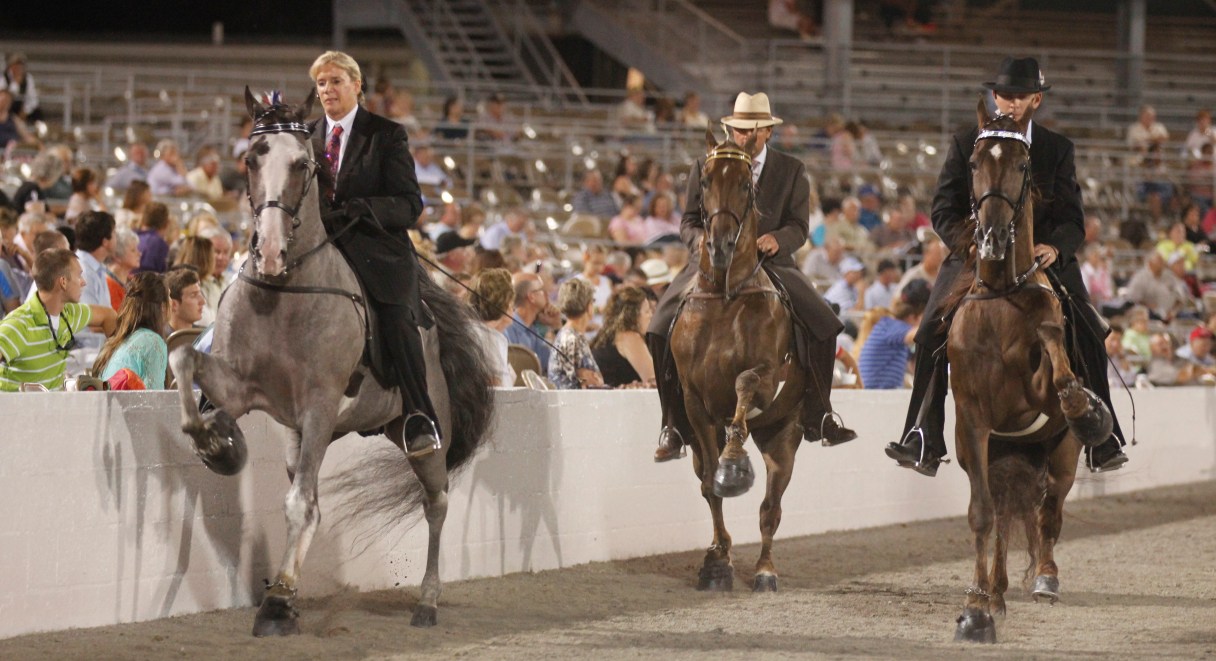
Finally the use of stacks and chains will be banned in the Tennessee Walking Horse industry.
The U.S. Department of Agriculture Friday announced the release of new rules to upgrade Horse Protection Act regulations – designed to protect Tennessee walking horses. The rule “should largely spell the end of the barbaric and gratuitous practice of horse soring,” according to a statement from the Humane Society of the United States – an organization that has fought for reform in the walking horse industry for more than a decade.
“It’s a great day in history for the horses,” said Keith Dane, the Humane Society’s senior adviser for equine protection.
Chattanooga had a starring role in this reform effort – an effort that actually began 46 years ago when Congress passed the Horse Protection Act of 1970. Our own federal courthouse is where one-time Walking Horse Trainer of the Year Jackie McConnell and some of his stablehands pleaded guilty in 2013 on charges of abusing horses in the name of “training them” to step ever higher and higher.
Industry voices had long said that abuse was limited to just a few “bad apples” trying to make it to the big time, but in 2012, the country was shocked by video on prime-time news showing McConnell and his hired hands soring and beating horses. Many in the walking horse industry knew McConnell’s barn had been raided by federal agents during the 2011 Tennessee Walking Horse Celebration event in Shelbyville. What they didn’t know until the video debuted was that the Humane Society of the United States had hidden-camera footage of the abuse.
In an apology video that McConnell made as a condition of his probation, he acknowledged that soring abuse is widespread in the industry.
Soring is the practice of deliberately injuring a horse’s legs and hooves to force the horse to perform the artificial, high-stepping gait known as the “big lick.” Soring and the “big lick” turn beautiful, athletic walking horses with a natural and somewhat arched gait into horses that lurch around a show ring with little resemblance to the smooth, fluid magic of our champion animals from the 1940s, 1950s and early 1960s.
The publicity of McConnell’s case and a handful of others – the first ever prosecuted under the federal provisions of the Horse Protection Act – prompted activists, including Tennessee’s Priscilla Presley, to lobby Congress to pass a law ending soring for good by banning all soring devices, including stacked shoes and pads that can help hide soring. Chains and foreign substances at horse shows, exhibitions, sales and auctions also would have been banned in that law.
But the horse industry and its supporters are strong and moneyed. Their lobbying stalled the legislation in committees.
None of Tennessee’s Republican leadership would support the bill, and some – including Sen. Lamar Alexander – sponsored a watered-down industry-led bill that masqueraded as reform but in reality would maintain the status-quo. In July, the Obama administration’s USDA – buoyed by the support of 50 senators and 273 House members who cosponsored the stalled bill – proposed these rule changes, which mirror the provisions in the Past Act.
The stack and chain bans are expected to take effect in about 30 days.
Another portion of the rule eliminates an inspection program that placed the very people abusing horses in charge of enforcing the law. That change will take effect in January 2018. The delay will give USDA time to adequately train future inspectors. Those future inspectors will be independent contractors paid by the shows and overseen by USDA. There will be no additional cost to taxpayers, Dane said.
It’s almost certain that some will cry these new rules will kill Tennessee’s multimillion-dollar walking horse industry. The annual show in Shelbyville runs for 11 days. Some in the industry likely will try to thwart the rules with lawsuits or push to have the incoming administration undo them.
But this doesn’t have to be a show killer. Truthfully these horses will be more valuable and more beautiful just as they are without the lurching “big lick.” They were valuable and beautiful before soring and they will be again.
The majestic and graceful Tennessee walking horse has been around since plantation times in the late 18th century, when farmers used smooth-gaited horses to cover lots of land quickly and comfortably. The horses had a natural, distinctive gait that is fast like a trot, but not at all jarring. Those utility horses were flat-shod, patiently trained and carried an outstanding reputation for calmness.
The first Tennessee Walking Horse National Celebration was in 1939, but caustic chemicals and weighted or stacked hoof devices didn’t become the short-cut training methods called soring until the 1960s and after.
The industry will suffer more (and has) thanks to the scar it gave itself with this horrible abuse – a fact made clear by continually falling walking horse show attendance.
Horse lovers will always love and pay highly for true Tennessee walking horses – the ones that walk naturally and smoothly, thanks to traditional flat-shod and patient training methods.
Trainers would do themselves and these horses a favor by embracing these new rules and returning the Tennessee Walking Horse breed to its graceful roots.