
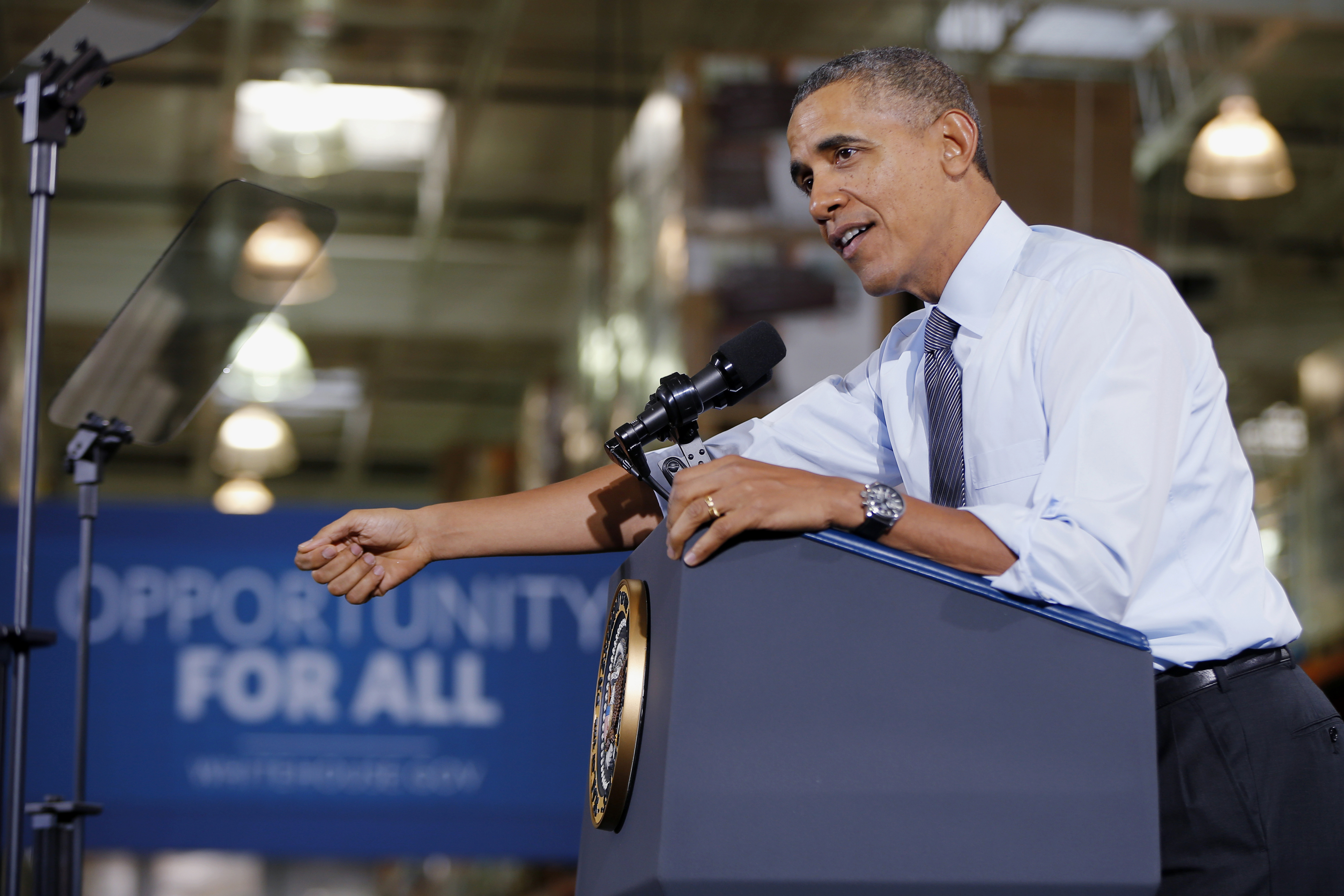
 President Barack Obama speaks about raising the minimum wage during a visit to a Costco store in Lanham, Md. “Give America a raise!” President Barack Obama implored Congress in his State of the Union address. But it would cost jobs, Republicans warned. The political divide over raising the federal minimum wage is deep, driven by politics, ideology and demographics. Democrats, it turns out, represent more poor and low-wage workers than Republicans do.
WASHINGTON – The federal minimum wage has been below what’s needed to keep a family of three out of poverty since 1980. It’s also well shy of the peak of its buying power almost half a century ago.
Is the current $7.25 hourly minimum fair? Is now the time to raise it, and if so, by how much?
There is no objective answer. It depends on the political slant of lawmakers or the views of economists being asked.
Economic data over the minimum wage’s 76-year history doesn’t provide definitive help. It shows erosion over time in the plight of minimum-wage earners, but that reflects what the nation’s political system has produced, not necessarily what’s fair.
Democrats backed by President Barack Obama are preparing to force election-year votes on gradually increasing today’s minimum to $10.10 by 2016, an effort that seems likely to fail in Congress but that Democrats hope will drive their supporters to the polls in November’s congressional elections. Republicans generally oppose the proposal, saying it would cost too many jobs.