
DAMASCUS, Syria (AP) – Syrian government forces advanced, seizing high ground around Palmyra on Wednesday and positioning themselves to recapture the historic town held by the Islamic State group.
The troops, supported by Lebanese Shiite militiamen fighting on the side of the Damascus government reached to within 3 kilometers (1.8 miles) of the town, according to the state TV broadcaster. In Lebanon, the militant Hezbollah group’s television station broadcast footage of the troops, advancing single file through a desert landscape as helicopter gunships provided cover.
The push was from the west and south of Palmyra and Syrian forces were also closing in on the IS-held town of Qaryatain in central Syria, Homs governor Talal Barazi said.
“There is continuous progress by the army from all directions,” he said, adding that he expected “positive results” over the next few days.
In the push on Palmyra, which started in earnest last week, Syrian government forces have been backed by intense Russian airstrikes.
Palmyra, a UNESCO World Heritage Site, has been in the hands of the Islamic State group since the extremists captured it last May. The seizure signified a major coup for IS, which emerged out of al-Qaida to capture large swaths of Syria and neighboring Iraq in 2014.
The extremists cast themselves as Islamic warriors in an apocalyptic battle with Western civilizations, which they call “crusaders.”
In Palmyra, the IS destroyed many of the town’s Roman-era relics, including the 2,000-year-old Temple of Bel and the iconic Arch of Triumph, and also killed dozens of captive Syrian soldiers and dissidents from IS in public slayings at the town’s grand roman theater and other ruins.
Along with blowing up priceless archaeological treasures, among the first destructions IS carried out in Palmyra was the demolishing of the town’s infamous Tadmur prison, where thousands of Syrian government opponents had been imprisoned and tortured over the years.
The advance on Palmyra comes against the backdrop of Syrian peace talks currently underway in Geneva between representative of the Damascus government and the Western-backed opposition. The talks have been boosted by a Russia-U.S.-brokered cease-fire that has mostly held since late February.
The Islamic State group and other militant factions, such as Syria’s al-Qaida branch known as the Nusra Front, are not part of the truce.
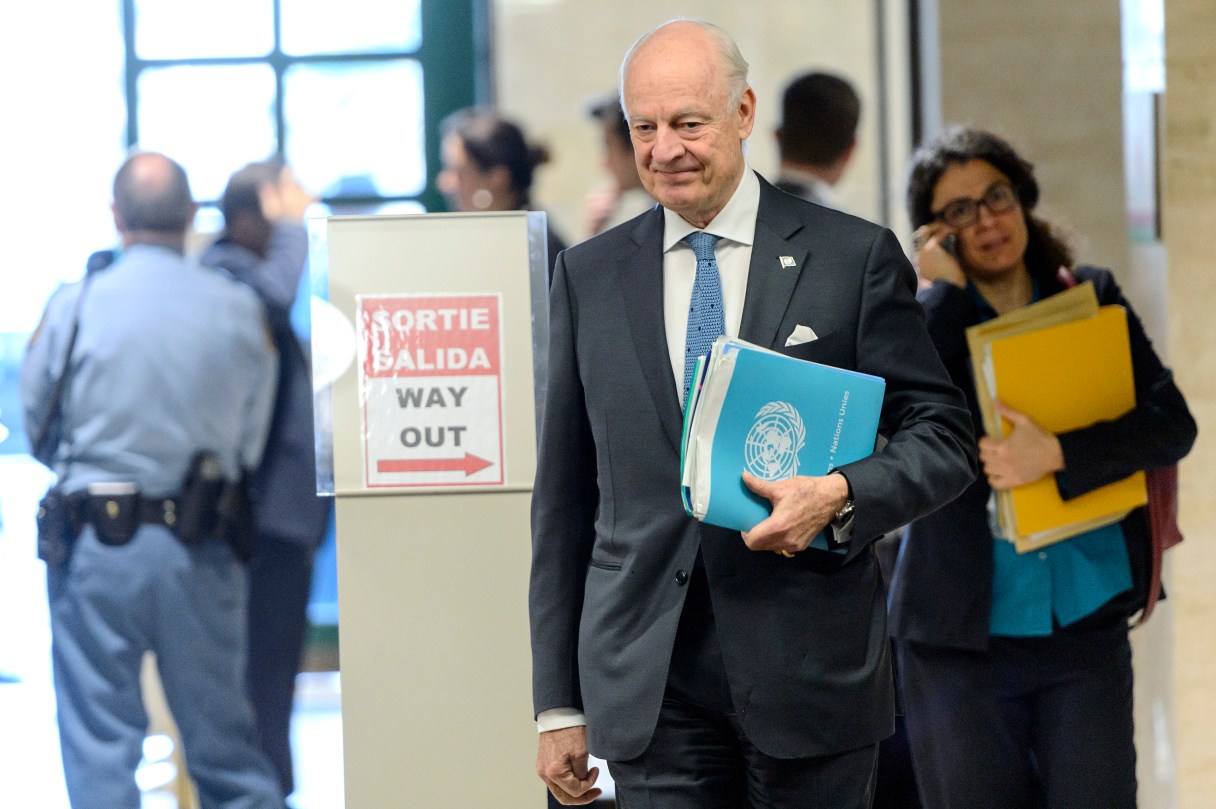
On Wednesday, Syria’s U.N. ambassador and head of the government team, Bashar Jaafari, said he was handed a proposal by U.N. Special Envoy Staffan De Mistura.
Jaafari told reporters in Geneva that the government side would take the proposal back to Damascus and study it, and would respond during the next round of negotiations, tentatively scheduled for April.
It was not clear if this meant government negotiators were pulling out of the talks before they are officially to adjourn on Thursday.
The negotiations have been held up over the question of President Bashar Assad’s role in any political transition to wind down the five-year conflict. The opposition has said Assad must step down as a precondition to any transition, while the government has refused to discuss Assad’s departure.
The U.N. envoy said Tuesday the two parties had not yet discussed the matter of Assad’s future.
___
Associated Press Writers Philip Issa in Beirut and Jamey Keaten in Geneva contributed to this report.