
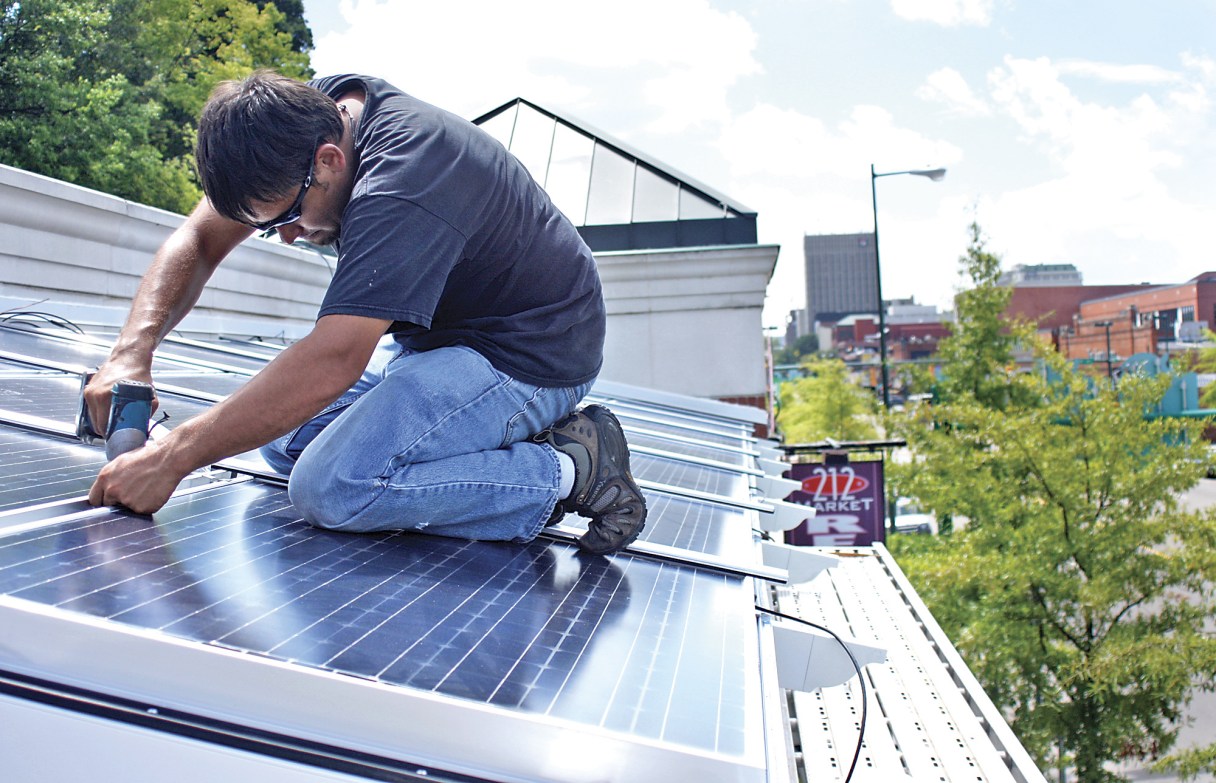
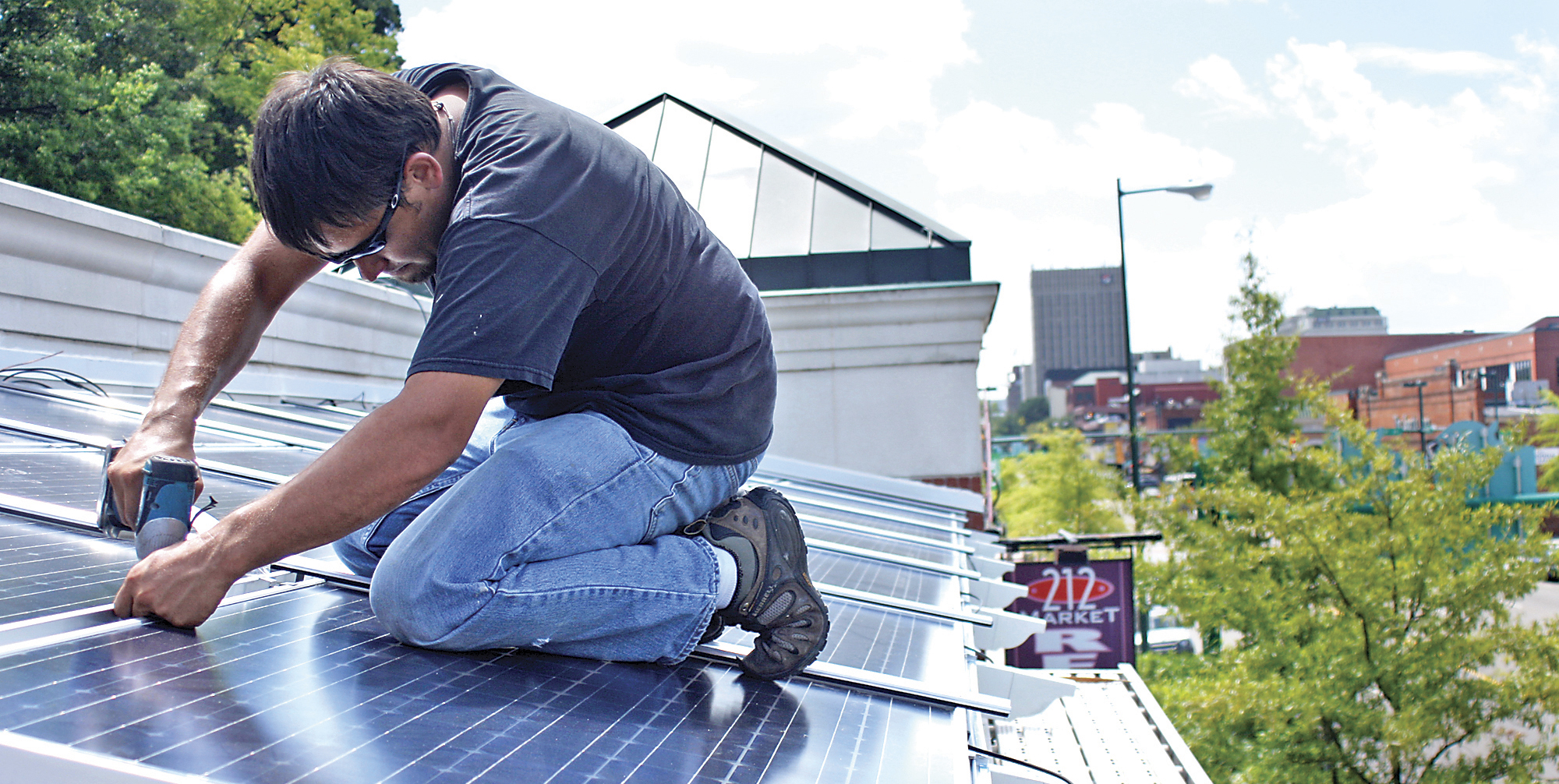
 Robert Gaskil installs solar panels at 212 Market Restaurant. Staff File Photo by Allison Carter
GOING GREEN1969: Chattanooga is declared the nation’s dirtiest city by anchorman Walter Cronkite on “CBS Evening News.” Soon after, the Air Pollution Control Bureau was created and placed limits on air pollution for local industries1972: Every major pollution source in Hamilton County attains air-pollution compliance, at a cost of more than $40 million.1982: Chattanooga Venture forms and creates the Vision 2000 project to develop recommendations to revitalize downtown.1989: The city’s air quality meets all federal health standards, and construction on the Tennessee Aquarium begins.1992: CARTA begins offering its free downtown electric shuttle rides.2005: Chattanooga loses its “attainment” rating from the Environmental Protection Agency for particulate pollution; the 21st Century Waterfront Project is completed.2006: Mayor Ron Littlefield signs the U.S. Conference of Mayors Climate Protection Agreement, a step toward making Chattanooga a sustainable city.2007: Littlefield appoints the Chattanooga Green Committee to assist in the goals for becoming green.2008: The city is designated in attainment with EPA standards for ozone pollution.Source: Chattanooga Visitors Bureau; CARTA; Chattanooga/Hamilton County Air Pollution Control Bureau; City of Chattanooga
Yellow smog hung in the air over Chattanooga more than 40 years ago, a tangible symbol of a manufacturing economy that was on the brink of collapse.
Dubbed the “Dynamo of Dixie” for its industrial prowess, boasting a diverse manufacturing base that included steel mills, nuclear steam-generating equipment and boiler shops, the city was said to have the nation’s dirtiest air in 1969.
“All the coal being used caused a great deal of air pollution, not unlike what happened in every industrial city,” said David Crockett, director of the city’s Office of Sustainability. “The downside is the air-quality issue; at one time it was a significant health issue.”
That year the city created the Air Pollution Control Bureau to get the air-pollution problem under control, meeting the compliance standards to clear the air three years later.