
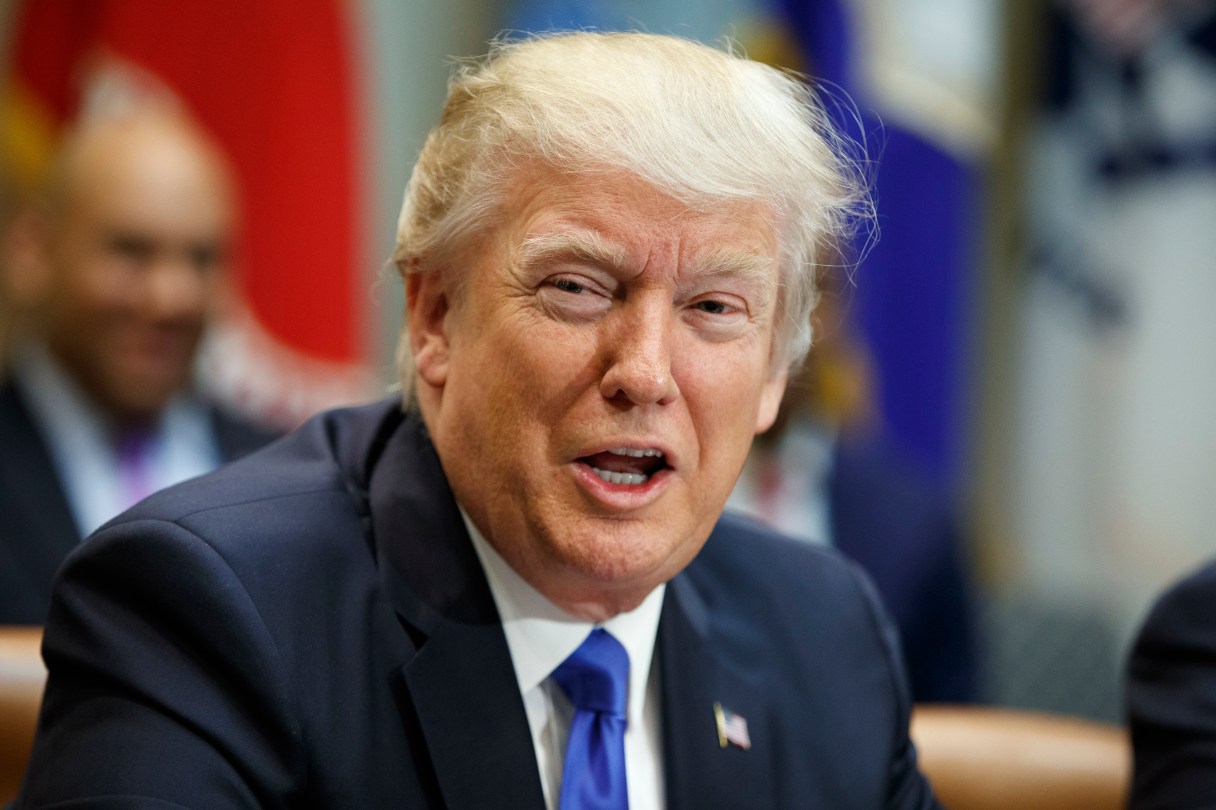
One of the most painful moments of President Donald Trump’s 77-minute burp about fine-tuned machines last week came when he invited a question from “a friendly reporter,” got one, and turned it into an attack, reprimand and slap-down as he became the victim of his own stereotyping.
Jake Turx, an Orthodox Jewish reporter for Ami Magazine, a Brooklyn weekly, took pains to preface a question about how the government plans to address an uptick in anti-Semitism – 48 bomb threats have been made against Jewish centers all across the country in the last couple of weeks – with a preamble acknowledging that Trump has Jewish grandchildren and he is their “zayde” – Yiddish for “grandfather” and often a word of great affection.
But as soon as Trump heard “anti-Semitism,” he came unglued – taking it as a personal attack on him.
It is all about him, as we are beginning to truly understand.
“See! He said he was going to ask a very simple, easy question. It’s not. That’s not a fair question. Sit down!” Trump interrupted. “I understand the rest of your question.”
As Turx took his seat, Trump said, “So here’s the story, folks. No. 1, I am the least anti-Semitic person that you’ve ever seen in your entire life. No. 2, racism, the least racist person.”
Turx tried to interject, realizing that the president misunderstood. But Trump shouted him down again: “Quiet, quiet, quiet. See he lied about [he] was going to get up and ask a simple, easy question. Welcome to the world of the media.”
No, welcome to a man with an ego so large that he can’t conceive of a question that is about American concerns rather than about him.
OK, so let’s talk about him, and the impact of his presidency. Let’s talk about why and how it is that Trump’s election and his attitude enbolden haters and hate groups.
Sadly, the president is shocked that people might think he personally is anti-Semitic or racist – and probably rightly so. Many of his supporters, too, rightly decried Hillary Clinton’s labeling them as “deplorables.”
But the fact remains that hate groups in the United States rose in 2016 for a second year in a row as the radical right became energized by Trump’s candidacy, according to the Southern Poverty Law Center’s (SPLC) annual census of hate groups and other extremist organizations.
The most dramatic growth was the near-tripling of anti-Muslim hate groups – from 34 in 2015 to 101 last year. The growth has been accompanied by a rash of crimes targeting Muslims, including an arson that destroyed a mosque in Victoria, Texas, just hours after the Trump administration announced an executive order suspending travel from some predominantly Muslim countries. The latest FBI statistics show that hate crimes against Muslims grew by 67 percent in 2015, the year in which Trump launched his campaign.
Overall, the SPLC found that the number of hate groups operating in 2016 rose to 917 – up from 892 in 2015.
“The country saw a resurgence of white nationalism that imperils the racial progress we’ve made, along with the rise of a president whose policies reflect the values of white nationalists. In Steve Bannon, these extremists think they finally have an ally who has the president’s ear,” said Mark Potok, senior fellow and editor of the Intelligence Report.
After the election, SPLC surveyed 10,000 educators to find that 90 percent said the climate at their schools had been negatively affected by the campaign. Eighty percent described heightened anxiety and fear among students, particularly immigrants, Muslims and African-Americans. Numerous teachers reported the use of slurs, derogatory language and extremist symbols in their classrooms.
Imagine what a difference it might make if Trump could make himself hear the real questions being asked by real people with real fears, and if he could answer them with a dose of reassurance.
How hard would it have been for him to say: “It is alarming to see those numbers going up, and I promise to have the Justice Department ramp up investigations of hate crimes and bullying.”
It’s a long shot, but we can hope.