
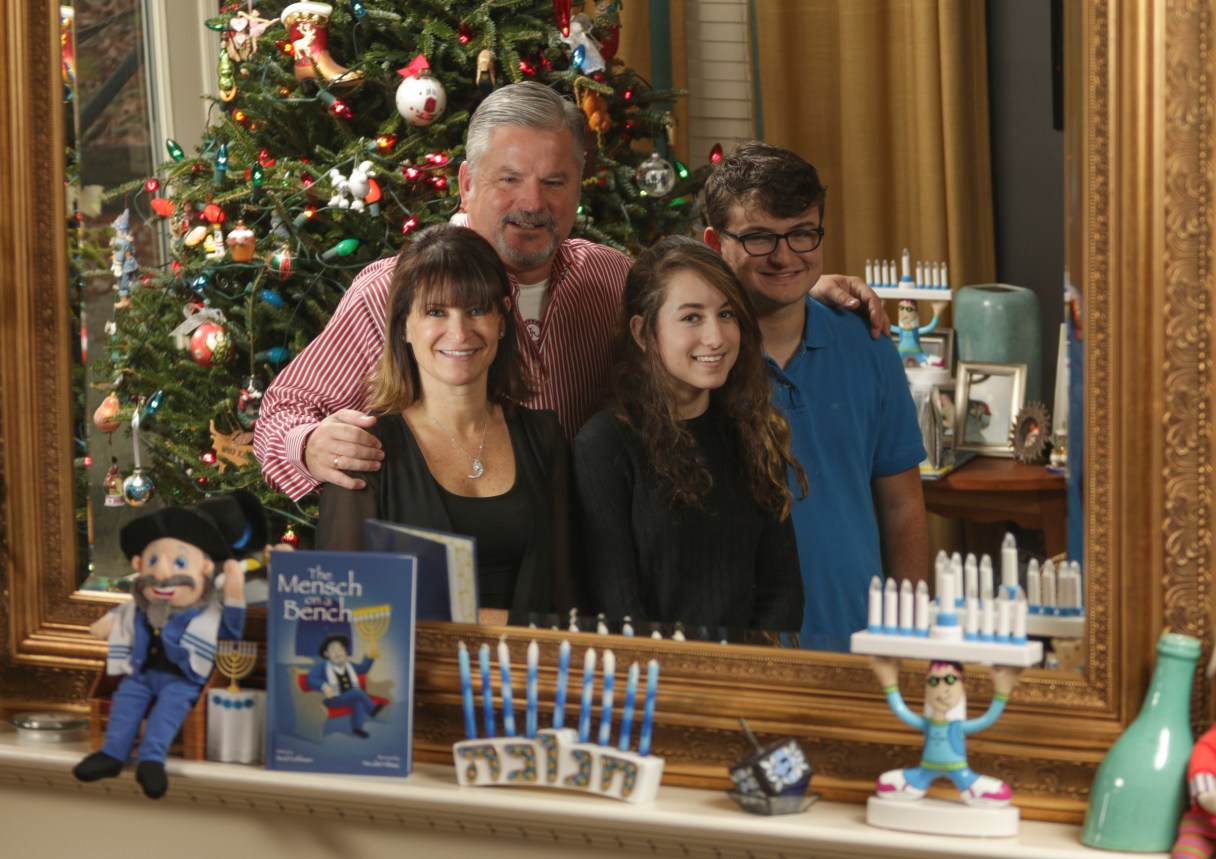
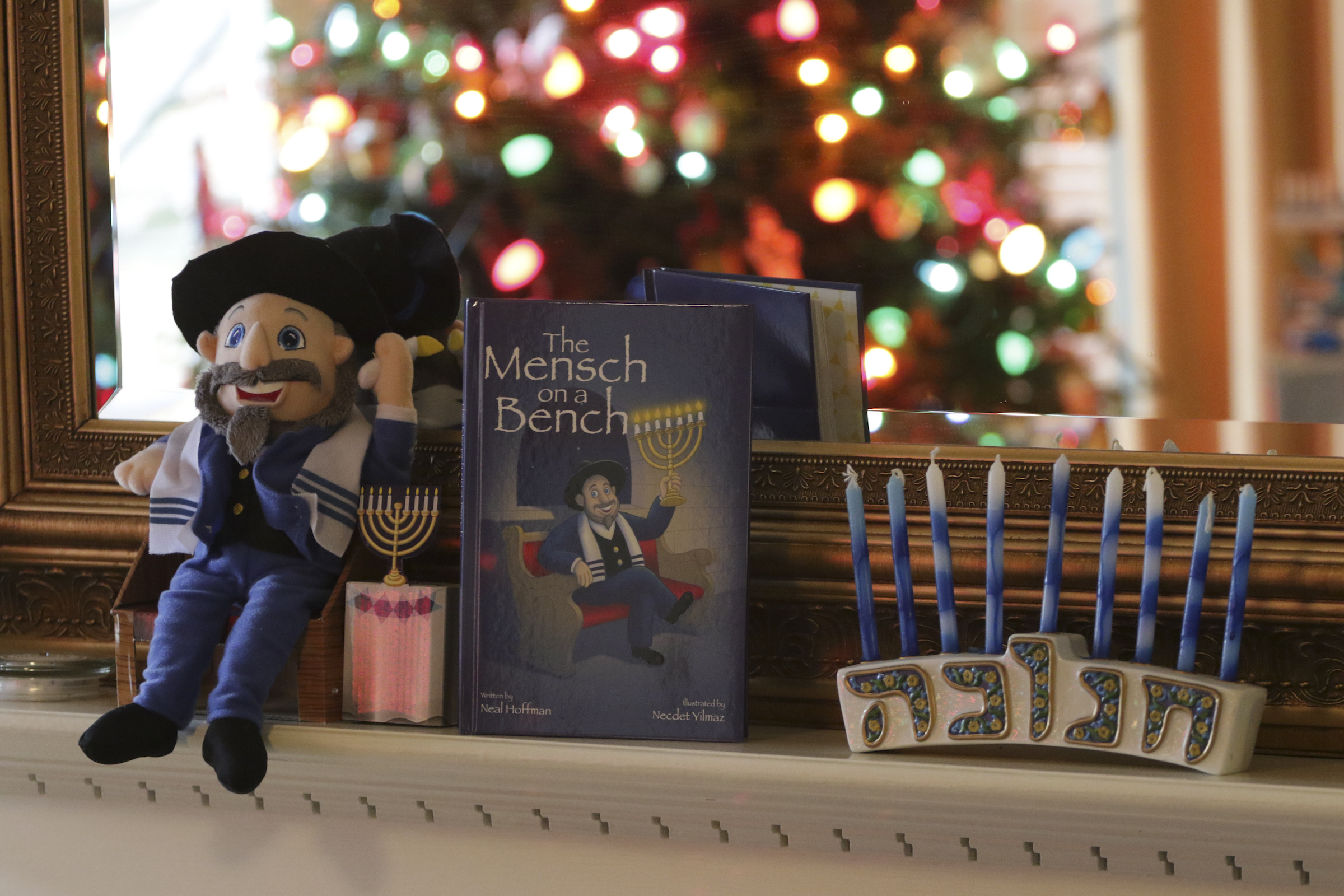
 “Mensch on a Bench” is the Hebrew spinoff of “Elf on the Shelf.” It was created by Neal Hoffman, a former Hasbro Toys executive who grew up in an interfaith family. After financing his idea on Kickstarter, Hoffman took Mensch to the TV show “Shark Tank,” where Robert Herjavec and Lori Greiner invested $150,000 in the toy. This season he has rolled out “Ask Bubbe,” a talking doll that speaks phrases of a concerned grandmother.
Hanukkah and Its Symbols
Hanukkah, sometimes called the Festival of Lights, celebrates the victory of the Maccabee brothers’ rebel army over the larger army of Greek King Antiochus IV, which had defiled the Jewish Temple, killed villagers and forced others into hiding.The upstart Maccabee army regained control of their land from the Greeks, then set about to restore and purify the Temple by burning ritual oil in its menorah for eight days. But they discovered there was only enough oil for one day. They lit the menorah anyway and the oil miraculously lasted eight days.Rabbi Susan Tendler of B’nai Zion Congregation explains that the miracle isn’t just the extended length the oil burned, but the fact “one small family took on an entire army and, through their passion and dedication, overthrew that huge, established army.“If the oil had lasted four days, it still would have been a miracle,” she says. “But eight days was enough time to get a fresh supply of olive oil — that was how long it took to produce a fresh batch — and bring it to the temple.”* Lighting of candles: In commemoration of that eight-day miracle, one candle is lit on the first night of Hanukkah, two on the second and so forth until eight candles are lit. Candles are placed in a menorah, a seven-branch candelabrum that represents seven days of the week, or hanukkiah, a menorah with nine branches. On the hanukkiah, eight candles represent the eight nights the oil burned and the ninth is the shamash, a center candle slightly elevated above the other eight and used to light the others.* Eating fried foods: Because Hanukkah celebrates the miracle of the oil, it is traditional to eat fried foods such as potato latkes and jelly-filled donuts.
Dr. Frank and Pam Miller threw Chattanooga’s first “Hanumas” party two years ago.
Just like that original name is a mashup of Hanukkah and Christmas, the couple’s marriage is a blend two faiths. He is Jewish, and she describes herself as “staunch Irish Catholic.”
“Ho, Ho, Shalom” read the sign welcoming guests to their party. The Miller’s home was decorated with a Christmas tree, stockings, creche and menorahs. Friends from Mizpah Congregation met folks from St. Jude Catholic Church. It was a celebration of diversity as well as values held in common.
“We had Christian, Catholic, Reform Jewish and Conservative Jewish here,” says Pam. “Foods were all labeled so everyone knew what was in them.