
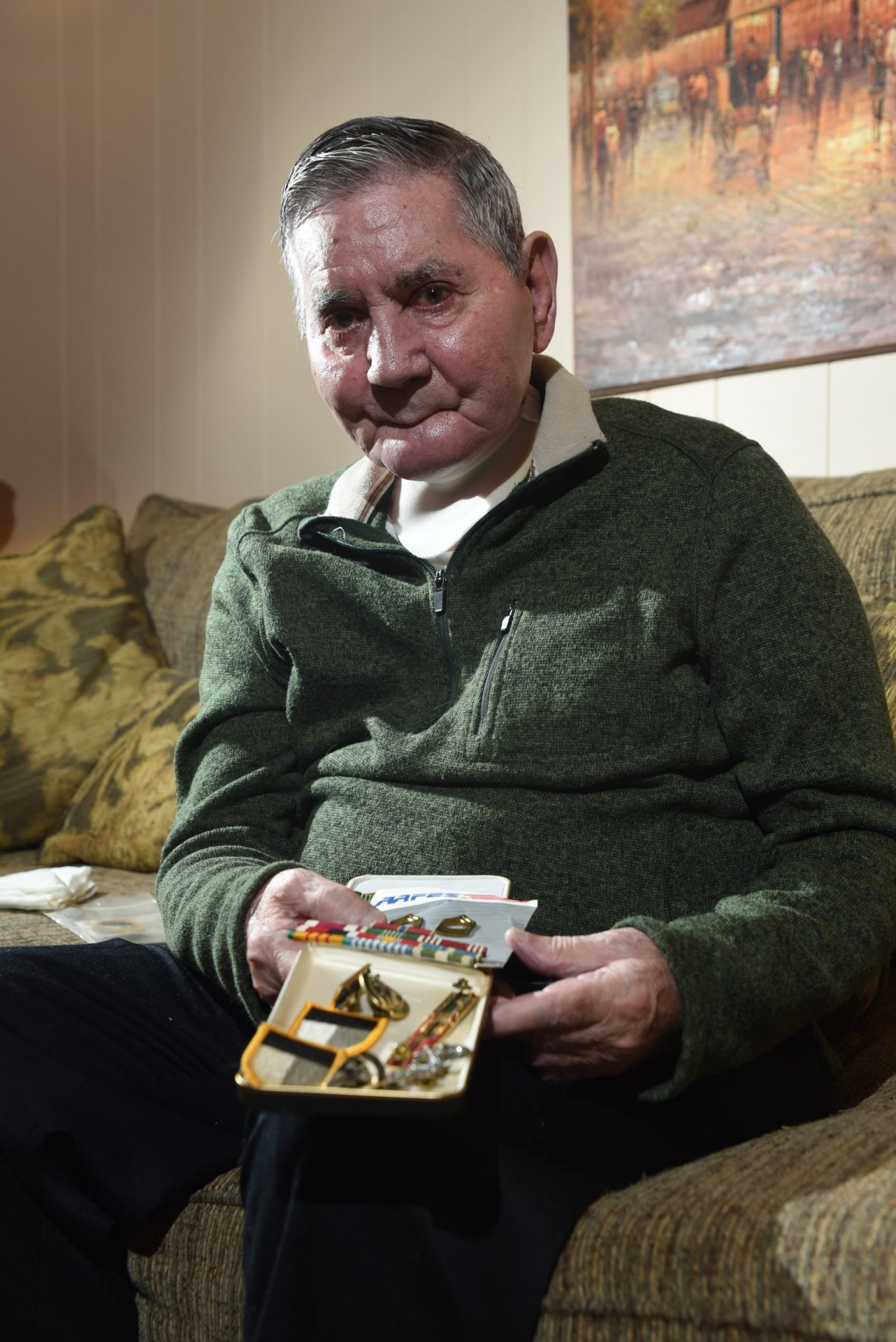
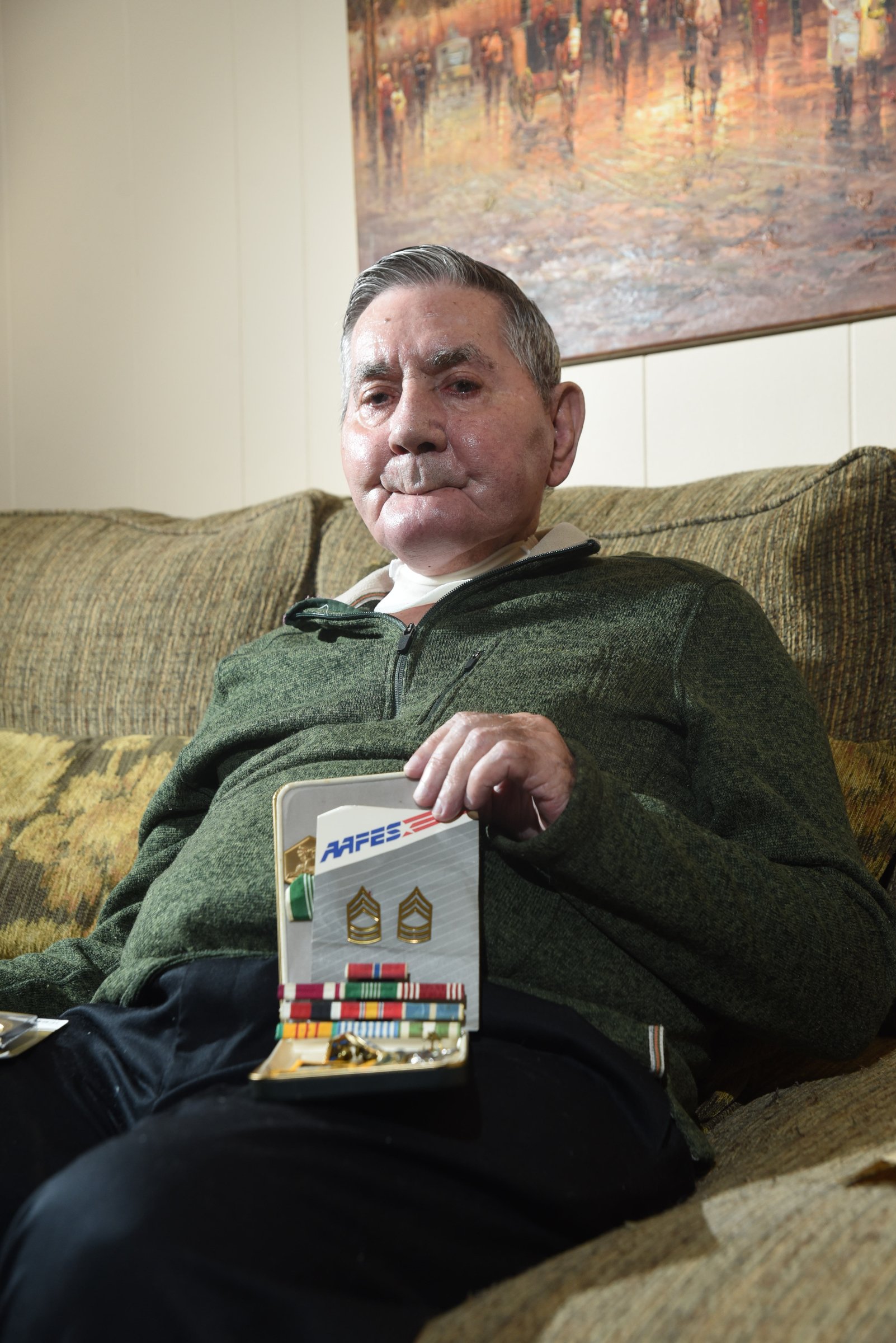
 Irvin Orsatti Boatwright, 82, holds his service medals at home in Rossville.
Master Sgt. Irvin Boatwright’s right hand shook violently last month as he ran a black marker across a small whiteboard on his lap. In his sister’s Rossville, Georgia, home, he tried to share the highlights of his 26-year military career, the key dates and locations and missions.
Writing is his main mode of communication these days. After finding cancer in his esophagus, a doctor removed Boatwright’s larynx in 2001. He then relied on an artificial voice box, using the robotic speech you hear in anti-smoking ads. But in 2015, his cancer returned. A doctor removed his tongue.
His hand betrays him now, too. A doctor hasn’t been able to explain the cause to his family, but Boatwright is racked with tremors. As he tries to write, he repeatedly slaps the tip of the marker against the board. TapTapTapTapTapTapTap. His sister and niece try to make out the words. They can’t make out the words.
But after about 30 minutes one morning, Boatwright became stable for a moment. His sister, Estelle, mentioned his time in Germany, where he and other members of the U.S. Army worked at Spandau Prison. Boatwright guarded somebody important, she said. But who was it?
“RUDOLF HESS,” Boatwright wrote, cleanly.