
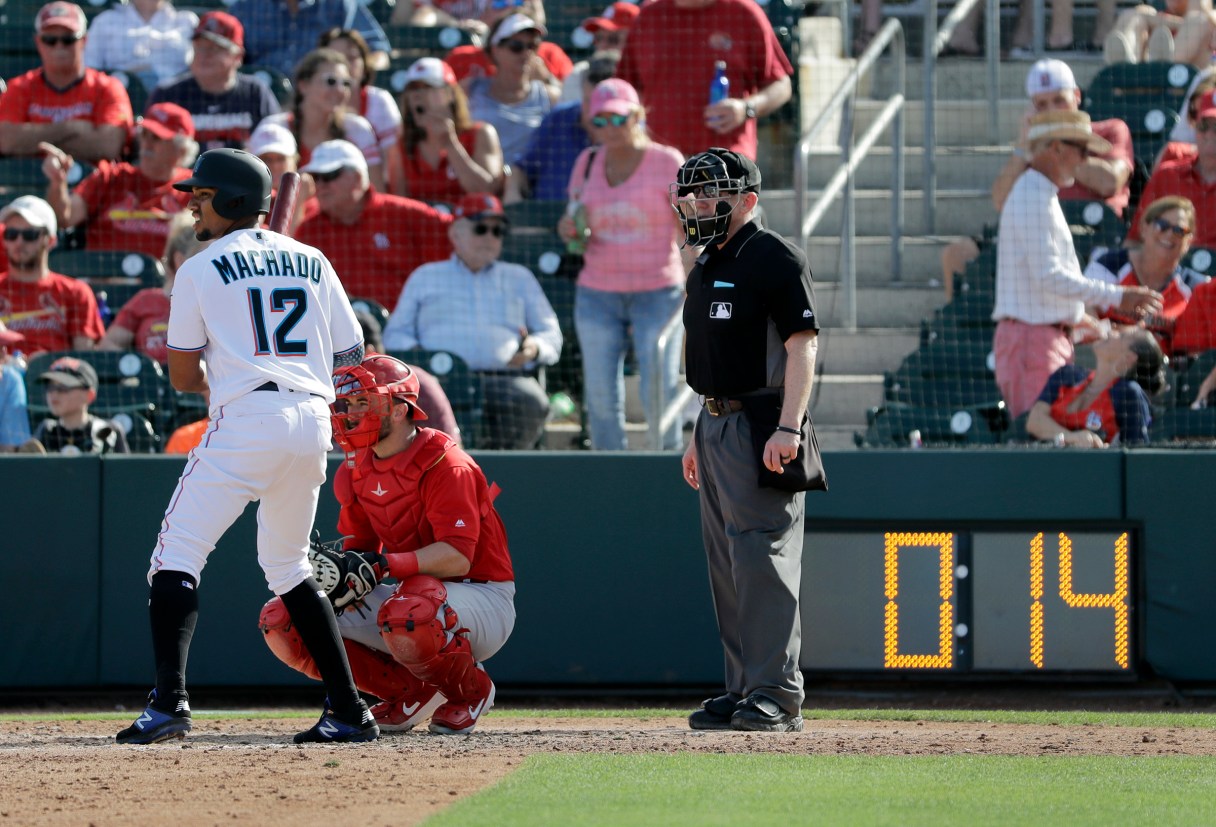
NEW YORK — Major League Baseball will introduce some of its most radical rules yet next year, adopting a pitch clock and limiting defensive shifts after concluding modern analytics created a slower, less entertaining sport.
The decisions were made Friday by the MLB’s 11-man competition committee despite the unanimous opposition of the panel’s four players. Commissioner Rob Manfred pushed for the innovations, along with a management team that included former Boston Red Sox and Chicago Cubs executive Theo Epstein, now an MLB consultant.
“The influx of data in our industry,” Epstein said, “have not improved the game from an aesthetic standpoint or from an entertainment standpoint. So in my role now, it’s my responsibility to try to look at the big picture, think about what’s great for fans.”
Players supported the third major initiative: larger bases that are expected to lead to fewer injuries and more stolen bases because of a decreased distance of 4 1/2 inches.
Manfred called the rules an attempt to “bring back the best form of baseball.”
“Number one, fans want games with better pace,” he said during a news conference. “Two, fans want more action, more balls in play. And three, fans want to see more of the athleticism of our great players.”
Tony Clark, executive director of the MLB Players Association was noticeably absent — just as he was at the announcement of an agreement in March that ended a 99-day lockout by MLB management.
“Players live the game — day in and day out. On-field rules and regulations impact their preparation, performance, and ultimately, the integrity of the game itself,” the union said in a statement released Friday. “Major League Baseball was unwilling to meaningfully address the areas of concern that players raised.”
The pitch clock will be set at 15 seconds with no runners on base and it will be set at 20 seconds with runners, numbers that are up from the 14/19 tested at Triple-A this season and 14/18 at lower minor league levels.
There will be a limit of two of what MLB calls disengagements by pitchers — pickoff attempts or steps off the rubber — per plate appearance, and a balk would be called for a third or more unless there is an out. The disengagement limit, which some players predict will benefit baserunners, would be reset if a runner advances.
A catcher is required to be in the catcher’s box with nine seconds left on the clock, and a hitter is required to be in the batter’s box and focused on the pitcher with eight seconds remaining. Penalties for violations will be a ball called against a pitcher and a strike called against a batter. A batter can ask an umpire for time once per plate appearance, and after that it would be granted only at the umpire’s discretion if the request is made while in the batter’s box.
The clock, which some players suggested be altered for late and close situations, has helped reduce the average time of a nine-inning game in the minor leagues from 3 hours, 4 minutes in 2021 to 2:38 this season. The average time of a nine-inning game in the major leagues this year is 3:07, up from 2:46 in 1989 and 2:30 in the mid-1950s.
“It reminded me of the game that I grew up watching in the ’70s and ’80s,” said former outfielder Raúl Ibañez, now an MLB senior vice president.
As for the shift rule, infielders will be required to be on either side of second base and all infielders to be within the outer boundary of the infield when the pitcher is on the rubber. Infielders may not switch sides unless there is a substitution, but five-man infields will still be allowed, MLB executive vice president Morgan Sword said.
Shifts have soared from 2,357 times on balls hit in play in 2011 to 28,130 in 2016 and 59,063 last year, according to Sports Info Solutions. Shifts are on pace for 68,000 this season.
“I think fans will cherish the moments absent the extreme defensive shifts when games are decided not by whether their team’s infield is positioned by the perfect algorithm, but by whether their team’s second baseman can range to make an athletic dive playing with everything on the line,” Epstein said.
MLB’s season batting average has dropped from .267 in 1997 to .243 this year, with a team’s average runs declining from 4.77 to 4.33.
“The game has evolved in a way that nobody would have chosen if we were sitting down 25 years ago to chart a path towards the best version of baseball,” Epstein said. “Nobody would have asked for fans to have to wait more than four minutes for balls to be put into play. Nobody would have asked for generational lows in stolen bases, triples and doubles.”
Base size will increase to 18-inch squares from 15, with the expectation first basemen are less likely to get stepped on by runners.
In addition, each team will be allowed a sixth mound visit in the ninth inning next year, if it has used five during the first eight innings.
Until last winter, MLB had to give a one-year advance notice to amend on-field rules without union approval, but the March lockout settlement established the committee. St. Louis Cardinals pitcher Jack Flaherty, Tampa Bay Rays pitcher Tyler Glasnow, Toronto Blue Jays infielder/outfielder Whit Merrifield and San Francisco Giants outfielder Austin Slater represented players Friday in a group that included Cubs infielder Ian Happ as an alternate.
“It’s going to be hard on guys. … It’s a shame that that we weren’t taken more seriously,” Merrifield said. “It’s an overcorrect, and they’re going to have to tweak it. And that’s just what we were trying to avoid.”
Seattle Mariners chairman John Stanton headed the committee, which included Cardinals CEO Bill DeWitt Jr., Giants chairman Greg Johnson, Colorado Rockies CEO Dick Monfort, Blue Jays CEO Mark Shapiro and Red Sox chairman Tom Werner, along with umpire Bill Miller.
“It’s hard to get consensus among the group of players on changing the game,” Manfred said. “I think at the end of the day, what we did here was about giving fans the kind of game they want to see.”