
Saturday, November 14, 2026Nov 14

Why is a NASA spacecraft crashing into an asteroid?

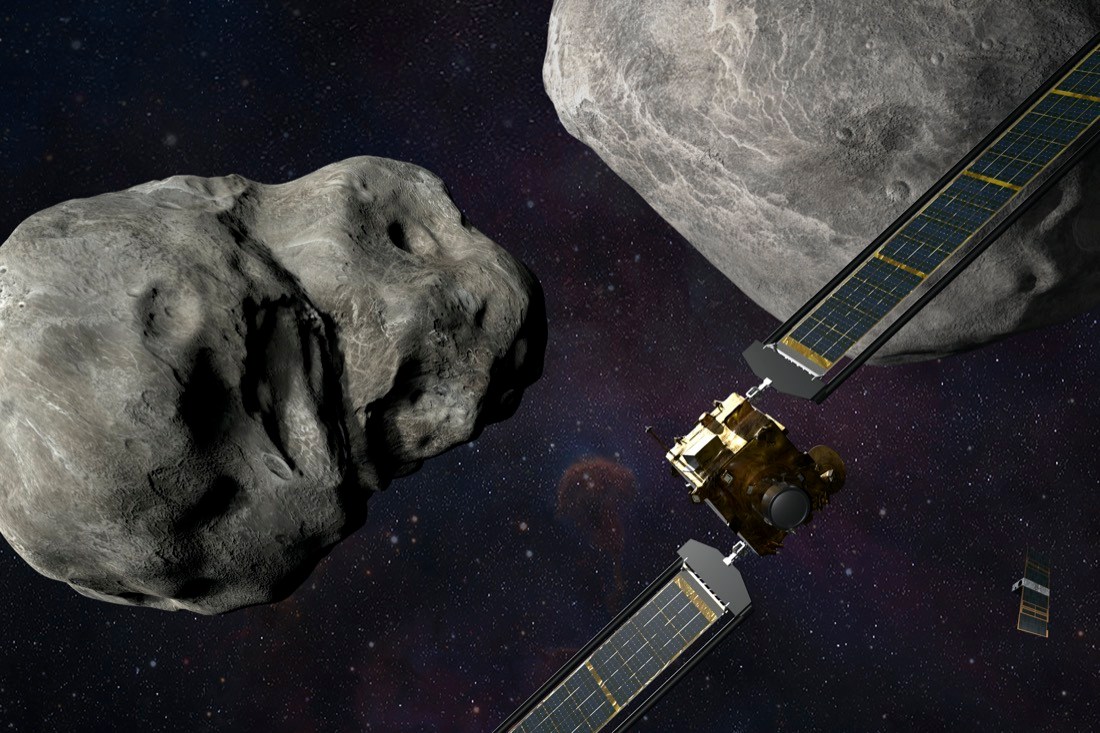
This illustration made available by Johns Hopkins APL and NASA depicts NASA's DART probe, foreground right, and Italian Space Agency's (ASI) LICIACube, bottom right, at the Didymos system before impact with the asteroid Dimorphos, left. DART is expected to zero in on the asteroid Monday, Sept. 26, 2022, intent on slamming it head-on at 14,000 mph. The impact should be just enough to nudge the asteroid into a slightly tighter orbit around its companion space rock. (Steve Gribben/Johns Hopkins APL/NASA via AP)

CAPE CANAVERAL, Fla. (AP) — In the first-of-its kind, save-the-world experiment, NASA is about to clobber a small, harmless asteroid millions of miles away.

A spacecraft named Dart will zero in on the asteroid Monday, intent on slamming it head-on at 14,000 mph (22,500 kph). The impact should be just enough to nudge the asteroid into a slightly tighter orbit around its companion space rock — demonstrating that if a killer asteroid ever heads our way, we’d stand a fighting chance of diverting it.

“This is stuff of science-fiction books and really corny episodes of “StarTrek” from when I was a kid, and now it’s real,” NASA program scientist Tom Statler said Thursday.

Cameras and telescopes will watch the crash, but it will take days or even weeks to find out if it actually changed the orbit.

The $325 million planetary defense test began with Dart’s launch last fall.