
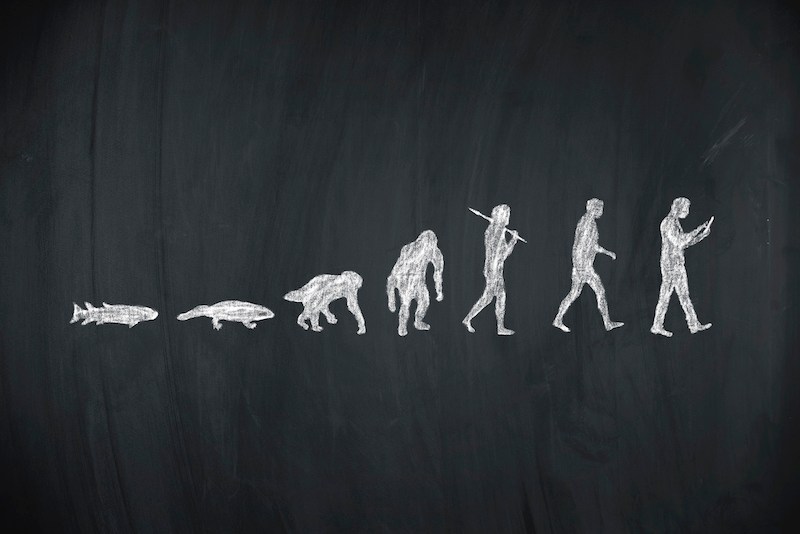
In 1973, evolutionary biologist Theodosius Dobzhansky wrote that “nothing in biology makes sense except in light of evolution.” Almost 50 years later, an increasing number of scientists are asking whether evolution makes any sense in light of what we now know from biology.
A recent long-form essay in The Guardian signals just how urgent the problem has become for the most dominant theory in the history of the sciences. In it, author Stephen Buranyi, gives voice to a growing number of scientists who think it’s time for a “new theory of evolution.”
For a long time, descent with slight modifications and natural selection have been “the basic” (and I’d add, unchallengeable) “story of evolution.” Organisms change, and those that survive pass on traits. Though massaged a bit to incorporate the discovery of DNA, the theory of evolution by natural selection has dominated for 150 years, especially in biology. The “drive to survive” is credited as the creative force behind all the artistry and engineering we see in nature.
“The problem,” writes Buranyi, is that “according to a growing number of scientists,” this basic story is “absurdly crude and misleading.” For one thing, Darwinian evolution assumes much of what it needs to explain. For instance, consider the origin of light-sensitive cells that rearranged to become the first eye, or the blood vessels that became the first placenta. How did these things originate? According to one University of Indiana biologist, “we still do not have a good answer. The classic idea of gradual change, one happy accident at a time,” he says, “has so far fallen flat.”
This scientific doubt about Darwin has been simmering for a while. In 2014, an article in the journal Nature, jointly authored by eight scientists from diverse fields, argued that evolutionary theory was in need of a serious rethink. They called their proposed rethink the “Extended Evolutionary Synthesis,” and a year later, the Royal Society in London held a conference to discuss it.