
Friday, November 13, 2026Nov 13

NASA Mars lander captures strikes by 4 incoming space rocks

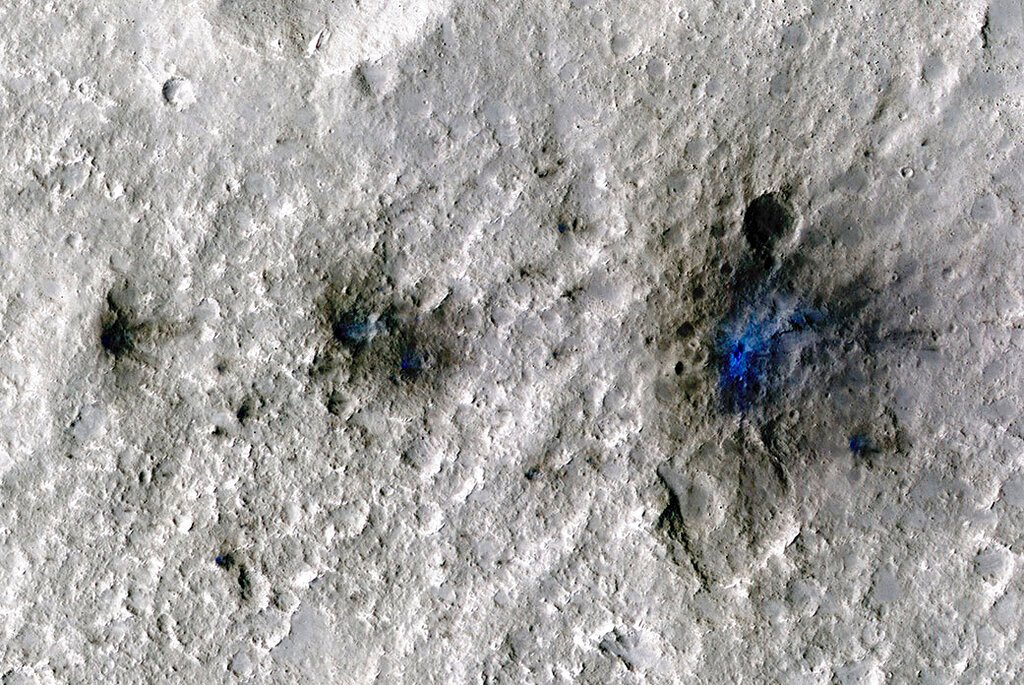
This undated photo released by NASA shows craters that were formed by a Sept. 5, 2021, meteoroid impact on Mars, the first to be detected by NASA’s InSight. Taken by NASA’s Mars Reconnaissance Orbiter, this enhanced-color image highlights the dust and soil disturbed by the impact in blue in order to make details more visible to the human eye. NASA lander on Mars has captured the vibrations and sounds of four meteorites striking the planet's surface. Scientists reported Monday, Sept. 19, 2022, that Mars InSight detected seismic and acoustic waves from a series of impacts in 2020 and 2021. (NASA/JPL-Caltech/University of Arizona via AP)

CAPE CANAVERAL, Fla. (AP) — A NASA lander on Mars has captured the vibrations and sounds of four meteoroids striking the planet’s surface.

Scientists reported Monday that Mars InSigh t detected seismic and acoustic waves from a series of impacts in 2020 and 2021. A satellite orbiting the red planet confirmed the impact locations, as far as 180 miles (290 kilometers) from the lander.

Scientists are delighted by the detections — a first for another planet.

The first confirmed meteoroid exploded into at least three pieces, each leaving its own crater. An 11-second audio snippet of this strike includes three “bloops,” as NASA calls them, one of sounding like metal flapping loudly in the wind here on Earth.

“After three years of InSight waiting to detect an impact, those craters looked beautiful,” Brown University’s Ingrid Daubar, a co-author of the research paper in the journal Nature Geoscience, said in a statement.