
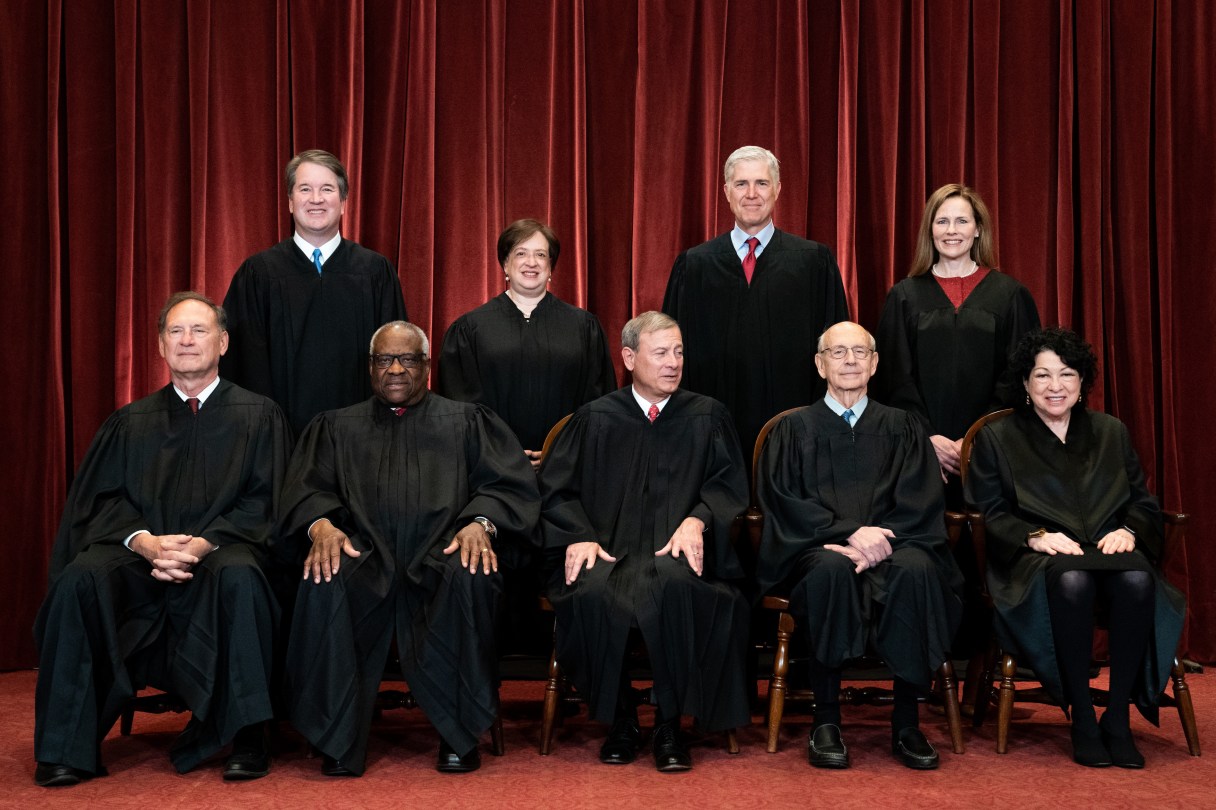
Supreme Court Chief Justice John Roberts lamented recently that he didn’t “understand” why the court’s legitimacy has been diminished in Americans’ eyes merely because it has issued “opinions people disagree with.” If he really thinks that’s the problem, then, no, he doesn’t understand at all. Any sober assessment of the court’s behavior in the relatively brief period since Senate Republicans repeatedly rewrote the rules to stack it with conservatives yields a clear conclusion: The court is increasingly being viewed as a tool for partisan political hackery because it’s increasingly acting like one.
The court’s current conservative majority is in place primarily because of the darkly impressive gamesmanship of then-Senate Majority Leader Mitch McConnell. He infamously held one vacant seat open for 11 months on the makeshift premise that the next president should choose, then rammed through another nominee in mere weeks to ensure that a subsequent president couldn’t. Shameless hypocrisy, once a bug in politics, was thus confirmed as a feature for today’s GOP.
As damaging as that Machiavellian stunt was to the court’s legitimacy, it might have rebounded if not for its behavior since then. Though blessed with lifetime appointments that supposedly insulate justices from the muck of partisanship, the court’s majority has nonetheless hewed to the Republican political agenda as diligently as any freshman legislator on issues like gun restrictions, the environment and, most of all, abortion rights.
In its Dobbs v. Jackson Women’s Health Organization decision this year, the court’s majority overturned a half-century of precedent protecting abortion rights even though (as Roberts himself wrote in a scolding concurrence) it wasn’t a necessary step to decide the case at hand. Yet the court’s five hard-core conservatives eagerly reached around that case to bigfoot into the broader culture-war fight over abortion.