
Monday, November 16, 2026Nov 16

Neptune and rings shine in photos from new space telescope

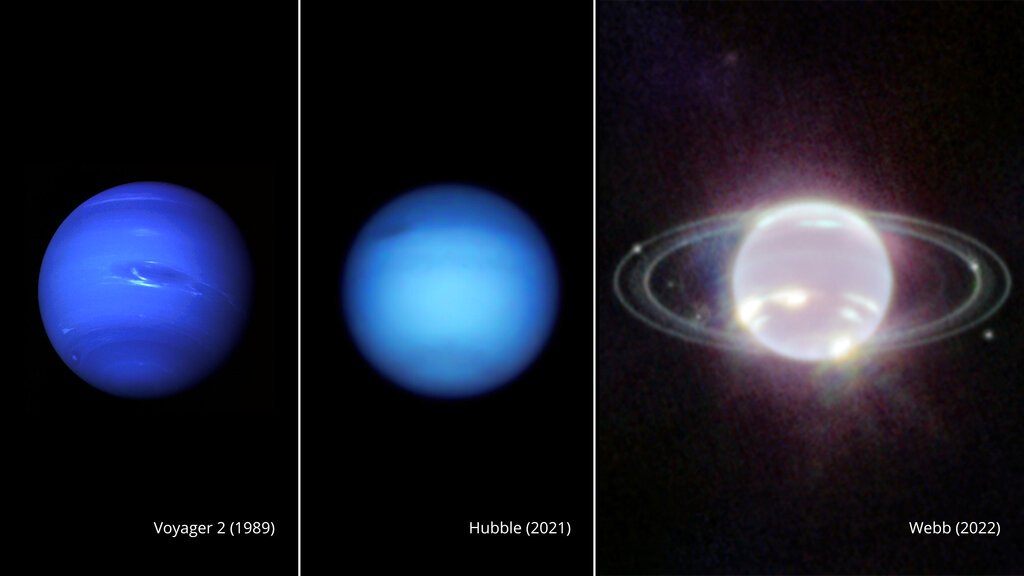
This composite image provided by NASA on Wednesday, Sept. 21, 2022, shows three side-by-side images of Neptune. From left, a photo of Neptune taken by Voyager 2 in 1989, Hubble in 2021, and Webb in 2022. In visible light, Neptune appears blue due to small amounts of methane gas in its atmosphere. Webb’s Near-Infrared Camera instead observed Neptune at near-infrared wavelengths, where Neptune resembles a pearl with thin, concentric oval rings. (NASA, ESA, CSA, STScI via AP)

CAPE CANAVERAL, Fla. (AP) — Neptune and its rings haven’t looked this good in decades.

NASA released new glamour shots of our solar system’s outermost planet Wednesday taken by the James Webb Space Telescope. The pictures taken in July show not only Neptune’s thin rings, but its faint dust bands, never before observed in the infrared, as well as seven of its 14 known moons.

Webb showed Jupiter at its best in a series of fresh photos released last month.

Launched less than a year ago, the $10 billion Webb is spending most of its time peering much deeper into the universe. Astronomers hope to see back to almost the beginning of time when the first stars and galaxies were forming.

NASA’s Voyager 2 was the first spacecraft to see Neptune in all its gaseous glory, during a 1989 flyby. No other spacecraft have visited the icy, blue planet. So it’s been three decades since astronomers last saw these rings with such detail and clarity, said the Space Science Institute’s Heidi Hammel, a planetary astronomer working with Webb.