
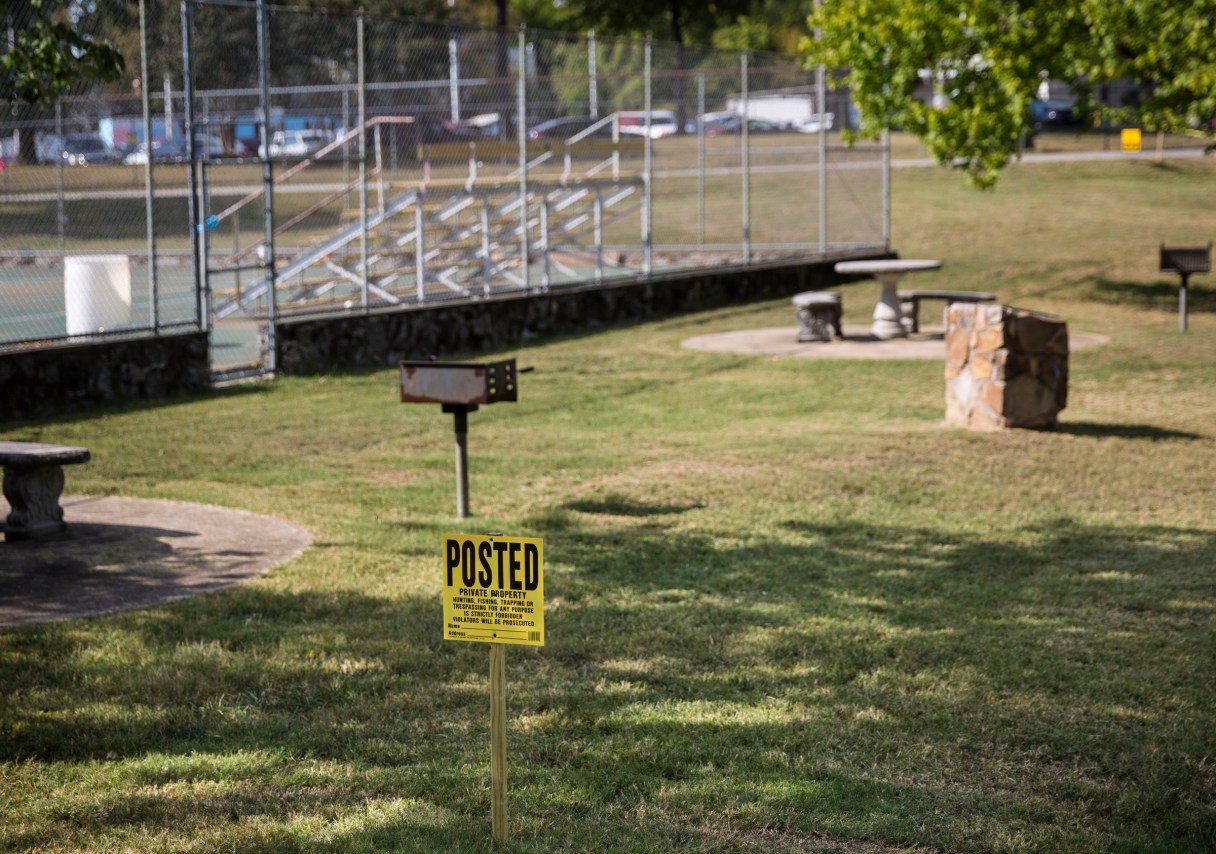

Erlanger Health System employees park on the former tennis courts. Concrete tables and benches in various stages of repair sit scattered across a roughly triangle-shaped expanse of green lawn. The grass is cut, though, and it’s evident the area can be used for limited neighborhood recreation.
That’s what’s left of Lincoln Park, the century-old former recreation area, at the end of north end of Central Avenue. It’s said the space once held an Olympic-sized pool, a small zoo, dance pavilion, amusement rides and played host on its baseball field to stars such as Satchel Paige and Willie Mays. But all that’s long gone.
For 11 years, the city has wanted to extend Central Avenue along the edge of the park and out to Riverside Drive, a project that would save ambulances precious minutes in getting from busy Amnicola Highway to Erlanger. But for nearly as long, residents of the Lincoln Park neighborhood have pushed back, citing the continuity of the community and the historic aspects of the park in its heyday.
We believe it’s possible to retain most of what’s left of the park, enhance it and accommodate the needed extension. But the process has advanced little in the past four years.
Erlanger officials said last week they know of no updates on the road extension but anticipate the project ultimately will move forward. In 2018, hospital officials said they were supportive of the city working through the process to resolve any effects on the historical aspects of the property.
The Facebook page of the Coalition to Save Chattanooga’s Lincoln Park also has had no updates since 2019 except a 2021 announcement that — due to the COVID-19 pandemic — a Lincoln Park Festival would not be attempted until 2022.
Ellis Smith, director of special projects for the city, said plans for the extension are “ongoing … progressing” and that the community had been involved in every step of the process.
“If an ambulance can get to Erlanger faster, it will save lives,” he said. “It’s a matter of doing the right thing, but making sure we’re doing it right with all the stakeholders in the area involved.”
The Chattanooga-Hamilton County Hospital Authority, the governing body of Erlanger Health System, took possession of Lincoln Park in 1979 when it traded the city of Chattanooga the former Children’s Hospital property in Glenwood. An Erlanger official at the time said the hospital would use the property for “future physical plant expansion.” City officials said Lincoln Park was little used except for ballfields and that newer and better facilities were and soon would be available at nearby Warner Park, Carver Recreation Center and Avondale Recreation Center.
The road extension has been discussed most recently since 2011, but officials first met with area residents in 2013.
In 2016, the city agreed to acquire part of the Lincoln Park property from Erlanger to help redevelop a park there but not until the land for the extension was worked out.
In 2017, the park was determined to be eligible for inclusion in the National Register of Historic Places “for its importance in the social and recreational history of the city’s African-American population.”
According to the Tennessee Department of Transportation, the National Historic Preservation Art of 1966 requires federally funded projects — the extension would be in part federally funded — to identify historic properties, determine how a project would affect them, and, if negatively, work in good faith with consulting and interested parties to resolve any effects of the project on identified historic properties.
In 2018, cultural resources firm New South Associates, working as a subcontractor to city engineering consultants due to the historic characteristics, found the proposed extension would have an adverse effect on the park.
Two of the then-plans for the road would cause the removal or relocation of an entrance pillar, and a third plan would separate the pillar from the rest of the park, thus changing the characteristic of the park and causing an adverse effect on it.
Since then, a flurry of paperwork has been sent back and forth from Washington, D.C., as local officials consider additional options or answer exhaustive federal questions in an attempt to mitigate any adverse effects on the historic aspects of the park. Indeed, as recently as Sept. 22, the city submitted a 594-page report on potential options for the extension.
Smith said whenever that process concludes and the path for the road is determined, the city plans to fulfill a memorandum of understanding signed during the Berke administration that lays out what the city would do, including making Lincoln Park a city park, creating historic interpretation of the park, developing a National Register of Historic Places nomination for the park and monitoring the discovery of any cultural items at the site.
Lincoln Park was an integral part of Chattanooga’s history and can still be a symbolic and useful park for the community. But the Central Avenue extension can save lives. Let’s hope not much more time goes by before we can have both.