
Running hot water began to become a staple of home living more than 100 years ago. The first hot water heater was introduced in 1868 when Englishman Benjamin Waddy invented a heater using natural gas. His appliance proved to be unstable, as home owners were in danger of blowing up their houses with his heater. Edwin Ruud, a Norwegian mechanical engineer, invented a tankless heater in 1889 that proved safer. His model came to be the one most used in homes. With a few improvements, his heater design has continued to provide hot water for use today.
As the Tennessee Valley Authority electrified Chattanooga and its surroundings, Tennesseans began to equip their homes with electric water heaters. In 1927, the PTA of Sunnyside Grammar School financed the installation of an electric water heater. Having an electric hot water heater became a selling point for many Chattanooga homes.
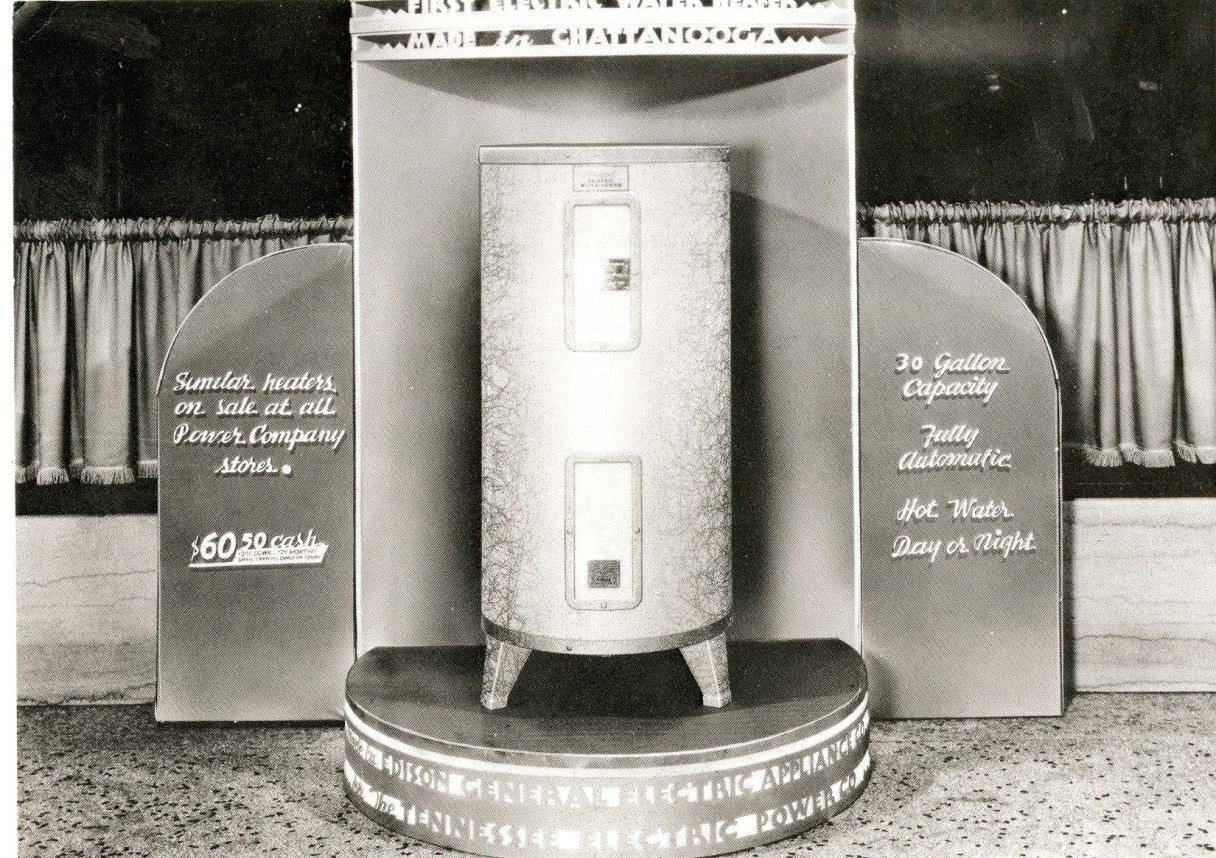
In 1934, Chattanoogans saw another factory located in the Dynamo of Dixie. The Edison General Electric Appliance Co. installed its machinery at the former site of the Vesta Gas Range and Manufacturing Co. at 17th and Broad streets. This plant would manufacture Hotpoint water heaters, the “first electric appliance of its kind ever manufactured in Chattanooga.”
According to a June 5, 1934, Chattanooga Times article, Jo Conn Guild Jr., president of Tennessee Electric Power Co., had been working for six months to bring to Chattanooga an Edison plant, which would produce both Hotpoint heaters and TVA brand heaters. Management expected to produce between 200 and 300 appliances a week. Hedges-Walsh-Weidner Co., which eventually became part of Combustion Engineering, made the boilers for the heaters. The Times article noted that the new Edison company would be “a great contribution to the further upbuilding of Chattanooga industrially.”