
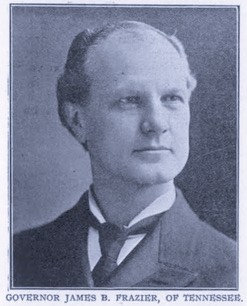
(Editor’s note: First of two parts)
The Sept. 29, 1904, Chattanooga Daily Times headline announced “Big Parade for Frazier,” followed by the report that more than 800 Democrats had marched in company with Gov. James Frazier from his headquarters at the Read House to an auditorium for a public rally.
At 7 p.m., a military band had gathered at the corner of Broad and then-Ninth streets and serenaded the governor with a melody of his favorite patriotic songs. Thirty minutes later, the parade formed and then snaked through the city, “following several of the principal downtown thoroughfares,” and the governor had been greeted along the route by hundreds of well-wishers. “The appearance of Governor Frazier was the signal at every point for vociferous applause. To this the governor, in his usual dignified but graceful manner, made acknowledgement by bowing to the right and left.” Gov. James Beriah Frazier had arrived home.
Frazier was born in Pikeville, Bledsoe County, and traced his paternal lineage to Samuel Frazier, his great-grandfather, and Abner Frazier, his grandfather, both veterans of the Revolutionary War’s Battle of King’s Mountain. His middle name honored his uncle, Dr. Beriah Frazier, who had served as one of the earliest Chattanooga mayors. Thomas Frazier, his father, had served as a criminal court judge in Davidson County. Young James had attended Franklin College and then graduated from the University of Tennessee. He was admitted to the bar in 1881, moved to Chattanooga to begin his career and two years later married Louise Douglas Keith. Chattanooga became his home, and Frazier immediately immersed himself in the Chattanooga community, inspired by his family’s legacy of service.
Recognized for an outstanding oratory style, his political leadership seemed natural. While Frazier was defeated in his first campaign against the incumbent, 3rd District U.S. Rep. Henry Snodgrass, in 1894, he captured the attention of the Tennessee Democratic Party. By 1900, the party chose him as the state’s at-large elector for presidential candidate William Jennings Bryan. Traveling across the state in support of Bryan provided Frazier an opportunity to meet the leadership teams in almost every Tennessee county, creating a network of political allies.